

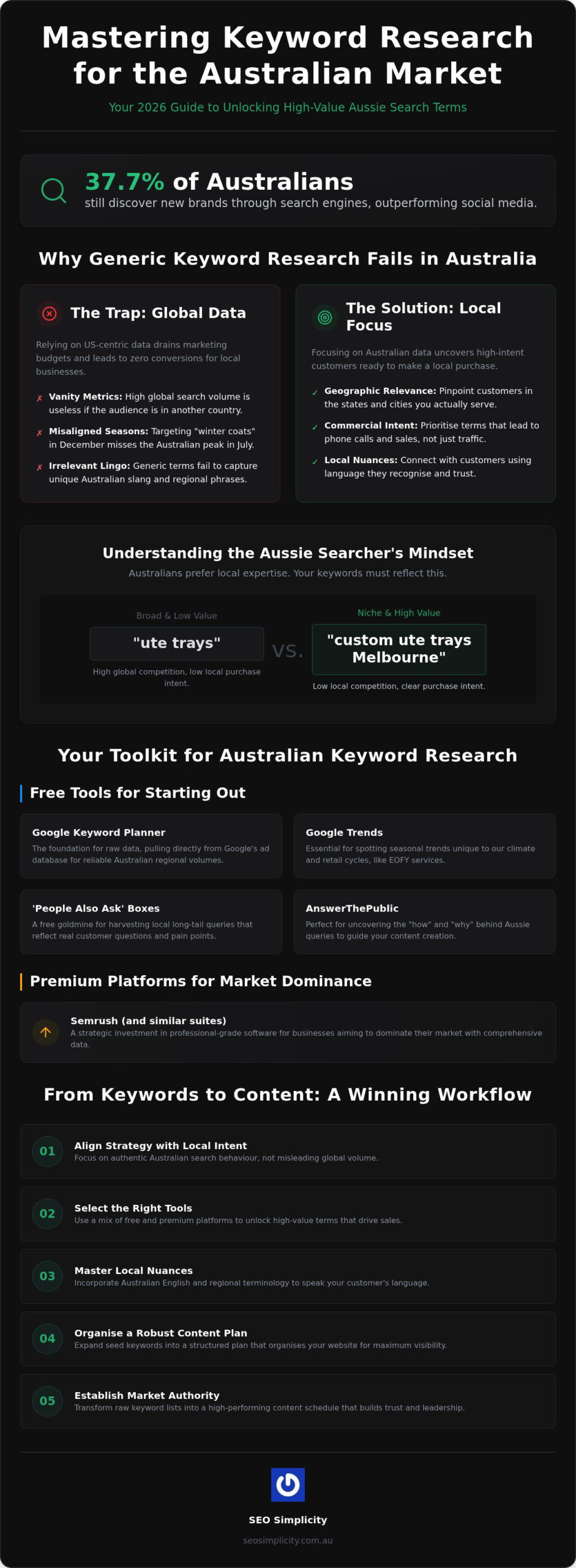
Did you know that 37.7% of Australians still discover new brands through search engines, outperforming even the most aggressive social media advertising? Finding the right keyword research tools australia offers is the first step to capturing that massive audience. It’s often frustrating to pour your marketing budget into expensive software only to realise the search volumes are skewed by US data or completely irrelevant to your local Brisbane or Perth shopfront. You likely feel the sting of targeting high-volume terms that look great on paper but never actually lead to a local sale.
We understand that you need clarity and a strategic partner to help you cut through the noise. This guide will empower you to master the art of finding high-value Aussie search terms using the most reliable local and global tools available in 2026. You’ll gain access to a clear list of vetted platforms and a repeatable process designed to transform your local search visibility. We’ve done the heavy lifting to ensure you can stop guessing and start growing your digital presence with confidence and precision.
Key Takeaways
- Understand why US-centric data often misleads Aussie businesses and how to align your strategy with authentic local search intent.
- Identify the most reliable keyword research tools australia has available in 2026 to unlock high-value terms that drive actual sales.
- Master the nuances of Australian English and regional terminology to ensure your content speaks the same language as your local customers.
- Follow a structured, step-by-step workflow to expand seed keywords into a robust content plan that organises your website for maximum visibility.
- Transform your raw keyword lists into a high-performing content schedule that establishes your brand as a leading authority in the Australian market.
Why Generic Keyword Research Fails in the Australian Market
Many business owners start their SEO journey by looking at massive global trends. They see a term with 50,000 monthly searches and assume it’s a goldmine for their brand. However, if those searches are predominantly from the United States or the UK, your Australian business won’t see a cent of that traffic. Relying on US-centric data is a common pitfall that drains marketing budgets and leads to zero conversions. To understand the foundations of this process, it helps to ask: What is keyword research? at its core. It is the act of identifying the specific phrases your actual customers use, not just what the rest of the world is typing into a search bar.
The Trap of Global Search Volume
Search volume is often a vanity metric. A keyword might have 10,000 US searches but only 50 in Australia. If you’re a local plumber in Adelaide or a boutique agency in Perth, that global volume is useless. Using the right keyword research tools australia provides ensures you are looking at data filtered specifically for our backyard. You’ll often find “Aussie-only” trends that global tools miss, such as specific slang or seasonal differences. For example, “winter coats” peaks in July here, not December. Prioritise commercial intent over raw volume every time. It’s better to rank for a term with 100 searches that leads to a phone call than a term with 10,000 searches that only attracts window shoppers from Ohio. Consider these factors when evaluating volume:
- Geographic relevance: Ensure the data reflects the states or cities you actually serve.
- Seasonal alignment: Align your content with the Australian calendar, not the Northern Hemisphere.
- Linguistic nuances: Identify terms unique to the Australian market that global databases might ignore.
Understanding the Aussie Searcher’s Mindset
Australian consumers have a distinct preference for local expertise. We look for trust signals like “Australian-owned,” “locally operated,” or references to specific suburbs. This preference significantly changes how you should choose your keywords. When an Aussie searcher sees a result that feels too generic or “Americanised,” they often bounce back to the search results. For the Australian buyer journey, search intent is the specific motivation behind a query that reflects a local’s desire to find a reliable, nearby solution for their immediate problem.
High volume doesn’t always equal high value for small to medium enterprises. In fact, the most competitive keywords are often the least profitable because you’re fighting national giants for broad terms. Local competition determines your real keyword difficulty. You might find that a niche term like “custom ute trays Melbourne” is far more valuable than the broader “ute trays” because the competition is local and the intent is clear. Focusing on these high-value, lower-competition terms allows you to dominate your specific territory without wasting resources on unwinnable global battles.
Top Australian Keyword Research Tools: Free to Pro 2026
Selecting the right keyword research tools australia provides is the first step toward building a sustainable digital presence. Google Keyword Planner remains the foundational choice for raw data because it pulls directly from Google’s own advertising database. While it’s designed for paid search, it provides reliable search volumes for specific Australian regions, helping you understand where your audience actually lives. It’s an essential starting point for any campaign that requires local precision and data directly from the source.
Best Free Tools for Starting Out
Identifying seasonal trends is vital for our unique climate and retail cycles. Use Google Trends to spot when Aussies start searching for summer essentials or EOFY services. You can also harvest the ‘People Also Ask’ boxes in search results as a free goldmine for local long-tail queries that reflect real customer pain points. AnswerThePublic is another excellent choice; its free plan allows for three searches per day, which is perfect for uncovering the “how” and “why” behind Aussie queries. If you need a more detailed step-by-step guide to keyword research, foundational resources can help you structure these initial findings without any upfront cost. These free platforms allow you to brainstorm broad variations before you commit to a specific niche or budget.
Premium Platforms for Market Dominance
Investing in professional-grade software like Semrush is a strategic move for businesses ready to dominate their local market. As of 2026, a Semrush Pro plan starts at $139.95 per month, offering deep insights into the competitive landscape. These platforms allow you to spy on your local competitors’ best-performing terms, revealing exactly which keywords are driving their traffic and where they might be vulnerable. You’ll also gain access to ‘Keyword Difficulty’ scores, which are vital for prioritising terms you can actually rank for in the competitive Australian landscape. A score of 30 might be easy to target, while anything over 70 usually requires a significant investment in authority building.
For those seeking a budget-friendly middle ground, KWFinder provides a powerful alternative. KWFinder’s Entry plan sits at $19.90 per month when billed annually, offering professional insights without the enterprise price tag. At SEO Simplicity, we complement these resources with our own specialised SEO tools and audits designed to simplify the technical side of your research. This ensures you aren’t just collecting data but actually transforming it into a roadmap for growth. We help you move past the confusion of global metrics so you can focus on the terms that truly move the needle for your Australian business.
Step-by-Step: How to Perform Keyword Research for Australian Audiences
Unlock your business potential by following a structured workflow that prioritises local results. You don’t need to be a data scientist to find winning terms; you just need to think like your customers. By applying the right keyword research tools australia provides, you can transform a messy list of ideas into a strategic growth plan that actually brings people through your door. This process ensures your content resonates with the specific needs of your local community while building long-term search authority.
Identifying Your Seed Keywords
Start by brainstorming seed keywords that represent your core Aussie services. Think about what your customers actually say when they walk through your door or call you on the phone. Don’t just focus on the solutions you provide. Include ‘problem’ keywords that address the pain points leading people to your business. For instance, a mechanic shouldn’t just target ‘car service’; they should also look at ‘why is my engine knocking’ to capture users earlier in their journey. Validate your seed keywords by checking Google Search Console to see which terms are already driving impressions to your site.
Refining Your List for Commercial Value
Once you have your seeds, use the keyword research tools australia has available to expand into long-tail variations. Always set your target location to ‘Australia’ to ensure you aren’t chasing ghosts in the global market. Look for the ‘Golden Ratio’ in your data: keywords with high commercial intent and manageable difficulty scores. You can use ‘Cost Per Click’ (CPC) as a reliable proxy for keyword value, as high CPCs usually indicate that competitors are willing to pay for that traffic because it converts into revenue.
Finally, map your findings to the different stages of the buyer journey. Organise your keywords into clusters to build a better site architecture. This ensures you have content for every stage of the funnel:
- Awareness: Educational ‘how-to’ queries and problem-solving guides.
- Consideration: Comparison terms, ‘best of’ lists, and product reviews.
- Decision: Specific service pages, pricing queries, and ‘near me’ searches.
Analysing competitor keywords during this phase often reveals easy wins that your rivals have overlooked. This structured approach moves you from guessing to knowing exactly what content will drive your business forward. By aligning your research with real-world goals, you create a foundation for sustainable digital growth.
Navigating Australian English and Local Search Intent Nuances
Success in the local market requires more than just a list of high-volume phrases. While keyword research tools australia provides the raw data, you must interpret those results through a local lens to avoid alienating your audience. Using “color” instead of “colour” or “organize” instead of “organise” might seem minor, but these subtle cues tell an Aussie searcher whether you truly understand their world. Metadata that reflects these linguistic expectations ensures your click-through rate remains high because users instinctively trust familiar spelling and terminology.
Terminology often shifts significantly across the ocean. An Australian looking for a rugged work vehicle will search for a “ute,” whereas an American might type in “pickup truck.” If your content targets the latter, you’re effectively invisible to your primary market. Similarly, “near me” searches behave uniquely across our vast continent. Whether someone is in a dense Sydney suburb or a regional centre like Wagga Wagga, they expect Google to prioritise local proximity and verified Australian businesses. Aligning your keywords with these expectations transforms your visibility from generic to authoritative.
Spelling and Grammar for Local Authority
Using Australian English builds immediate rapport and establishes your brand as a local expert. Google’s algorithms have become increasingly sophisticated at recognising regional variations, meaning that local spelling acts as a trust signal for both users and search engines. When your content matches the searcher’s query exactly, including the “u” in “labour” or “honour,” you improve your chances of ranking in local results. To see how we implement these details in practice, explore our SEO Content Creation Services Australia for a deeper look at strategic growth.
Local Intent Beyond Just Place Names
Local intent is about the “Aussie” way of asking for help online. About one-third of Australians use voice search daily, and many of these queries are conversational and location-dependent. Instead of typing “plumber Melbourne,” a user might ask their phone, “Who’s the best plumber near me?” This shift requires you to target long-tail keywords that mimic natural speech patterns. You can also use local slang like “tradie” or “relo” sparingly to increase engagement, provided it fits your brand voice. This approach makes your business feel accessible and grounded in the community.
Don’t let global data dictate your local strategy. If you want to ensure your keywords are actually driving results, our team can help you refine your approach. Book a professional SEO Audit today to see exactly where your local strategy can be improved.
Transforming Your Keywords into a High-Performing Content Strategy
Data is only as valuable as the action it inspires. You might have a spreadsheet filled with hundreds of terms, but without a clear execution plan, those words will never translate into revenue. Moving from a static list to a real-world publishing schedule requires a shift in mindset. While the keyword research tools australia provides give you the “what,” your strategy determines the “how” and “when.” You must treat keyword research as a monthly habit rather than a one-off task to stay ahead of shifting Aussie search trends and evolving consumer behaviour.
Organise your findings into a logical hierarchy of ‘Pillar’ and ‘Supporting’ content. Your pillar pages should target broad, high-value terms that define your core services. Supporting content then orbits these pillars, targeting long-tail queries and specific customer questions you uncovered during your research. This structure creates a topical authority that search engines reward. When measuring success, look beyond vanity metrics like total impressions. For a local Aussie business, the KPIs that actually matter are conversion rates, local lead volume, and the cost per acquisition.
Building Your 2026 Content Roadmap
Prioritising your keywords based on immediate customer pains ensures your content provides instant value. Start with the “problem” keywords that lead directly to your solutions. You can then integrate these insights into a comprehensive SEO Content Strategy Australia template to dominate your market. Statistics show that businesses in Australia publishing two or more pages of content per month see an average of 326% more traffic than those that stay stagnant. Remember that your roadmap isn’t just about new content. Regularly refreshing old articles with fresh keyword data can breathe new life into your rankings and maintain your competitive edge.
When to Call in the Pros
There often comes a point where DIY research reaches its limit and your growth begins to plateau. If you find your traffic has stalled or you’re struggling to rank for high-competition terms, it’s time to leverage professional expertise. A specialist SEO Site Audit can uncover hidden keyword opportunities and technical roadblocks that standard keyword research tools australia users might miss. Pairing this with a dedicated on-page SEO checker allows you to identify and fix the critical website issues that are actively holding back your rankings. We help you bridge the gap between having data and achieving results, ensuring your digital presence is as robust as your physical one.
Ready to transform your organic traffic and turn search terms into sales? Book a consultation with SEO Simplicity today and let’s build a strategy that works for your unique business goals.
Securing Your Future in the Australian Search Landscape
Mastering your local search presence begins with a commitment to precision and cultural relevance. You’ve seen that effective SEO isn’t about chasing global volume; it’s about aligning your brand with the specific language and intent of the Australian searcher. By leveraging the right keyword research tools australia offers, you can move beyond guesswork and build a content roadmap that addresses real-world customer needs. Whether you’re refining your spelling to build trust or clustering keywords for better site architecture, every strategic adjustment brings you closer to market dominance.
Unlocking significant growth often requires a more detailed look at your technical foundations. We provide specialist Australian SEO knowledge and fixed-price audits for total transparency, helping you navigate the complexities of the 2026 search environment. With a proven track record in national market dominance, we are ready to help you turn data into results. Maximise your visibility with a professional SEO strategy from SEO Simplicity. You now have the knowledge to transform your digital shopfront; take the lead and start your journey toward sustainable success today.
Common Questions About Australian Keyword Research
What is the best free keyword research tool for Australian businesses in 2026?
Google Keyword Planner remains the most effective free resource for accessing raw Australian search volumes. It provides the ability to filter by specific cities or regions, which is essential for businesses serving local communities from Hobart to Darwin. While it is primarily a tool for paid advertising, the data it offers is the most direct reflection of what Aussies are typing into search bars daily.
How do I filter keyword data to only show Australian search volume?
Most keyword research tools australia specialists utilise allow you to set the target location to ‘Australia’ within the project settings. Platforms like Semrush or KWFinder enable you to drill down into specific states to see how search behaviour differs between Queensland and Victoria. This ensures your content strategy is built on local reality rather than being skewed by global averages from larger markets like the US.
Does it matter if I use American or Australian spelling in my keywords?
Yes, it matters significantly for both user trust and local relevance. While search engines are sophisticated enough to bridge the gap between “color” and “colour,” Australian users are far more likely to engage with a site that feels local. Consistent use of Australian spelling acts as a subtle trust signal that can improve your click-through rates and keep visitors on your page longer.
How many keywords should I target on a single page?
Aim to target one primary keyword and three to five closely related variations per page. This approach ensures your content remains focused and highly relevant to a specific topic without becoming cluttered or difficult to read. By concentrating on a tight cluster of terms, you help search engines understand the exact purpose of your page, which improves your chances of ranking for a range of relevant local queries.
Can I do keyword research for my Australian business without expensive tools?
You can certainly build a strong foundation using free methods like Google Trends and the “People Also Ask” boxes found in search results. These features provide real-time insights into the specific questions your customers are asking. While premium platforms offer deeper competitive analysis, these free techniques are perfect for smaller brands looking to identify immediate opportunities and seasonal search spikes in their local area.
How often should I update my keyword research?
Review your keyword strategy at least once every quarter to ensure you are keeping pace with changing market trends. Search behaviour in Australia can shift due to seasonal changes, new competitors entering the market, or evolving consumer preferences. A regular quarterly audit allows you to refresh your content and pivot your strategy to capture new, high-value terms as they emerge in your industry.
What is a ‘long-tail’ keyword and why are they important for Aussie SEO?
A ‘long-tail’ keyword is a specific, multi-word phrase like “boutique accountant in Canberra” rather than just “accountant.” These are vital for Aussie SEO because they attract users with much higher intent and are generally less competitive than broad, generic terms. Focusing on these specific phrases allows you to capture ready-to-buy customers in your suburb without needing the massive budget of a national franchise.
Is Google Keyword Planner still accurate for Australian search data?
Google Keyword Planner is still highly accurate for identifying trends, though it often provides volume ranges rather than exact numbers for those not running active ad campaigns. It’s the most reliable source for raw data because it pulls directly from Google’s local database. However, it’s best used alongside other keyword research tools australia provides to help interpret the commercial intent and competition levels behind those numbers.