
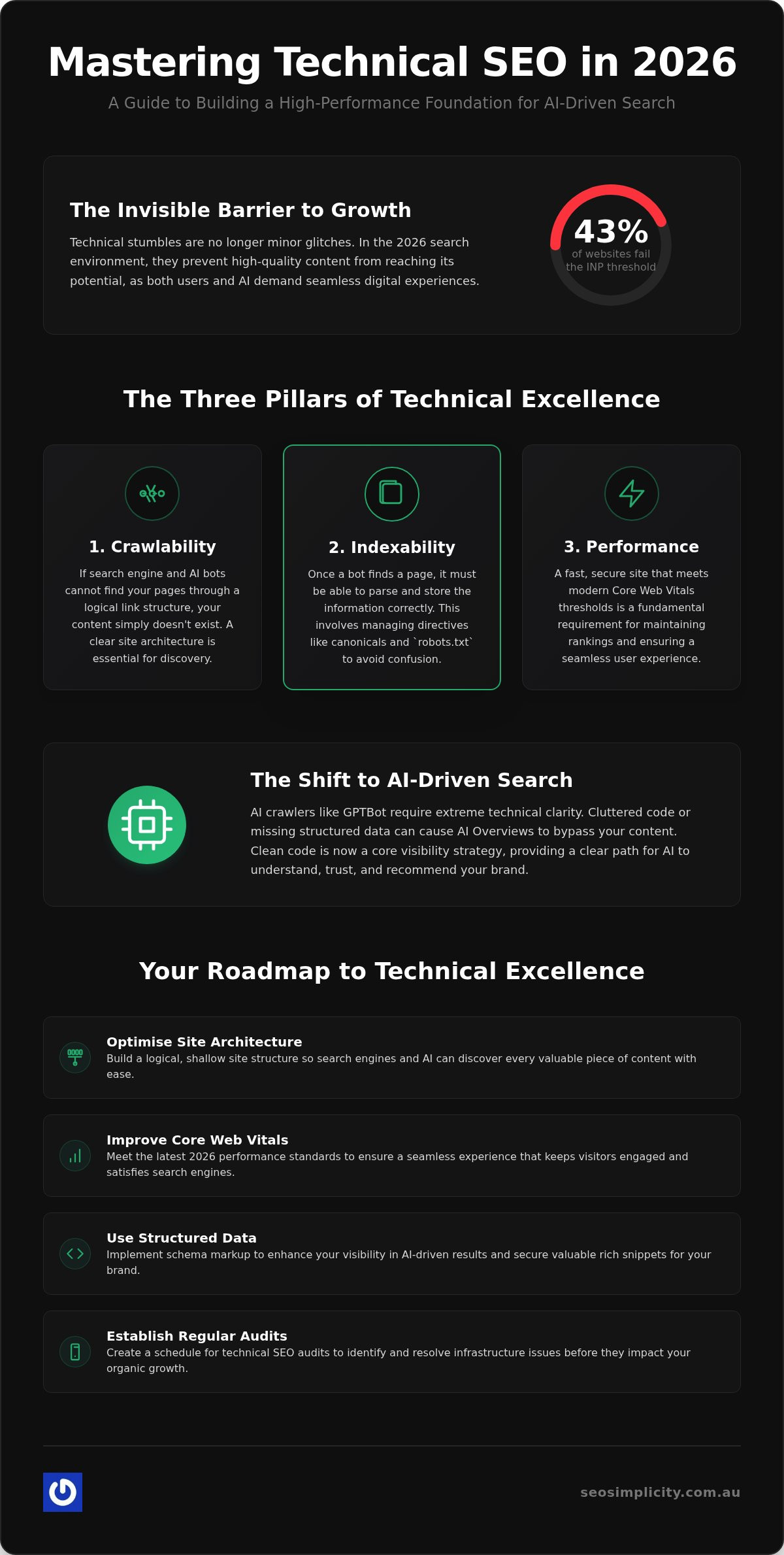
Did you know that 43% of websites currently fail the Interaction to Next Paint (INP) threshold of 200 milliseconds? In the 2026 search environment, these technical stumbles aren’t just minor glitches; they’re invisible barriers preventing your brand from reaching its full potential. You’ve likely felt the frustration of watching your high-quality content stall in the rankings, even while you’re paying for premium hosting and chasing every new trend. It’s exhausting to face a wall of complex jargon like “JavaScript rendering” or “canonicalisation” when you just want your site to perform.
We understand that conflicting errors in Google Search Console can feel like a maze without an exit. This guide empowers you to master technical seo foundations that satisfy both human users and the latest AI-powered search systems. By refining your site’s digital plumbing, you’ll transform it into a high-performance asset that search engines and AI agents trust. We’ll provide a clear roadmap to resolve crawling issues, boost your Core Web Vitals scores, and ensure your brand is ready for the “AI Mode” default search experience that launched in May 2026.
Key Takeaways
- Build a high-performance foundation that allows search engines and AI crawlers to navigate your site infrastructure with ease.
- Optimise your site architecture to ensure every valuable piece of content is discovered, indexed, and prioritised for search results.
- Improve your Core Web Vitals scores to meet the latest 2026 standards, ensuring a seamless experience that keeps visitors engaged.
- Use structured data to enhance your visibility in AI-driven search results and secure valuable rich snippets for your brand.
- Establish a regular schedule for technical seo audits to identify infrastructure issues before they impact your organic growth.
Building a Performance Foundation: What is Technical SEO in 2026?
Technical SEO in 2026 involves the meticulous optimisation of your website’s infrastructure to ensure it’s fully legible for both traditional search engines and the generative AI agents that now dominate the web. Think of it as the digital plumbing of your site. While your content strategy provides the beautiful fixtures and finishings, your technical foundation ensures the water actually flows. Without this structural integrity, even the most brilliant copywriting will remain invisible to the systems that decide what users see. Investing in this foundation is a non-negotiable step for any brand seeking sustainable organic growth.
Historically, many Australian brands treated web development and marketing as separate silos. Today, technical seo serves as the vital bridge between these two worlds. It translates marketing goals into a language that servers and crawlers understand. This alignment ensures that every dollar spent on content creation isn’t wasted on pages that search engines can’t find or users can’t load. By focusing on the mechanics behind the scenes, you create a stable platform that supports all your other digital marketing efforts.
The Three Pillars of Technical Excellence
To achieve visibility in a competitive market, your site must excel across three core areas. First is crawlability. If bots like Googlebot or GPTBot can’t find your pages through a logical link structure, they simply don’t exist in the digital ecosystem. Second is indexability. Once a bot finds your page, it must be able to parse and store the information correctly. This involves managing directives like canonical tags and robots.txt files to prevent index bloat and confusion. Finally, performance focuses on the user’s experience. A fast, secure site that meets modern Core Web Vitals thresholds is a fundamental requirement for maintaining your rankings.
The Shift from Traditional Search to AI-Driven Answers
The rise of AI Overviews has transformed how we approach site architecture. AI crawlers, such as GPTBot, require high levels of technical clarity to accurately cite your brand as a source. If your site’s code is cluttered or your structured data is missing, these AI systems may bypass your content in favour of a competitor with a cleaner technical setup. Clean code has become more than a development preference; it’s a visibility strategy. By organising your site’s technical mechanics, you provide a clear path for AI to understand, trust, and ultimately recommend your brand to potential customers.
Ensuring Your Content is Discovered: Crawling and Indexability
Discovery is the first hurdle your website must clear to achieve organic success. Search engines traverse your site by following links and adhering to specific directives you provide in your code. If your site architecture is a tangled web of poorly organised pages, bots will struggle to find your high-value content. A logical, shallow hierarchy allows search engines to reach your deepest pages with fewer clicks, ensuring your entire catalogue is visible. Crawl budget is the limited number of pages a search engine bot will crawl on your site during a specific timeframe before moving on, and it is a vital metric for larger sites to manage so their most important content remains prioritised.
Efficiency is the cornerstone of effective technical seo. When bots encounter broken links or long redirect chains, they waste precious resources that should be spent on your newest updates. These technical hurdles create friction, slowing down the indexing process and potentially leaving your latest products or articles in the dark. As highlighted by Forbes in their discussion on Technical Optimization For SEO, structural clarity is essential for any brand that wants to maintain a competitive edge. If you’re unsure where your site is losing bot attention, performing a comprehensive technical audit is the most effective way to identify and fix these hidden barriers.
Directing Crawlers with Robots.txt and XML Sitemaps
Think of your robots.txt file as a gatekeeper that tells bots which areas of your site are off-limits. Use this tool to prevent search engines from wasting time on low-value pages like internal search results or admin folders. Complement this with a well-structured XML sitemap that acts as a clear roadmap for your content. To avoid “Discovered – currently not indexed” errors, ensure your sitemap only includes high-quality, indexable URLs that provide genuine value to your audience. Regularly updating these files ensures that search engines always have the most current version of your site’s structure.
Managing Canonicalisation and Duplicate Content
Duplicate content can dilute your ranking power by confusing search engines about which page is the “master” version. Implement canonical tags to solve this by explicitly pointing bots toward your preferred URL. This is particularly important for e-commerce sites using faceted navigation or pagination, where multiple URLs might display similar products. By reinforcing your most important pages through a strategic internal linking structure, you help search engines understand the relative importance of your content. This systematic approach to technical seo ensures your brand’s authority is concentrated where it matters most.
Optimising the User Experience: Core Web Vitals and Site Speed
Speed is no longer just a technical metric; it’s a vital component of user retention and commercial success. Research shows that sites passing all three Core Web Vitals thresholds see 24% lower bounce rates, proving that performance directly impacts your bottom line. When your website responds instantly, you build trust and keep visitors engaged with your brand. This focus on the user experience is a central pillar of modern technical seo, ensuring that your infrastructure supports your marketing goals rather than hindering them.
Since mobile-first indexing is the primary standard in 2026, your mobile performance serves as the definitive benchmark for your rankings. Search engines prioritise the mobile version of your site for crawling and indexing, so a slow mobile experience will drag down your entire organic presence. By prioritising mobile speed, you cater to the majority of Australian users who browse on the go while simultaneously satisfying search engine requirements.
Google currently measures three specific metrics to evaluate your site’s health:
- Largest Contentful Paint (LCP): This tracks how quickly the main content of your page loads. Aim for a “Good” score of under 2.5 seconds.
- Interaction to Next Paint (INP): This replaced First Input Delay as the standard for responsiveness. It measures how quickly your site reacts to user inputs like clicks or taps. A “Good” score is under 200 milliseconds.
- Cumulative Layout Shift (CLS): This ensures your page is visually stable. It measures whether elements jump around while loading, which can frustrate users. Aim for a score of under 0.1.
The Impact of Local Australian Hosting and CDNs
Many brands overlook the physical distance between their server and their audience. Hosting your site in an Australian data centre reduces latency by keeping data close to your local visitors. To further enhance this, implement a Content Delivery Network (CDN) to serve static assets from edge locations across the country. This setup, combined with modern protocols like HTTP/3, ensures that your site loads with the speed and reliability that Australian consumers expect. For brands targeting specific geographic markets, pairing strong technical performance with dedicated local SEO services creates a powerful foundation for capturing high-intent customers in your area.
Advanced Speed Tactics for Modern Websites
Unlock faster perceived load times by optimising your “Critical Rendering Path,” which ensures the most important content appears on the screen first. Move beyond standard image compression by adopting next-generation formats like WebP or AVIF, which provide superior quality at smaller file sizes. Finally, audit your third-party scripts and marketing pixels. These external tools often bloat your code and slow down your responsiveness, so remove any that aren’t strictly necessary for your operations.
Future-Proofing Your Site: Schema Markup and AI Visibility
Schema markup acts as a sophisticated digital translator, converting your human-readable content into a structured format that search engine bots and AI models can digest instantly. While earlier sections of this guide focused on the “plumbing” of technical seo, schema provides the vital context that allows these systems to understand the relationships between your products, your brand, and your audience. By providing this clarity, you ensure that your site isn’t just crawled, but truly understood by the Large Language Models (LLMs) that now power the majority of search interactions. This structured data provides the essential context that AI models crave, allowing them to categorise your brand with precision.
National brands must prioritise Organisation and LocalBusiness schema to establish a clear, authoritative identity across the web. Implementing these specific types of structured data helps AI systems verify your brand’s credentials and relevance for complex, intent-based queries. When you explicitly define your business entities, you reduce the risk of AI systems misrepresenting your services or overlooking your brand during the generative search process. This level of technical clarity is essential for maintaining visibility as “AI Mode” remains the default search experience following its May 2026 rollout. Brands that combine robust schema implementation with a comprehensive strategy for local SEO services are best positioned to dominate both traditional map results and AI-generated answers for location-based queries.
Leveraging Structured Data for Rich Results
Identify the schema types that provide the highest return on investment for your specific business model. For many Australian brands, Product, Review, and FAQ schemas offer the most immediate benefits by generating eye-catching rich results like star ratings and price displays. These enhanced snippets significantly improve your Click-Through Rate (CTR) by making your listing more prominent than standard text results. Always validate your implementation using the Rich Results Test to ensure your code aligns with the latest Schema.org version 30.0 standards, which were published in March 2026. If you’re ready to enhance your brand’s digital presence, our technical SEO audits include a comprehensive review of your structured data health.
Preparing for AI Search and LLM Crawlers
Take control of how AI agents interact with your content by managing permissions within your robots.txt file. You can specify which crawlers, such as GPTBot, are allowed to access your data, ensuring your intellectual property is handled on your terms. This shift coincides with the rise of “Entity-based SEO,” where search systems focus on the relationship between concepts rather than simple keyword matching. Organise your site structure to be easily readable by these non-traditional search systems, as they often prioritise sites that offer a clear, logical map of their expertise and service offerings.
Taking Control: How to Audit and Organise Your Technical SEO
Mastering your site’s health requires a systematic approach to identifying and prioritising technical debt. Many brands treat these fixes as a one-off project, but technical seo is an ongoing commitment to excellence. Without regular monitoring, small errors accumulate, leading to “ranking decay” that can erode your organic visibility over time. By organising your maintenance schedule, you prevent minor glitches from becoming major barriers to your growth. This proactive mindset ensures your infrastructure remains a robust asset rather than a liability.
While basic tools provide a surface-level view, a professional technical seo audit service can uncover hidden issues that standard crawlers often miss. These deep-dive assessments allow you to prioritise fixes based on their potential impact on your revenue and user experience. Once resolved, these technical insights should be integrated into a comprehensive monthly seo report. This allows you to track progress, maintain structural integrity, and ensure your site remains fully optimised for the latest search engine requirements.
The 5-Step Technical Health Check
Implement this structured routine to maintain peak performance across your digital presence:
- Step 1: Check for critical crawl errors in Google Search Console to ensure your priority pages are accessible to bots.
- Step 2: Benchmark your Core Web Vitals against your closest competitors to identify specific performance gaps in LCP or INP.
- Step 3: Audit your XML sitemap and robots.txt files for accuracy, ensuring they reflect your current site hierarchy.
- Step 4: Verify your mobile responsiveness across multiple devices, as mobile performance remains the primary benchmark for indexing.
- Step 5: Review your HTTPS security and SSL certificate status to maintain a secure environment for your visitors.
Partnering with SEO Simplicity for Long-Term Growth
Staying ahead of algorithm updates requires constant vigilance and specialist expertise. Our ongoing management ensures your site remains compliant with the latest standards, from the March and May 2026 core updates to the nuances of AI-driven search. We handle the complex technical maintenance and enterprise link building required to scale your authority in a competitive national market. We act as your strategic partner, doing the heavy lifting so you can focus on your core business. Contact us today to transform your technical foundation into a ranking powerhouse and secure your brand’s future in the evolving search landscape.
Securing Your Brand’s Digital Future
Mastering the technical foundations of your website is no longer a luxury; it’s a strategic necessity in the 2026 search landscape. By prioritising a robust technical seo strategy, you ensure that search engines and AI systems can crawl, understand, and prioritise your content effectively. You’ve already explored how optimising for Interaction to Next Paint (INP) and implementing precise schema markup transforms your site into a high-performance asset. These structural improvements don’t just help you rank; they protect your brand from the ranking decay that often follows major algorithm updates.
We are here to help you navigate these complexities with confidence. Our team is trusted by national Australian brands to scale organic visibility through expert monitoring of Core Web Vitals and crawl health. When you Request a Comprehensive Technical SEO Audit, you’ll receive a detailed technical roadmap designed to unlock your site’s full potential. Take the first step toward a more visible, resilient, and high-performing website today. Your brand’s growth is within reach when the digital foundation is solid.
Frequently Asked Questions
What is the difference between on-page and technical SEO?
On-page SEO focuses on the content and keywords visible to your visitors, whereas technical SEO addresses the underlying infrastructure and server configurations. While on-page strategies involve optimising your copy and headers, technical work ensures that bots can actually reach and understand those elements. Think of it as the difference between the interior design of a house and its structural foundation. Both are essential for success, but the technical side provides the platform for your content to perform.
How often should I conduct a technical SEO audit?
You should ideally conduct a comprehensive technical audit at least once every six months to identify emerging issues. For larger enterprise sites or those with frequent updates, quarterly reviews are more appropriate to prevent technical debt from accumulating. Regular monitoring allows you to catch crawl errors or broken redirects before they impact your organic traffic. This systematic approach ensures your site remains healthy and compliant with the latest algorithm changes throughout the year.
Do I need a developer to fix technical SEO issues?
You will likely need a developer to resolve complex issues like server-side rendering, database optimisations, or advanced schema implementation. While marketers can often handle basic tasks like updating meta tags or robots.txt files, structural changes require technical coding expertise. Partnering with a specialist ensures that fixes are implemented without breaking other site functions. We recommend a collaborative approach where SEO specialists identify the requirements and developers execute the technical changes.
Can technical SEO errors cause my site to be de-indexed?
Yes, critical errors like accidental “noindex” tags or misconfigured robots.txt files can lead to your entire site being removed from search results. If search engines can’t crawl your pages or receive instructions to ignore them, your visibility will disappear instantly. Canonicalisation errors can also cause search engines to de-prioritise your preferred pages in favour of duplicates. Regular technical seo monitoring is the best way to safeguard your site against these catastrophic discovery failures.
How does site speed affect my search engine rankings?
Site speed acts as a direct ranking signal and a tie-breaker when competing with similar content. Google uses Core Web Vitals to measure the user experience, and failing these thresholds can lead to lower positions in search results. Faster sites also enjoy better crawl efficiency, allowing bots to index more pages in less time. Beyond rankings, improved speed reduces bounce rates and enhances conversion, making it a vital part of your overall digital strategy.
What are the most common technical SEO mistakes for Australian sites?
Many Australian brands struggle with high latency caused by hosting their sites on overseas servers rather than local data centres. Other common errors include redirect chains that frustrate both users and bots, and poorly managed faceted navigation on e-commerce platforms. You should also ensure your schema markup meets current standards to avoid missed rich result opportunities. Addressing these local infrastructure and configuration issues is a critical step in any national SEO campaign.
Is technical SEO still relevant with the rise of AI search?
Technical seo is more relevant than ever because AI crawlers and Large Language Models require structured, clean data to understand your brand’s context. If your site’s code is cluttered or your architecture is confusing, AI models may fail to cite you as a credible source in generative answers. Providing clear technical signals through schema and logical hierarchy helps these systems trust your information. This structural clarity ensures your brand remains visible in the evolving search landscape.
What tools do I need to monitor my technical SEO health?
Start with Google Search Console and Bing Webmaster Tools for direct feedback from search engines. Use crawling software like Screaming Frog or Semrush to identify broken links and duplicate content. For performance tracking, PageSpeed Insights and the Chrome User Experience Report provide vital data on your Core Web Vitals. This combination of tools ensures you maintain a comprehensive view of your site’s technical integrity.