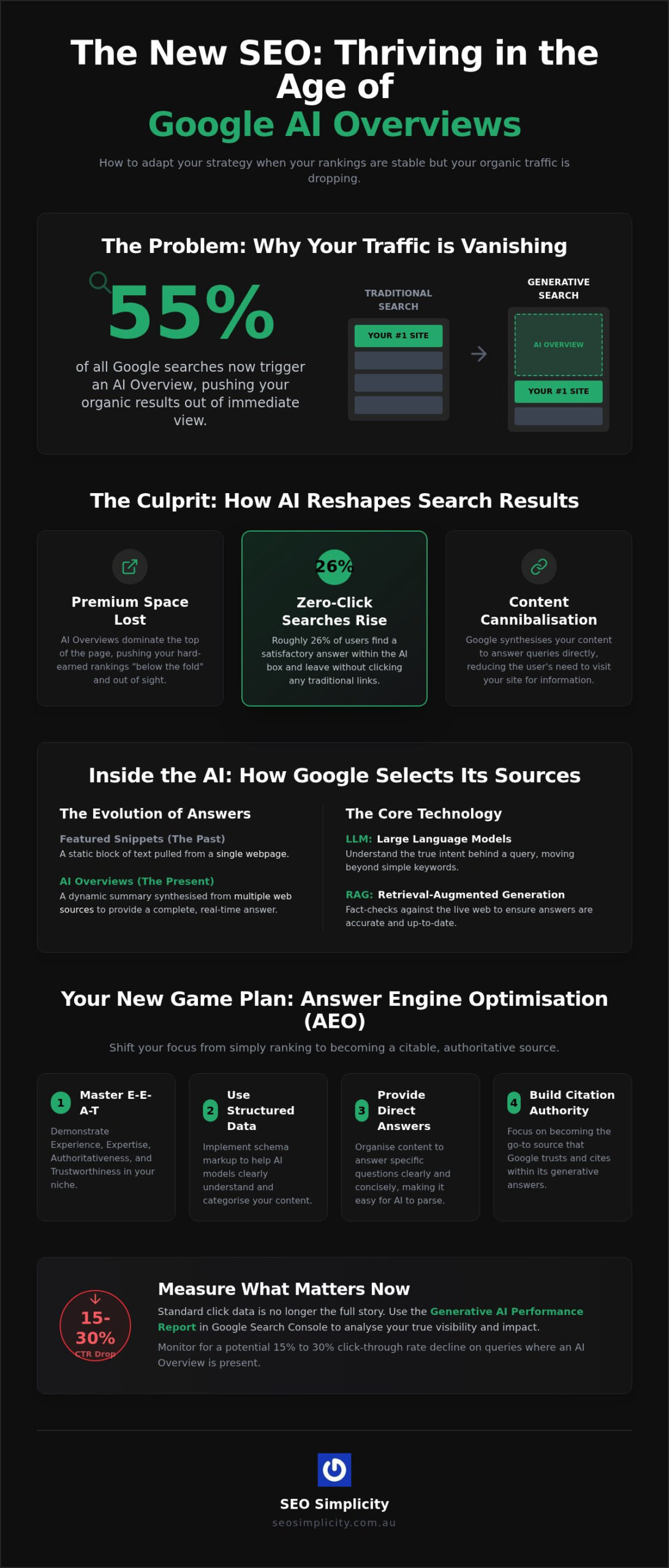
Did you know that nearly 55% of all searches now trigger google ai overviews, effectively pushing your hard-earned organic rankings below the fold and out of sight? It’s incredibly frustrating to see your site maintaining its position in the traditional results while your organic traffic continues to slide. You’ve likely noticed that Google is increasingly answering queries directly, leaving many Australian business owners feeling as though their content is being cannibalised by the very platform they rely on for growth.
We understand the uncertainty this shift creates, but this transition isn’t the end of SEO; it’s a fundamental change in how you must compete for “citation authority” rather than just blue links. This guide will help you understand the mechanics of generative search so you can stop the traffic bleed and start securing your place within the AI box. We’ll explore how Google selects its sources, the latest reporting tools in Search Console, and the specific content strategies you need to enhance your performance and grow your brand’s visibility in a generative-first world.
Key Takeaways
- Understand how google ai overviews have evolved into a permanent generative layer that synthesises multiple web sources to provide direct, real-time answers.
- Identify the causes of declining organic clicks by analysing how AI-generated summaries occupy premium screen real estate and encourage zero-click search behaviour.
- Learn the mechanics of selection to improve your chances of being cited as a primary source, focusing on established E-E-A-T principles and structured data.
- Shift your content strategy towards Answer Engine Optimisation (AEO) to ensure your information is easily accessible and interpreted by Google’s generative models.
- Future-proof your brand by performing a professional SEO audit to uncover vulnerabilities and adapt your technical framework for the 2026 search landscape.
What are Google AI Overviews and How Do They Work?
Google has fundamentally changed how we interact with search results by introducing a generative AI layer that sits directly at the top of the page. This feature, known as google ai overviews, synthesises information from multiple web sources to provide a single, cohesive answer to a user’s query. This shift represents a significant evolution from the experimental Search Generative Experience (SGE) to the permanent, public-facing model we see today. If you’re wondering What are Google AI Overviews and how they differ from what came before, it’s helpful to view them as a move towards a more conversational and assistive search engine.
It’s easy to confuse these summaries with the Featured Snippets we’ve lived with for years, but the underlying technology is far more advanced. While a Featured Snippet pulls a specific, static block of text from a single website, an AI Overview is dynamically generated. It doesn’t just copy and paste; it reads, understands, and rewrites information to address the specific nuances of a search. Google’s primary goal here is to satisfy complex queries instantly, often providing enough detail that a user feels they don’t need to click through to a traditional website. For brands, this means the competition is no longer just about ranking first, but about being the trusted source that the AI chooses to cite.
The Technology Behind the Box: LLMs and RAG
Google uses sophisticated Large Language Models (LLMs) to grasp the true intent behind your search, moving beyond simple keyword matching. To ensure these answers are accurate and up-to-date, the system employs a process called Retrieval-Augmented Generation (RAG). This allows the AI to “fact-check” its own internal knowledge against the live web before generating a response. Retrieval-Augmented Generation serves as the critical bridge between the static knowledge of an AI model and the real-time, evolving data found on live websites. By pulling from current sources, Google can provide answers that include the latest news, product releases, or technical updates, ensuring the information remains relevant to the user’s immediate needs.
Where AI Overviews Appear in 2026
By mid-2026, these overviews have become a standard feature for informational searches across more than 100 countries. In Australia, they’ve gained a heavy presence, particularly for queries that require multi-step instructions or deep comparisons. You’ll most likely see google ai overviews triggered by “How-to” guides, “What is” definitions, and complex research tasks where a single link might not provide the full picture. The search layout has also become more fluid, often referred to as a “Generative UI.” This means the interface actually changes its structure based on the user’s follow-up questions, creating a tailored research path that keeps the audience engaged within Google’s own ecosystem for longer periods.
The Traffic Drop: Why Your Organic Clicks Are Declining
Many Australian business owners are facing a confusing reality: their keywords are still ranking in the top three positions, but their organic traffic is in freefall. This isn’t necessarily a sign that your SEO is failing; it’s a direct result of how google ai overviews have redefined the search results page. By synthesising answers directly on the SERP, Google has accelerated the “Zero-Click Search” phenomenon. Recent data from 2026 shows that roughly 26% of users now find their answer within the AI box and leave without ever clicking a traditional link.
The issue is largely one of screen real estate. In the past, being number one meant you were the first thing a user saw. In 2026, an AI Overview can occupy a massive portion of a mobile screen, pushing your high-ranking organic links “below the fold”. This impact is most severe for informational keywords. While transactional searches for specific services still drive clicks, queries like “how to” or “what is” are increasingly being answered by the AI, leaving your site with fewer visitors despite your established authority.
Measuring the Impact on Your Australian Business
To understand how this shift affects your bottom line, you must look beyond standard click data. Open your Google Search Console and navigate to the Generative AI performance report. This tool allows you to distinguish between a genuine ranking drop and an AIO-induced traffic shift. You might find that your rankings remain stable, but your click-through rate has dipped by 15% to 30% on queries where an AI summary is present.
In this new environment, “Impressions” have become a vital metric for brand awareness. Even if a user doesn’t click, seeing your brand cited as a source within the AI Overview builds trust and authority. Analysing these shifts helps you identify which pages need a revised content strategy to recapture attention and maintain your market presence.
The Reddit and Forum Factor
Another reason for the traffic decline is Google’s recent tendency to prioritise user-generated content from platforms like Reddit and Quora. The 2026 search shake-up, often called the “Reddit Drop” by industry professionals, saw many corporate blogs lose visibility to forum discussions. Google’s AI models often favour these “hidden gems” because they provide lived experience that feels more authentic than a polished marketing piece.
To compete, you must pivot your approach. Rather than writing generic articles, focus on providing unique data, case studies, or expert opinions that a forum thread cannot replicate. If you’re unsure where your traffic is going, a professional SEO audit can help pinpoint exactly which queries are being lost to forums or AI summaries.
The Mechanics of Selection: How Google Chooses Its Sources
Securing a citation within the google ai overviews box has effectively become the new “Position Zero” for Australian brands. Google no longer simply looks for relevant keywords; it searches for the most reliable consensus. This is where E-E-A-T (Experience, Expertise, Authoritativeness, and Trustworthiness) moves from a theoretical guideline to a strict technical requirement. The generative model prioritises content that demonstrates first-hand experience and deep expertise, particularly in industries where accuracy is paramount to the user’s well-being or financial security.
Google also relies on a “Corroboration” factor to maintain the integrity of its summaries. The AI cross-references facts across multiple reputable sites to ensure the information it presents is accurate and widely accepted. If your data aligns with the consensus of other industry leaders, your chances of being cited increase significantly. You must also ensure your site is technically sound to even be considered. Excellent technical health is a non-negotiable prerequisite for being indexed by the generative crawler, as the system needs to parse your data quickly and without encountering crawl errors.
Authority and Brand Mentions
Building authority in the generative era requires more than just high-quality backlinks; it involves consistent brand mentions and digital PR across the web. When other reputable Australian platforms discuss your brand, it signals to Google that you are a trusted voice in your specific field. This “niche authority” is far more valuable than being a generalist, as the AI seeks out specialists to provide depth to its summaries. Strengthening your technical SEO is the first step in ensuring the generative crawler can actually find, understand, and credit these mentions across your site.
Structured Data and Schema
To increase your citation probability, you must make your content as easy to read as possible for an algorithm. Structured data serves as the critical “translator” between your content and Google’s Large Language Model (LLM), providing a clear map of the facts on your page. By implementing specific Schema.org markup, such as Speakable or FactCheck schema, you help the AI identify exactly which parts of your text are most relevant for a summary. This level of clarity allows Google to extract your insights with confidence, placing your brand at the centre of the search experience and helping you reclaim visibility lost to the AI shift.
Optimising for AI Overviews: A Strategic Framework
Transitioning your focus from traditional keyword density to what we call Answer Engine Optimisation (AEO) is the most effective way to maintain visibility in 2026. Rather than stuffing pages with specific search terms, you must prioritise the specific intent behind a user’s query. Google ai overviews are designed to extract the most direct and helpful information available, so your content needs to be structured in a way that is easily interpreted by the generative crawler. This shift requires a more methodical approach to how you present information on the page.
Start every major section of your content with a concise, direct answer of roughly 40 to 60 words. This block of text acts as a perfect summary that the generative model can use as a citation. When you provide an immediate solution at the beginning of your H2 sections, you significantly increase the likelihood of your brand appearing in the AIO box. You should also incorporate high-quality, original data and proprietary statistics that AI models find “quotable”. Unique research and case studies are highly valued because they offer fresh information that the model cannot simply synthesise from other generic sources across the web.
The “Answer-First” Content Structure
Adopting an “Inverted Pyramid” writing style ensures that both human readers and AI bots appreciate your content. This method places the most critical information at the top, followed by supporting details and broader context. Organise your content so that it respects the reader’s time while providing enough detail to build significant trust. High skimmability is essential, and you can achieve this through the strategic use of formatting. Bullet points and tables allow the generative crawler to parse specific data points instantly, which is often the difference between being ignored and being featured in a prominent citation card.
Generative Engine Optimisation (GEO) Techniques
Signal your expertise by using authoritative language that avoids passive phrasing. The AI crawler looks for confident, well-supported claims that demonstrate a clear understanding of the subject matter. Internal linking also serves as a vital tool for building a topical map that the AI can easily navigate. By connecting related articles, you reinforce your site’s hierarchy and demonstrate comprehensive coverage of a topic. This systematic improvement in your site structure makes it easier for the crawler to verify your claims. Finally, focus on long-tail conversational queries. These multi-word phrases are far more likely to trigger google ai overviews, making them the ideal target for your generative-first strategy. If you’re ready to refine your approach, our team can help you develop a specialised content strategy that secures your place in the AI-driven search results.
Future-Proofing Your Search Strategy with SEO Simplicity
In the 2026 search environment, a “set and forget” SEO strategy is no longer a viable option for Australian brands. The rapid evolution of google ai overviews means that a site that was perfectly optimised six months ago might now be losing massive amounts of traffic to generative summaries. To stay competitive, you need a dynamic approach that adapts to how Google synthesises information in real-time. This is where professional oversight becomes essential, as it allows you to focus on running your business while we handle the complex technical shifts that define modern search.
Identifying your brand’s specific risks begins with a comprehensive SEO audit. This process uncovers AIO vulnerabilities by analysing which of your high-traffic keywords are being cannibalised and where your technical framework might be failing to support generative crawlers. By pinpointing these gaps, we can implement systematic improvements that protect your visibility. Our team organises national campaigns designed to dominate this new landscape, ensuring your brand remains a primary source of information for your target audience.
Our Approach to Generative Search
We combine technical excellence with strategic content creation to ensure your site meets the high standards required for AI inclusion. Our management extends beyond Google, as we actively monitor your brand’s mentions and rankings across other major platforms like Gemini, ChatGPT, and Perplexity. By tracking how these Large Language Models interpret your data, we can refine your topical map and strengthen your authority. Our goal is to ensure your business isn’t just another link in the search results, but a cited authority that the AI trusts to answer user queries.
Secure Your Brand’s Future Today
Taking a proactive stance on AI search is the only way to safeguard your long-term growth. The risk of waiting is significant, as your competitors are already optimising their content for these high-value AI boxes. If you delay your transition to a generative-first strategy, you may find it increasingly difficult to reclaim the screen real estate lost to more agile brands. Don’t let your organic traffic continue to slide while the search landscape evolves around you. You can enquire about our Monthly SEO Management today to ensure your brand stays ahead of the AI curve and continues to thrive in the years to come.
Secure Your Brand’s Authority in the Generative Era
The shift toward generative search doesn’t mean the end of visibility for Australian brands; it simply demands a more sophisticated approach. Success now depends on your ability to transition from traditional keyword targeting to becoming a trusted source of truth that google ai overviews can confidently cite. By prioritising E-E-A-T and adopting an “answer-first” content structure, you can protect your market share and turn zero-click searches into valuable brand-building opportunities.
We specialise in managing these technical complexities so you can focus on your core business operations. Since 2024, we’ve provided expert Australian SEO management with a focus on Generative Engine Optimisation (GEO) and national strategic coverage. Our team is ready to help you simplify this transition and ensure your site remains a high-performing asset in 2026 and beyond. Unlock your brand’s potential with our specialised SEO services and take the first step toward a more resilient search presence. You’ve built a great brand, and we’re here to make sure Australia continues to find it.
Frequently Asked Questions
Can I turn off Google AI Overviews for my business website?
Yes, you can use the site-level controls provided by Google to opt out of having your content featured in generative AI results. However, doing so prevents your brand from being cited as an authority in the AIO box. We generally recommend optimising for inclusion rather than opting out, as being a cited source helps maintain brand visibility in an increasingly zero-click search environment where traditional links are pushed further down the page.
How much traffic will I lose because of Google AI Overviews?
While the impact varies by industry, studies have shown a decline in organic click-through rates between 15% and 30% for top-ranking results. Approximately 26% of users now end their search session after viewing an AI summary without clicking any links. This shift makes it essential to move beyond traditional traffic metrics and focus on “citation authority” to ensure your brand remains visible when users seek detailed answers directly on the results page.
Does AI-generated content rank well in AI Overviews?
Google prioritises content that demonstrates high levels of E-E-A-T (Experience, Expertise, Authoritativeness, and Trustworthiness). While AI-generated content can be indexed, it often lacks the unique data and lived experience that Google’s models find most “quotable”. To rank well in google ai overviews, you should focus on producing original research, case studies, and expert insights that provide clear, factual value that a generic AI model cannot easily replicate from other sources.
What is the difference between SEO and GEO?
Traditional Search Engine Optimisation focuses on improving rankings within the “ten blue links” by targeting specific keywords and building backlinks. Generative Engine Optimisation (GEO) is a newer discipline that focuses on making your content “quotable” for AI models like Gemini or ChatGPT. While SEO organises your site for crawlers, GEO ensures your facts are structured so that generative models can easily synthesise them into a concise summary for the user.
How do I track if my business is being mentioned in an AI Overview?
You can use the dedicated Generative AI performance report in Google Search Console to monitor your visibility. This tool provides data on impressions and pages for when your site appears in google ai overviews or other generative features. While it doesn’t currently include specific query data, it’s the most reliable way to track whether your brand is being cited as a trusted source across different devices and countries throughout the Australian market.
Are AI Overviews accurate for Australian-specific business queries?
Accuracy for Australian queries has improved significantly as Google uses Retrieval-Augmented Generation to cross-reference facts against the live web. However, the AI can still struggle with very niche local regulations or regional nuances if the available data is sparse. This is why maintaining a technically sound website with clear, factual information is vital; it ensures the generative crawler has access to the correct data to provide an accurate summary of your business.
What happens if Google AI provides incorrect information about my brand?
If the AI displays inaccurate information, it usually stems from conflicting data found across different websites. You can mitigate this risk by ensuring your site uses clear Schema.org markup to act as a “translator” for the Large Language Model. By providing structured, corroborated facts on your own domain, you help the AI verify its information against your authoritative source, reducing the likelihood of hallucinations or errors regarding your brand identity.
Is traditional SEO still worth the investment in 2026?
Absolutely, because traditional SEO provides the technical foundation that generative search relies on. A technically healthy website is a non-negotiable prerequisite for being indexed by the generative crawler in the first place. While the tactics have evolved toward Answer Engine Optimisation, the core principles of building authority and providing a great user experience remain the most effective ways to drive long-term growth and organic traffic for Australian businesses today.