

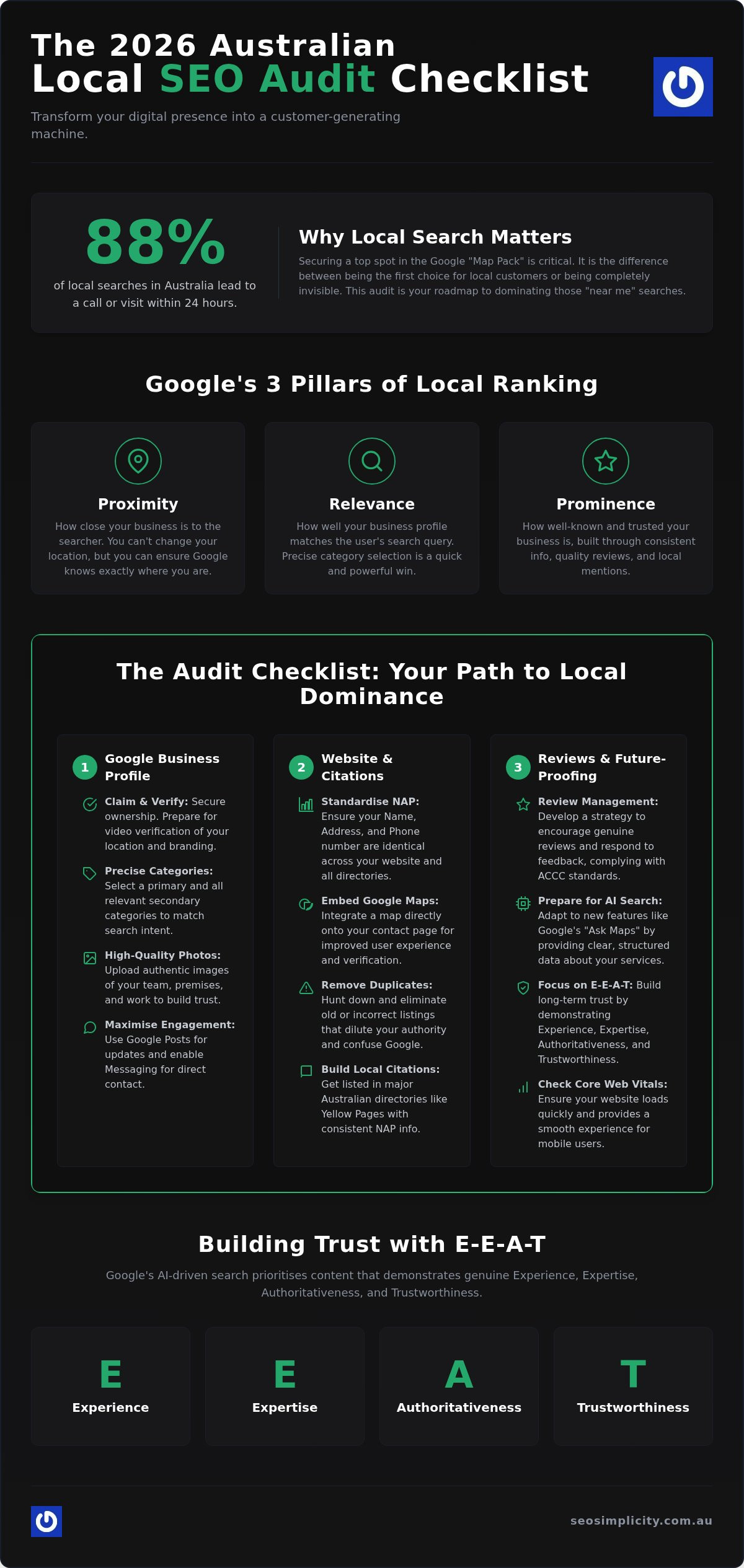
Did you know that 88% of local searches in Australia result in a phone call or a physical visit to the business within just 24 hours? This statistic highlights a massive opportunity for growth, yet many Australian business owners feel invisible in the local map pack. You’ve likely felt the frustration of seeing a competitor claim the top spot while your own listing is buried under outdated information or a lack of reviews. It’s difficult to know where to start when the rules of search change so rapidly, leaving many feeling overwhelmed by technical jargon.
By following this action-oriented local seo audit checklist, you can reclaim your visibility and transform your digital presence into a customer-generating machine. We’ve designed this guide specifically for the 2026 Australian market to help you standardise your information and build genuine trust with your community. You’ll discover how to navigate Google’s latest AI “Ask Maps” features, meet the current Core Web Vitals thresholds, and implement a review management strategy that complies with ACCC standards while driving real results for your bottom line.
Key Takeaways
- Master the distinction between traditional organic search and the Google Map Pack to ensure your business appears exactly where local customers are looking.
- Optimise your Google Business Profile by selecting precise categories and verifying ownership to claim full control over your digital storefront.
- Utilise our comprehensive local seo audit checklist to standardise your NAP information across your website and major Australian directories like Yellow Pages.
- Identify and remove duplicate listings that dilute your authority while learning how to integrate Google Maps directly into your site for improved verification.
- Prepare for the shift toward AI-driven search by focusing on E-E-A-T principles that build long-term trust with both search engines and local clients.
What is a Local SEO Audit and Why Does Your Business Need One?
Think of a local SEO audit as a comprehensive health check for your business’s digital footprint. It’s a systematic process where you examine how your brand appears to customers searching for services in their immediate area. While traditional SEO focuses on ranking for broad terms across the country, local SEO is about winning the “near me” moments that happen every day in Australian suburbs. If you’ve ever wondered why a competitor three streets away consistently appears at the top of search results while your business remains hidden, an audit will provide the answer. It moves you from guesswork to a strategic roadmap for growth.
Local search operates differently from the standard list of blue links you see on a desktop. It’s defined by the “Map Pack” or “Local Pack,” which highlights the top three businesses most relevant to a user’s location. Securing a spot here is critical. Data shows that 46% of all Google searches have local intent, and 78% of those searches on a mobile device result in an offline purchase. Failing to appear in these results means you’re effectively handing over leads to competitors who have taken the time to organise their digital presence. Using a structured local seo audit checklist allows you to identify the technical and content gaps that are currently acting as barriers between you and your local customers.
The Core Pillars of Local Search Visibility
Google uses three primary metrics to determine who wins the top spots in local search. Understanding these helps you prioritise your efforts:
- Proximity: This measures how close your business is to the person searching. While you can’t change your physical location, you can ensure Google knows exactly where you are.
- Relevance: This looks at how well your business description and categories match what the user is looking for. Precise category selection is a quick win for better matching.
- Prominence: This reflects how well-known and trusted your business is. It’s built through consistent information across the web, high-quality reviews, and local mentions.
How an Audit Unlocks Hidden Growth Opportunities
Conducting an audit helps you uncover “low-hanging fruit” that can lead to immediate improvements in your rankings. You might find that your phone number is slightly different on two different directories or that you’ve missed a secondary business category that your customers frequently use. These small errors confuse search engine algorithms and lower your trust score. By resolving these issues, you create a solid foundation for more advanced strategies.
An audit also reveals exactly why competitors are outranking you. It might be a lack of local backlinks or a website that loads too slowly for mobile users. Establishing this baseline is the first step toward a broader SEO site audit, allowing you to align your local presence with your overall digital strategy. This local seo audit checklist serves as your guide to transforming your online visibility from a source of frustration into a reliable engine for local traffic and sales.
Google Business Profile (GBP) Optimisation Checklist
Your Google Business Profile is the cornerstone of your local digital identity. Completing this stage of your local seo audit checklist begins with claiming and verifying your listing to ensure you have full ownership of your data. In 2026, Google has tightened its verification processes, frequently requiring video evidence of your physical location, branding, and equipment to combat spam listings. Once verified, you must select your primary and secondary categories with surgical precision. Choosing “Electrician” as your primary category while adding “Solar Power Installer” as a secondary one ensures you match the specific search intent of your local community.
Write a business description that is both compelling and informative. Use natural keywords that describe your services clearly, but avoid the temptation to “keyword stuff,” as this can trigger spam filters. Complement your text with high-quality, original photos of your team, your premises, and your completed projects. Authentic imagery builds immediate visual trust and helps you stand out from competitors who rely on generic stock photography.
Maximising GBP Engagement Features
Engagement signals tell Google that your business is active and reliable. Use Google Posts to share weekly updates, special offers, or upcoming events directly in the search results to keep your audience informed. Enabling the Messaging feature allows potential customers to contact you instantly, meeting the modern expectation for immediate communication. You should also proactively manage the “Ask Maps” section. This AI-powered feature has replaced the traditional Q&A in 2026, answering user questions in real-time based on your profile content. By pre-emptively providing answers to common queries within your profile, you help the AI provide accurate information to prospective clients.
The Importance of Accurate Operating Hours
Inconsistency in your operating hours is a quick way to lose both customer trust and search rankings. Check that your hours match your website and physical signage exactly. It’s vital to update your “Special Hours” for Australian public holidays, such as Anzac Day or the King’s Birthday, to avoid the frustration of a customer arriving at a closed shop. Accurate hours directly impact your local rankings because Google prioritises businesses it knows are open and available to serve the searcher at that specific moment. If managing these technical details feels like a distraction from your core work, consider a professional Local SEO strategy to handle the heavy lifting for you.
On-Page Local Signals: Optimising Your Website
Your website serves as the ultimate source of truth for search engines. While your Google Business Profile captures initial attention, your site must confirm those details to build lasting authority. A critical step in your local seo audit checklist is verifying NAP (Name, Address, Phone) consistency across every single page. If your footer lists a different phone number than your contact page, search engines receive conflicting signals, which can diminish your rankings in the Local Pack. Ensure these details are identical to your GBP listing to provide a clear, unified identity.
Embedding a Google Map directly onto your contact page is another powerful way to help search engines verify your physical location. This simple integration provides a direct link between your site and your map listing, reinforcing your proximity to local searchers. You should also refine your Title Tags and Meta Descriptions by adding local modifiers. Instead of a generic “Plumbing Services,” consider adding local modifiers to signal your relevance to users in your specific service area. These small adjustments transform a general website into a locally relevant powerhouse.
If your business operates across multiple suburbs or cities, creating location-specific landing pages is non-negotiable. Statistics show that Australian businesses targeting multiple local service areas see an average of 557% more traffic than single-location businesses. Each page should feature unique content tailored to that specific community, avoiding the “cookie-cutter” approach that search engines often penalise.
Technical Foundations for Local Success
Technical health is the backbone of local visibility. Since 88% of local searches occur on mobile devices, you must audit your site for mobile-friendliness to ensure a seamless experience for users on the move. Implementing Local Business Schema markup is also essential; it uses structured data to tell Google exactly what your business does and where you are located. Finally, check your page load speeds for Australian users. As of August 2026, you should aim for a Largest Contentful Paint (LCP) of 2.5 seconds or less and an Interaction to Next Paint (INP) of 200 milliseconds or less to keep bounce rates low and engagement high.
Local Content Strategy and Internal Linking
Developing content that speaks to your local community builds prominence and trust. Write blog posts that address local industry trends, community events, or specific regional challenges. This demonstrates your expertise and shows that you are an active participant in the local market. Use descriptive anchor text to link these articles to your on page seo services australia to create a strong internal linking structure. Finally, audit your sitemap to ensure all your new local landing pages are easily discoverable by search engine bots, ensuring no part of your digital footprint is left in the dark.
Off-Page Authority: Citations and Review Management
Building prominence requires you to look beyond your own website and Google Business Profile. A key component of your local seo audit checklist is a thorough audit of your digital citations across major Australian directories like Yellow Pages, True Local, and Hotfrog. Many businesses treat this as a one-time task, but old, conflicting data can accumulate over time. You must identify and remove duplicate listings that confuse search engine algorithms and dilute your authority. Consistent information across these high-traffic platforms reinforces your legitimacy and helps search engines verify your business details with absolute certainty.
Review management has become increasingly complex in 2026. With Google’s March 2026 update to its review policies, AI-driven enforcement is now more aggressive in identifying spam. You need a systematic programme for requesting and responding to feedback that complies with Australian Consumer Law. Data from Salesgenie indicates that 89% of consumers expect business owners to respond to online reviews, making active engagement a standard expectation rather than a luxury. Monitor your brand mentions across the web to build natural local authority and respond to customer sentiment in real-time.
The Review Audit: Quality, Velocity, and Diversity
Analyse your review sentiment to identify specific areas where your business can improve. Check your review velocity to ensure you are receiving a steady, natural stream of feedback rather than suspicious bursts of activity. You can encourage the use of keywords in reviews by asking customers to mention specific services they used, such as “emergency plumbing” or “home extensions”. This diversity in feedback signals to search engines that your business is a trusted provider of various local services.
Building Local Backlinks and Partnerships
Local link building is essentially the digital version of community networking. Identify opportunities for guest posts or features in local industry publications and community blogs. Audit your existing link profile to ensure your backlinks are coming from relevant, high-quality sources that actually add value to your domain. In Australia, 81.6% of a business’s organic traffic in local search is correlated with its backlinks, making this a high-impact task for your local seo audit checklist. If you find the technical aspects of building off-page authority challenging, you can book a Local SEO Audit to get a professional assessment of your current standing.
Future-Proofing: AI and Professional Local SEO Audits
Prepare your business for the next era of search by focusing on the principles of E-E-A-T: Experience, Expertise, Authoritativeness, and Trustworthiness. In 2026, Google’s generative search experiences and AI-powered “Ask Maps” features rely on these signals to determine which businesses deserve the top spot. Your local seo audit checklist shouldn’t just be a list of technical fixes; it must become a strategy for demonstrating your real-world impact. AI assistants now pull information from your reviews, website content, and third-party mentions to draft answers for potential customers. By refining your digital footprint today, you ensure that these AI models present your business as the most reliable choice in your suburb.
Moving from a manual, DIY approach to a professional Fixed-Price SEO Audit allows you to uncover technical nuances that standard tools often overlook. While basic checks are helpful, the emergence of sophisticated AI SEO Tools has changed how local data is processed and interpreted. Professional audits provide the depth required to understand how your site interacts with these new technologies. Set up monthly reporting alongside your audit to track the long-term ROI of your optimisation efforts. This steady stream of data allows you to pivot your strategy as local search algorithms continue to evolve throughout the year.
Adapting to Generative Search Experiences
Generative search requires a shift toward “entity-based” SEO, where search engines look for identifiable concepts rather than just matching keywords. You must ensure your business is recognised as a distinct entity with a verified physical location and a clear service area. Organise your data using structured markup so AI search assistants can extract your business hours, service list, and pricing with ease. Maintaining a high “trust score” through consistent information and positive customer sentiment is now a primary requirement for appearing in AI-generated summaries. Focus on building a brand that search engines can verify with absolute confidence across multiple Australian platforms.
Taking the Next Step with SEO Simplicity
Leverage our specialist expertise to transform your initial checklist findings into a high-performance growth strategy. While a local seo audit checklist helps you identify the “what,” our team provides the “how” through systematic execution and technical refinement. Enquire about our Monthly SEO Management to keep your local presence ahead of the curve and ensure you never lose ground to more agile competitors. We act as your dedicated partner, helping you navigate the complexities of AI-driven search with a results-oriented methodology. Book your comprehensive SEO Audit today to unlock your business’s full potential in the Australian market.
Transform Your Local Search Performance
Securing your place in the Australian market requires a methodical approach to your digital presence. You now have the foundational knowledge to align your Google Business Profile with search intent and optimise your site for local relevance. By implementing this local seo audit checklist, you can bridge the gap between being a hidden gem and becoming the first choice for customers in your area. This process is about more than just technical fixes; it’s about building a brand that both users and AI search assistants can trust implicitly.
As specialists in Australian Local SEO, we offer comprehensive Fixed-Price Audits that turn these insights into a clear roadmap for growth. We provide the ongoing monthly support needed to ensure your progress is sustainable and your rankings remain resilient against algorithm shifts. Unlock your local growth with a professional SEO Audit from SEO Simplicity. You’ve already done the hard work of starting the journey. Now, take the final step to ensure your business thrives in 2026 and beyond.
Frequently Asked Questions
What is the most important part of a local SEO audit?
Ensuring your Name, Address, and Phone number (NAP) are identical across all platforms is the most critical element of any health check. Google relies on this consistency to verify your legitimacy and physical location. If your details vary between your website and your Google Business Profile, search engines lose trust in your data, which directly lowers your visibility in the Local Pack and confuses potential customers.
How long does it take to see results from a local SEO audit?
You will typically notice improvements in your local rankings within four to twelve weeks after implementing the findings of your audit. While technical fixes like updating operating hours or primary categories can have a faster impact, building prominence through reviews and local backlinks takes more time. Steady, incremental growth is a sign that your optimisations are being recognised and rewarded by search engine algorithms.
Do I need a physical office for local SEO to work?
You don’t need a physical storefront to succeed in local search if you operate as a Service Area Business (SAB). Professionals like plumbers, electricians, and mobile consultants can hide their residential addresses on Google Business Profiles while defining the specific suburbs they serve. This allows you to appear in local results for your target areas without requiring customers to visit a physical office location.
How often should I perform a local SEO checklist audit?
Perform a comprehensive review using a local seo audit checklist at least once every quarter to maintain your competitive edge. Digital environments change rapidly, and new competitors or updated Google policies can impact your standing. Regular audits help you catch incorrect citations, duplicate listings, or broken links before they significantly damage your organic traffic or local lead generation efforts.
Can I do a local SEO audit myself or do I need an agency?
You can certainly perform a basic audit yourself using structured guides, but an agency often uncovers deeper technical barriers that hinder long-term growth. Professional specialists use advanced tools to analyse site speed, schema markup, and competitor backlink profiles. While a DIY approach is a great starting point, expert intervention ensures your strategy is fully future-proofed against the latest AI search trends.
What are the most common local SEO mistakes Australian businesses make?
Creating duplicate Google Business Profiles and selecting the wrong primary categories are the most frequent errors we see in the Australian market. These mistakes split your authority and confuse search engines about your core services. Additionally, many businesses forget to update their “Special Hours” for Australian public holidays, which leads to poor user experiences and negative reviews from frustrated local customers.
Does social media impact my local SEO audit results?
Social media does not directly influence your local search rankings, but it provides vital brand signals that build your overall prominence. Active profiles on platforms like Facebook or Instagram drive traffic to your site and encourage customers to leave Google reviews. These indirect benefits help search engines recognise you as a popular and trusted entity within your local community, supporting your wider search visibility.
What is NAP consistency and why is it so critical?
NAP consistency refers to having your Name, Address, and Phone number match exactly across every directory, social profile, and website page. It’s critical because search engines use this data to confirm your physical existence and service area. Inconsistent details are viewed as a red flag by algorithms, often resulting in your business being filtered out of the top local pack results in favour of more reliable competitors.