

In 2026, the most surgical way to dominate a niche isn’t by overhauling your entire digital presence; it’s by launching a dedicated, high-impact Microsite SEO Strategy. You’ve likely felt the frustration of watching your brand authority get diluted while you struggle to rank for high-intent keywords against larger competitors. Restructuring a main website is often a costly, exhausting process that doesn’t always deliver the specific visibility your latest campaign needs, especially when 68% of searches now result in no click to a website.
We believe in making complex search processes manageable and rewarding for Aussie brands. This guide explores how a targeted microsite provides a high-ROI alternative to broad SEO efforts, helping you capture niche traffic without the heavy investment of a site-wide redesign. Discover how this approach empowers you to optimise your search landscape and drive performance for specific campaigns.
We’ll provide a clear roadmap for launching your first microsite, explain why it’s a remarkably affordable service for small business growth in Australia, and show you how to achieve better rankings. You’ll learn how to transform your search performance through strategic, systematic improvement that respects your budget and your time.
Key Takeaways
- Master the art of using standalone domains to provide hyper-relevant signals that search engines and AI models prioritise in 2026.
- Compare the cost-benefit ratio of microsites against subfolders to determine the fastest, most profitable path to page one for new campaigns.
- Implement a Microsite SEO Strategy that targets high-intent, low-competition niche gaps without diluting your main brand authority.
- Protect your digital assets by learning how to manage keyword cannibalisation and avoid the “thin content” traps that penalise unoriginal sites.
- Identify precise opportunities for niche growth using fixed-price audits that pinpoint exactly where a microsite could enhance your search performance.
What is a Microsite SEO Strategy and is it Right for You?
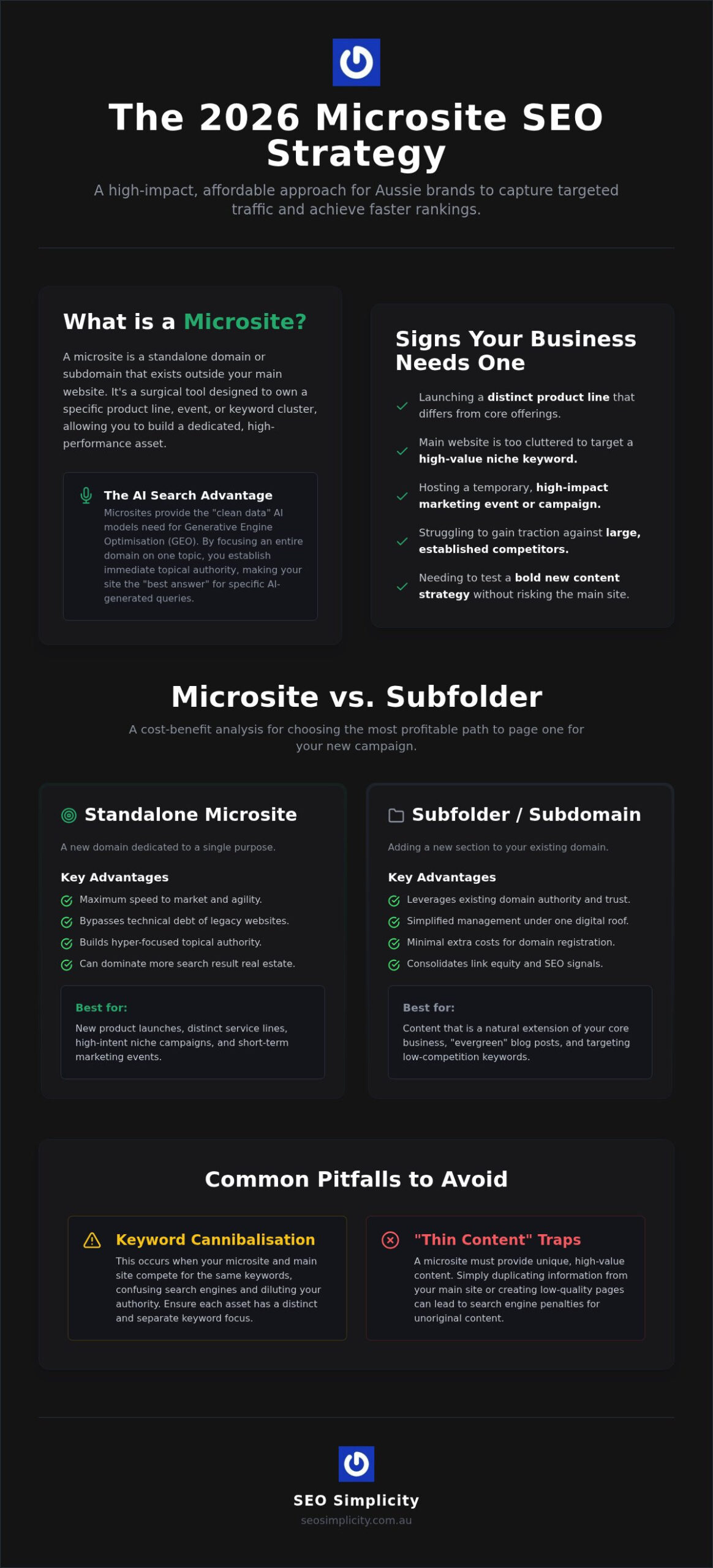
A microsite is a standalone domain or subdomain that lives outside your primary website’s main architecture. To understand the basics of this structure, you might ask, What is a Microsite? Essentially, it is a surgical tool designed to own a specific product line, event, or keyword cluster. While your main site serves as a broad digital headquarters, a Microsite SEO Strategy allows you to build a dedicated, high-performance asset that search engines and AI models can easily categorise. This focused approach ensures your message isn’t lost in the noise of a larger, more generalised site.
In 2026, search algorithms prioritising user experience and mobile speed have made agility a top-tier ranking factor. Smaller sites can be optimised faster and more aggressively than large legacy domains. Because they aren’t bogged down by years of technical debt or complex internal linking structures, microsites offer a “clean slate” for testing bold content strategies. By organising your niche content onto a dedicated microsite, you unlock faster rankings for specific, high-intent search terms that might otherwise get lost in your main site’s hierarchy. It’s a method that turns narrow focus into a competitive advantage.
The Role of Microsites in the AI Search Era
AI-driven search features thrive on clarity. Microsites provide the “clean data” required for Generative Engine Optimisation (GEO) by eliminating the noise found on multi-purpose websites. When you focus an entire domain on a single topic, you establish immediate topical authority. This makes your site the “best answer” for specific AI-generated queries. AI models can easily parse your expertise without sifting through unrelated service pages, which helps you capture zero-click search visibility and appear in AI-generated summaries more frequently.
Signs Your Business Needs a Microsite
Determining if this approach fits your goals depends on your current digital constraints. You might need a Microsite SEO Strategy if you’re launching a distinct product line that differs significantly from your core offerings. If your main site is currently too cluttered to target a high-value niche keyword effectively, a microsite provides the breathing room needed for a focused campaign. These sites also serve as excellent temporary homes for high-impact marketing events. Our fixed-price audits can help you identify these specific gaps where a microsite could transform your visibility without the risk of keyword cannibalisation.
Microsite vs. Subfolder: A Cost-Benefit Analysis for ROI
Deciding how to structure your niche content involves balancing immediate costs against potential returns. While adding a subfolder to your existing site requires minimal domain fees, the technical labour involved in ensuring that new section ranks can be significant. If your primary site carries technical debt or lacks topical relevance for a new venture, a standalone Microsite SEO Strategy often delivers a better cost-per-lead by bypassing these hurdles. It’s about choosing the path that offers the least resistance from search algorithms.
Speed to market is a critical factor in 2026. A microsite allows you to bypass the internal red tape and technical constraints of a larger site. You can deploy a high-performance, mobile-optimised asset in a fraction of the time it takes to restructure a legacy domain. This agility means you start generating traffic and conversions sooner, which significantly shortens your path to profitability. For many small businesses, this surgical approach is far more affordable than a sitewide SEO overhaul that might take months to show results.
When to Choose a Subdomain or Subfolder
Choosing a subfolder is a wise move when your main domain already possesses high authority and the new content is a natural extension of your core business. It simplifies your management routine by keeping all your digital assets under one roof. Subfolders are particularly effective for “evergreen” content that benefits from the established trust of your primary brand. This structure leverages your existing hard work to help low-competition keywords rank with minimal extra effort.
The Power of the Standalone Domain
Launching a standalone domain provides a unique opportunity to own more real estate on the first page of search results. In 2026, the power of the modern microsite lies in its ability to provide a specialised user experience that a generic corporate site simply cannot match. Exact Match Domains (EMDs) still hold value for Aussie businesses when they signal immediate relevance to a specific local niche. This focus helps you create a high-converting environment tailored to a specific audience’s needs. If you aren’t sure which path suits your budget, our fixed-price SEO audits can clarify the most profitable structure for your next campaign.
How to Build an Effective Microsite SEO Strategy
Launching a successful Microsite SEO Strategy requires a methodical approach that prioritises precision over volume. Start by identifying your niche through specialised keyword research to uncover high-intent, low-competition gaps that your main site might be too broad to capture. Once you’ve found your gap, select a clean, relevant domain name that signals immediate topical relevance. A domain that mirrors your target search term can still provide a slight edge in 2026, provided the content backing it up is of the highest quality.
Build your site with a mobile-first mindset from the very first line of code. Because websites that improved their mobile user experience saw a 15% increase in rankings following 2026 updates, passing all Core Web Vitals is no longer optional. Implement a robust technical SEO foundation immediately to ensure search bots can crawl and index your niche content without friction. Finally, establish a clear interlinking plan that connects your microsite to your main brand domain, allowing authority to flow between both assets while maintaining their distinct identities.
Content Strategy for Niche Dominance
Focus on “Depth over Breadth” by creating comprehensive resources that answer every possible question a user might have about your specific niche. To keep your strategy on track, define your core value proposition in a single sentence: “This microsite provides the most detailed, practical guide for your specific niche topic in the Australian market.” This clarity ensures you don’t drift into unrelated topics that could dilute your authority. Incorporate video and interactive elements to keep users engaged. These features significantly lower bounce rates and signal to search engines that your site provides genuine value.
Linking and Authority Building
Building authority for a brand-new domain requires a targeted outreach plan. Focus on acquiring high-quality Aussie backlinks from industry-relevant sites to establish local trust. Use the “Satellite” approach, where your microsite acts as a specialised hub that funnels high-intent traffic and link equity back to your main site. This structure enhances your entire digital ecosystem rather than just a single page. Always stay within Google’s 2026 spam guidelines by avoiding automated link schemes. Reliable growth comes from transparent, systematic improvement rather than shortcuts that risk your long-term visibility.
Avoiding Common Pitfalls in Microsite Management
Managing a Microsite SEO Strategy requires ongoing vigilance to ensure your niche asset doesn’t become a liability. One of the most frequent errors is keyword cannibalisation, where your microsite and main site compete for the same search traffic. Map your keywords carefully before launch to ensure the microsite targets specific, long-tail queries while your main site retains authority for broader brand terms. This clear separation prevents you from splitting your ranking power across two domains and ensures both sites can thrive simultaneously.
Avoid the “thin content” trap by providing substantial, original value on every page. Following Google’s core updates, which led to a 45% reduction in low-quality search results, the bar for “helpful content” in 2026 is higher than ever. A microsite with only three or four shallow pages will likely fail to rank or be flagged as spam. You must also account for technical debt, including the recurring costs for SSL certificates and hosting. While shared hosting can cost as little as $2 to $10 per month, managing multiple environments increases the risk of missed security patches or CMS updates. Maintain a consistent brand voice across all properties to prevent confusing your audience; your microsite should feel like a specialised branch of your business, not a disconnected entity.
For Aussie brands, local relevance is paramount. Ensure your microsite has its own unique citations in Australian directories to reinforce its distinct identity. This local footprint strengthens your topical authority without muddying the search signals for your primary domain. If you feel overwhelmed by the technical requirements, our team at SEO Simplicity can help you audit your current assets to ensure every site in your portfolio is performing at its peak.
Managing Technical SEO Across Multiple Sites
Monitor your entire digital network from a central dashboard to catch crawling errors before they impact your rankings. Use unique Schema markup for each microsite to help search engines understand the specific niche you are targeting. Because mobile user experience is a primary ranking factor in 2026, ensure fast load times across your entire Aussie network. Systematic health checks allow you to maintain high performance without being overwhelmed by the complexity of multiple domains.
When to Retire or Merge a Microsite
Evaluate your ROI regularly to determine if a microsite still serves its purpose. If a campaign has ended or a product line has been absorbed, you might decide to merge the asset back into your main domain. Use 301 redirects to point every microsite page to its most relevant counterpart on your primary site. This process preserves the link equity you’ve built and ensures your main site benefits from the microsite’s historical success. Preserving this authority is essential for long-term growth.
Why SEO Simplicity is Your Partner for Affordable SEO Services
Partnering with an expert who understands the nuances of the Australian market makes all the difference when launching a Microsite SEO Strategy. We pride ourselves on being an Aussie-owned specialist that treats your business growth as our primary mission. Our fixed-price audits take the guesswork out of your investment by identifying exactly where a microsite can transform your search visibility without overcomplicating your digital ecosystem. By choosing a partner that values transparency, you ensure every dollar spent contributes directly to systematic improvement and long-term progress.
We specialise in local seo services that scale as your business expands into new niches. Our transparent, monthly reporting provides a clear view of how your microsite performs in real-world search scenarios, ensuring you always see the impact on your bottom line. We’ve already done the heavy lifting by developing proprietary technical SEO audit tools, allowing us to evaluate your site health with surgical precision. This proactive approach ensures your niche assets remain competitive even as search algorithms evolve.
Tailored Strategies for Aussie Small Businesses
We customise our monthly SEO management retainers to handle the unique needs of a microsite portfolio, ensuring your niche assets remain healthy and profitable. Our focus remains on “Action-Benefit” results; we don’t just provide data, we deliver specific improvements that move the needle on your organic traffic. You gain access to the same high-level strategic insight usually reserved for larger corporations, but delivered with the dedicated care of a strategic partner. This approach unlocks new opportunities for visibility that broader, generic campaigns often miss.
Getting Started with Your Microsite Strategy
Book a consultation today to evaluate the high-intent niche opportunities waiting in your industry. We provide a clear roadmap that balances affordability with aggressive growth targets, giving you a manageable path toward market dominance. Transform your search presence by working with a team that values simplicity and results above all else. We’re ready to act as your catalyst for progress, helping you own the search landscape one niche at a time through a systematic Microsite SEO Strategy.
Transform Your Niche Visibility Today
Embracing a Microsite SEO Strategy empowers you to bypass the technical limitations of a cluttered main site and speak directly to your most valuable audience. By focusing on hyper-relevant content and mobile-first performance, you position your brand to thrive in the 2026 search landscape. This surgical approach doesn’t just save you from expensive, sitewide overhauls; it builds a dedicated asset that AI models and users alike can trust. You’ve seen how these targeted sites can own a niche, provided you avoid common pitfalls like thin content and keyword cannibalisation.
We’ve already done the heavy lifting by identifying the most profitable paths for Aussie small businesses. As an Aussie-owned and operated specialist, we use fixed-price SEO audits to pinpoint exactly where a microsite can unlock your potential. Our team stays ahead of 2026 search trends to ensure your growth remains steady and systematic. We’re committed to making your digital journey manageable and rewarding by providing the clarity you need to succeed.
Unlock your niche dominance with affordable SEO services for small business today. We’re here to act as your strategic partner and help you achieve the results your brand deserves.
Frequently Asked Questions
Are microsites still good for SEO in 2026?
Microsites remain highly effective in 2026 because they provide the hyper-relevant signals that search engines and AI models prioritised in the March and August core updates. By focusing an entire domain on a single niche, you build immediate topical authority. This makes it easier for search bots to categorise your expertise. Websites that improved their mobile user experience on these smaller platforms saw a 15% increase in rankings this year.
How much does it cost to set up a microsite for my business?
Setting up the infrastructure for a microsite is remarkably affordable. As of August 2026, a standard domain name typically costs between $10 and $20 per year. Shared web hosting for a new site ranges from $2 to $10 per month, while a basic SSL certificate can cost between $10 and $100 per year if it isn’t included for free by your provider. These low entry costs make a Microsite SEO Strategy accessible for small businesses.
Will a microsite hurt my main website’s rankings?
A microsite won’t hurt your main site’s rankings as long as you avoid keyword cannibalisation. You must ensure the two sites target different search terms or specific stages of the buyer journey. When you clear this hurdle, the microsite actually supports your main domain by acting as a specialised satellite that funnels high-intent traffic back to your headquarters. This structure expands your total search real estate rather than splitting your existing power.
What is the difference between a microsite and a landing page?
A microsite is a standalone website with multiple pages and its own domain, whereas a landing page is a single page within an existing site structure. Microsites are designed for long-term topical authority and complex user journeys. Landing pages usually focus on a single, immediate conversion goal for a specific ad campaign. While a landing page is a quick fix, a microsite is a strategic asset built for sustained organic performance.
How do I choose the best domain name for a microsite?
Select a domain name that signals immediate relevance to your target niche or campaign. In the 2026 search environment, including a primary keyword in the URL can still assist with topical categorisation. Ensure the name is punchy, memorable, and clearly distinct from your main brand to avoid user confusion. A clean domain helps establish the “satellite” identity needed to own a specific search landscape without diluting your primary brand’s authority.
Can I use the same content on my microsite and main website?
You shouldn’t use the same content across both properties because duplicate content can confuse search engines and lead to ranking penalties. Every microsite needs substantial, original value to satisfy the helpful content standards enforced by the 2026 algorithm updates. Copying text from your main site creates a “thin content” trap that undermines your authority. Instead, create unique resources that provide a deeper, more specialised look at your chosen niche.
How long does it take for a new microsite to start ranking on Google?
A new microsite typically takes between three to six months to establish authority and start ranking for competitive terms. Because it’s a brand-new domain, search engines need time to crawl, index, and trust your content. You can accelerate this process by passing all Core Web Vitals and securing high-quality Aussie backlinks. Consistency is key; sites that maintain technical health and regular updates see faster progress in the current volatile search landscape.
Do I need a separate SEO strategy for every microsite I own?
Yes, each microsite requires a tailored Microsite SEO Strategy to ensure it meets its specific goals without competing with your other assets. Every niche has different competitors, keyword difficulties, and user intents that you must account for. Managing these as individual projects allows you to track ROI accurately through transparent monthly reporting. A customised plan ensures that each site in your portfolio is optimised for its unique audience and search environment.