
Did you know that 68% of Google searches in early 2026 ended without a single click to a website? This shift signals a massive change in how Australians find information, forcing a rethink of the classic SEO vs AEO debate. While you might feel like your organic traffic is slipping away into the void of AI Overviews, this evolution isn’t the end of your digital presence. It’s simply a transition from being a link on a page to becoming the definitive answer for a generative AI model.
You’ve likely noticed that technical jargon like “LLM rank tracking” and “entity optimisation” is suddenly everywhere, leaving you wondering if your current strategy is falling behind the curve. We understand the frustration of watching AI-generated answers occupy the space where your website used to sit. This guide unlocks the critical differences between traditional search and AI-driven responses so you can transform your visibility in a zero-click world. We provide a clear roadmap to integrate AEO into your existing workflow, ensuring your brand earns the citations it deserves from ChatGPT and Gemini.
Key Takeaways
- Understand the fundamental shift in the SEO vs AEO landscape to ensure your brand remains visible as search engines evolve into sophisticated answer engines.
- Leverage Schema.org and entity-based optimisation to help AI models like Gemini and ChatGPT accurately identify and cite your business as a trusted authority.
- Adopt a “Citation Share” mindset to measure how often AI models name-drop your brand, providing a clearer picture of success in a zero-click environment.
- Implement a question-first content strategy to organise your expertise into the structured, logical formats that both search and generative engines prefer to digest.
- Identify and resolve technical roadblocks through targeted audits to ensure your website’s architecture supports AI discovery rather than hindering it.
Understanding the Shift: What is the Difference Between SEO and AEO?
Unlock the potential of your digital strategy by understanding how search has evolved over the last few years. Traditional Search Engine Optimization (SEO) focuses on organising your website so it ranks highly for specific user queries. The goal is simple: earn a click and drive a visitor to your page. However, the rise of generative AI has introduced Answer Engine Optimisation (AEO). This process optimises your content specifically to be digested, understood, and recited by AI models like ChatGPT, Gemini, and Google’s own AI Overviews.
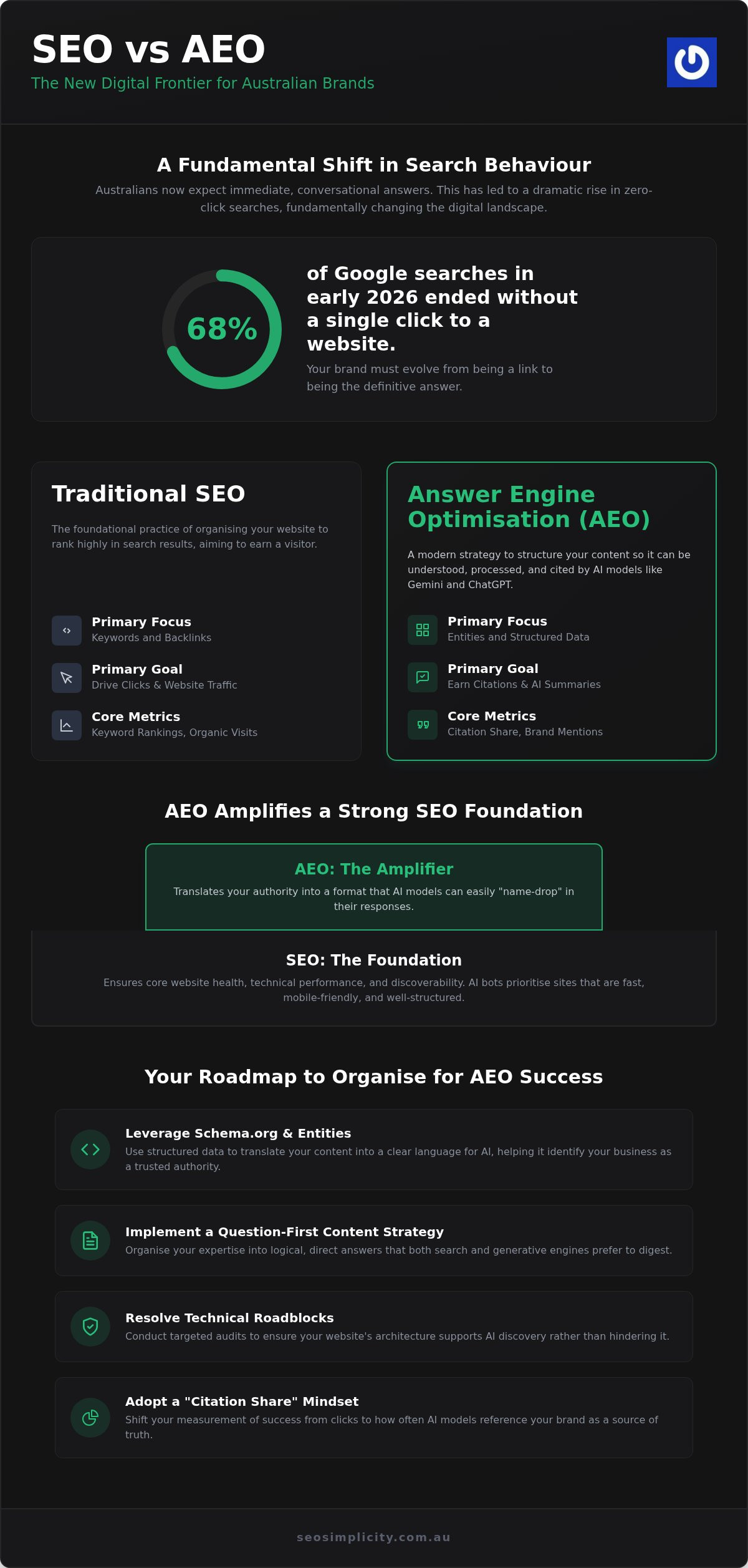
The fundamental shift in the SEO vs AEO debate lies in the final outcome for your business. While SEO targets traffic and clicks, AEO targets citations and summaries. In 2026, this distinction is critical for Australian brands. With AI Overviews now appearing on up to 60% of Google searches, your brand must transition from being just a destination to being the definitive source of truth that the AI trusts.
The Evolution from Keywords to Answers
User behaviour has shifted dramatically from “searching for links” to “asking for solutions.” Australians now expect immediate, conversational answers without having to hunt through multiple websites. This has led to a rise in zero-click searches, which reached a staggering 68% in early 2026. If your content relies on traditional keyword stuffing, you’ll likely find your visibility plummeting. Modern answer engines ignore repetitive phrases in favour of clear, intent-driven information. By focusing on providing direct solutions, you ensure your brand remains relevant even when a user never actually visits your site.
Why AEO Isn’t Replacing SEO
Think of SEO as the essential foundation of your digital house. It remains the primary driver of website health, technical performance, and discoverability. You can’t achieve AEO success without a robust SEO strategy because AI models still crawl the web via traditional SEO pathways to find their data. AI bots prioritise sites that are fast, mobile-friendly, and well-structured. AEO acts as an amplifier for your existing visibility, taking the authority you’ve built through technical SEO and content strategy and translating it into a format that AI models can easily “name-drop” in their responses. Instead of choosing one over the other, integrate both to capture every possible touchpoint in the modern search journey.
The Technical Engine: How Structured Data and Entities Power AEO
Success in the SEO vs AEO arena depends largely on how effectively you translate your website’s content into a language machines can process. While traditional search engines have become adept at reading text, AI models rely on “entities” to form answers. Entities are real-world objects, such as your brand, your products, or your key staff members, that exist independently of specific keywords. By defining these entities clearly, you move beyond simple ranking and start building a presence in the Large Language Models (LLMs) that power modern search.
A clean site architecture provides the foundation for this machine-led discovery. If an LLM crawler struggles to navigate your site, it won’t include your brand in its generative summaries. Ensuring your technical health is robust is the first step toward becoming an authoritative source. This involves more than just speed; it requires a logical hierarchy that allows AI to map the relationship between different topics on your site.
Mastering Schema Markup for AI Clarity
Utilise Schema.org markup to give AI models the specific context they crave. Even though Google retired FAQ rich results for standard search in mid-2026, this structured data remains a goldmine for answer engines looking for direct solutions. Implementing “Organisation” and “Person” schema helps establish your brand’s authority, linking your content to verified experts and historical data. For a deeper look at how to implement these changes, read our Technical SEO 2026 guide to stay ahead of the curve.
Building Brand Authority in the Knowledge Graph
Establish your brand as a distinct entity within the global Knowledge Graph to gain machine trust. This database, used by Google and Bing, connects information about your business from across the web. Consistency is your greatest asset here. Ensure your business details are identical across Wikipedia, industry journals, and social profiles. When AI models see a unified footprint, they are far more likely to cite your brand as a reliable expert. If you are unsure where your technical roadblocks lie, a comprehensive technical SEO audit can reveal exactly how to improve your entity recognition.
Measuring Success in a Zero-Click World: New Metrics for 2026
Relying solely on your position in the “ten blue links” is a risky strategy in 2026. Data shows that 68% of searches now result in zero clicks, meaning users find their answers directly on the results page without ever visiting a website. This reality shifts the SEO vs AEO dynamic from a battle for traffic to a battle for brand authority. You must now track your “Citation Share,” which measures how frequently AI models name-drop your business as a primary source of truth.
Beyond simple mentions, you should monitor the sentiment and accuracy of AI-generated summaries. If an LLM misrepresents your services or provides outdated information, it directly impacts your reputation before a person even reaches your site. Tracking these brand impressions within generative interfaces allows you to identify where your digital footprint needs sharpening. Success is no longer just about the click; it’s about being the entity the machine trusts most.
LLM Rank Tracking Tools and Techniques
Adopt specialised tools that monitor your presence across platforms like ChatGPT, Gemini, and Perplexity. These platforms operate differently from traditional search engines, prioritising structured data and entity relationships over simple backlink counts. By measuring your Share of Voice against other Australian competitors, you can pinpoint “Answer Gaps.” These are specific queries where a rival brand is being cited for information you should own. Closing these gaps requires a targeted content strategy that answers niche questions with authoritative, concise data.
The Value of a ‘Zero-Click’ Impression
Don’t dismiss a zero-click result as a lost opportunity. When an AI Overview features your brand as the expert source, it builds significant top-of-mind awareness for Australian consumers. While the click-through rate for the top organic result can drop by nearly 60% when an AI summary is present, the authority gained from the citation often leads to an increase in direct organic traffic later. A citation in a generative summary often carries more weight than a standard link because the AI has effectively “vouched” for your expertise. This endorsement is a powerful catalyst for long-term growth and customer loyalty.
Bridging the Gap: A Practical Strategy to Organise Your Content for Both
Stop treating your digital strategy as a choice between two competing methods. Integrating these approaches is the only way to maintain visibility in a market where AI and traditional search coexist. Start by adopting a “Question-First” mindset for every page you create. When you understand the nuances of SEO vs AEO, you realise that your content must serve the machine’s need for instant data while still providing the depth a human reader expects. Structure your pages with H2 and H3 headings that mirror the exact queries Aussies use when they speak to their devices.
Include TL;DR summaries and factual bullet points at the top of your articles. These elements act as a “fast lane” for AI extraction, allowing models to pull your key points into a summary without having to parse thousands of words. Write in natural language that reflects how people actually talk. If your content sounds like a robotic list of keywords, it’ll fail the trust test that modern answer engines apply to every source they cite.
The ‘Inverted Pyramid’ of AEO Content
Organise your information using the inverted pyramid model to satisfy different audiences simultaneously. Start with a direct, concise answer to the primary question to satisfy the machine’s requirement for efficiency. Once the bot has what it needs to generate a citation, provide the supporting evidence, case studies, and nuanced detail that satisfy a human reader’s curiosity. This dual-layered approach ensures you don’t sacrifice your organic rankings for the sake of an AI mention. If you need a roadmap for this transition, our SEO content creation services provide the strategic framework needed to grow your brand in 2026.
Optimising for Generative Engine Optimisation (GEO)
Build machine trust by using authoritative language and verified expert quotes throughout your content. Generative engines prioritise sources that provide hard facts and specific statistics over vague marketing claims. Ensure your content remains highly scannable for both bots and busy humans by using short paragraphs and clear signposting. When an AI model identifies your page as a data-heavy, reliable resource, it’s far more likely to name-drop your brand in its response. To see how your current pages stack up against these new requirements, book a content strategy review with our specialist team today.
Future-Proofing Your Brand with SEO Simplicity
Adopting a “set and forget” approach in 2026 is a guaranteed way to lose market share. The SEO vs AEO landscape is too volatile for static strategies, especially with Google releasing multiple core updates in the first half of the year. Staying visible requires a partner who monitors these shifts daily and adjusts your technical foundations in real-time. Our monthly management retainers are designed to pivot alongside these algorithm changes, ensuring your brand isn’t left behind when a new AI model rolls out or a search engine updates its citation logic.
Begin your transition by assessing your current AI visibility through a comprehensive technical audit. These reviews identify the specific roadblocks, such as broken crawl paths or missing entity markup, that prevent AI models from accurately citing your brand. Identifying these gaps today gives you a baseline for improvement. It’s the only way to move from being an overlooked link to becoming the primary answer for your target audience.
Strategic Growth through Integrated Search
Combine deep technical SEO with advanced content strategy to build a resilient digital presence that survives search volatility. We focus on creating a unified strategy that satisfies both the traditional searcher and the generative AI model. Our team understands the nuances of the Australian digital landscape, from local search habits to the specific ways Aussies interact with generative tools like Gemini and ChatGPT. By unlocking traffic sources beyond the traditional search bar, we ensure your brand thrives across every platform your customers use to find solutions.
Get Started with a Technical SEO Evaluation
A technical audit is the fair dinkum way to see exactly where your site stands in a zero-click world. We dive deep into your site’s architecture to find every opportunity for featured snippets and AI summaries. This process turns your existing expertise into machine-readable authority that search engines trust. Don’t wait for your traffic to decline further before taking action. Organise your technical SEO audit today to start your AEO journey and secure your brand’s future in the age of AI.
Mastering the New Search Frontier
The shift toward AI-driven answers doesn’t mean you should abandon your current efforts; it simply requires a more structured approach to authority. Success in the SEO vs AEO landscape depends on your ability to bridge the gap between human intent and machine understanding. By prioritising technical health, entity recognition, and question-first content, you ensure your brand remains a cited expert in Google’s AI Overviews and beyond.
We specialise in Technical SEO 2026 strategies that transform complex digital processes into manageable growth. As a results-oriented Australian agency, we focus on empowering your brand through strategic search growth that survives every algorithm update. Don’t let your traffic slip away in a zero-click world. Maximise your visibility with our expert SEO services and take the first step toward securing your digital future. We are here to guide you through every stage of this evolution, helping your business unlock its full potential in the age of AI.
Frequently Asked Questions
Is SEO still relevant in 2026 with the rise of AI?
Yes, SEO remains the essential foundation for all digital visibility. AI models and answer engines still rely on traditional crawling and indexing to find the information they synthesise. Without a technically sound website that is fast, mobile-friendly, and easy to navigate, your content won’t be discovered by these models. SEO ensures your site is visible to searchers, while providing the raw data that AI requires to function.
What is the main difference between SEO and AEO?
The core difference in the SEO vs AEO debate is the intended user outcome. Traditional SEO focuses on ranking your website to drive organic traffic through clicks. Answer Engine Optimisation (AEO) aims to provide direct, structured information that AI models can extract and cite as a definitive answer. While SEO builds your destination, AEO ensures your brand is the source of truth used in generative summaries.
How do I get my business cited in Google’s AI Overviews?
Focus on creating clear, factual content that answers specific user questions in a concise format. Google’s AI prioritises authoritative sources that use robust schema markup and demonstrate high levels of expertise. By defining your brand as a distinct entity and providing direct solutions at the top of your pages, you increase the likelihood that the AI will name-drop your business as the primary source in its overview.
Do I need a different strategy for ChatGPT vs Google Search?
While there is significant overlap, you should tailor your approach slightly. Google Search still prioritises real-time technical signals and traditional ranking factors for its link-based results. ChatGPT and other LLMs rely more on the relationships between entities and the consistency of your brand information across the web. Maintaining a unified digital footprint across Wikipedia, industry journals, and your own site satisfies the requirements of both platforms simultaneously.
What are the most important schema types for AEO?
Organisation and Person schema are the most critical types for establishing brand authority and machine trust. These tags tell AI models exactly who you are and what you specialise in. Additionally, Product and FAQ schema remain highly effective for feeding structured data to answer engines. Even if some rich results have changed in standard search, this data is still used by AI to parse and summarise your expertise accurately.
Can AEO help my local Australian business get more customers?
AEO is incredibly powerful for local businesses, particularly as voice search and conversational queries become more common. When an Aussie customer asks an AI for a specific specialist or service provider, the model looks for the most authoritative local entity. By using local business schema and answering common “near me” questions on your site, you ensure the AI recommends your brand over a competitor who lacks structured data.
How do I measure my brand’s visibility in AI answers?
You must shift your focus from traditional rank tracking to metrics like “Citation Share.” This involves using specialised tools to monitor how often AI models mention your brand name when answering queries related to your industry. You should also track the sentiment of these AI-generated summaries. If the machine trust is high, you’ll see your brand appear more frequently as a cited source, even if the user never clicks a link.
Will AEO cost more than my current SEO strategy?
Integrating AEO into your workflow doesn’t necessarily require a massive budget increase, but it does require a strategic reallocation of resources. You’ll need to focus more on technical SEO audits and structured content creation rather than just chasing keywords. Think of it as an evolution of your current investment. By refining your existing strategy to include AEO, you future-proof your visibility and ensure you aren’t left behind in a zero-click environment.