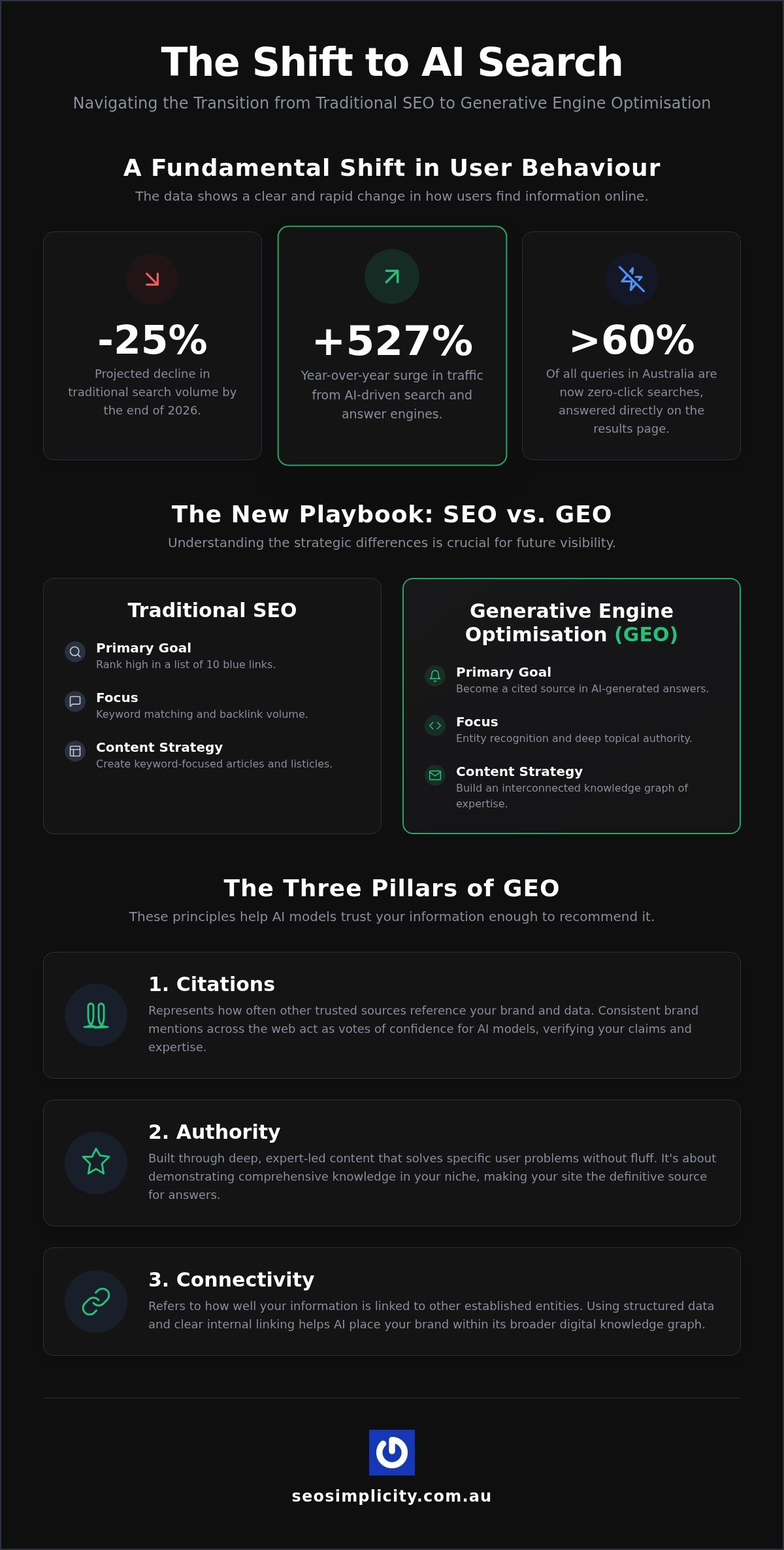
Traditional search engine volume is projected to decline by 25% by the end of 2026, while AI-driven search traffic has surged by a staggering 527% year-over-year. You’ve likely noticed your organic click-through rates softening as Google’s AI Overviews and platforms like ChatGPT provide direct answers before a user even considers clicking a link. It’s a shift that feels both rapid and slightly unsettling for any business owner used to the old rules of the game. By focusing on ai search optimisation now, you can turn this disruption into a competitive advantage that secures your brand’s visibility.
We understand the pressure to adapt when the digital landscape moves so quickly. This guide helps you master the transition from traditional rankings to generative discovery so you can stay ahead of the curve. You’ll learn how to restructure your content for maximum visibility, moving beyond simple keywords to become a highly citable authority that AI engines trust. We’ll show you exactly how to organise your digital assets to future-proof your strategy and ensure your business remains the first choice in a post-link era.
Key Takeaways
- Recognise the shift from traditional search engines to “answer engines” and learn how this evolution impacts your digital visibility.
- Uncover the three pillars of Generative Engine Optimisation to help your business secure more mentions in AI Overviews and ChatGPT responses.
- Transition your content from keyword-focused lists to entity-based knowledge that builds deep topical authority for your brand.
- Implement a practical framework for ai search optimisation by prioritising technical crawlability and advanced Schema Markup.
- Future-proof your marketing strategy by aligning your monthly SEO management with the rapidly changing generative technology landscape of 2026.
Beyond the Search Bar: Why AI Search Optimisation is Non-Negotiable in 2026
Search is no longer a simple list of ten blue links. It’s a conversation. As traditional search engine volume is projected to decline by 25% by the end of 2026, the way Aussie consumers find your business is undergoing a fundamental shift. We’re seeing a transition from search engines to “answer engines,” where platforms provide direct solutions instead of sending users to a website. This change impacts your bottom line directly. If your brand isn’t the one being cited in these generative responses, you effectively cease to exist for a massive segment of your market.
Relying on traditional ranking factors like backlink counts and keyword density is no longer enough to guarantee visibility. While these still matter, they don’t address how Large Language Models (LLMs) synthesise information. To remain relevant, you must embrace ai search optimisation. This discipline focuses on becoming a trusted entity within an AI’s knowledge graph, ensuring your brand is the preferred recommendation when a user asks a complex question. By aligning your content with how AI processes information, you unlock a new stream of high-intent traffic that bypasses the traditional search bar entirely.
The Rise of Generative Search in Australia
National Australian brands are navigating a landscape where zero-click searches now exceed 60% of all queries. Aussie consumers increasingly turn to ChatGPT, Gemini, and Perplexity to help with daily decision-making, from choosing a service provider to researching complex products. When an AI Overview appears at the top of a search page, it captures the user’s attention immediately, often satisfying their intent without a single click to an external site. Waiting to adapt to this “answer-first” world is a risk your business cannot afford. Implementing ai search optimisation now ensures you’re part of the answer rather than a casualty of the shift.
Defining the New Search Landscape
Understanding the difference between a query and a conversation is the first step toward mastery. Traditional search relies on index-based keyword matching, but LLMs operate through semantic intent and entity recognition. They don’t just look for words; they look for relationships between concepts. This shift means your content strategy must evolve from targeting isolated phrases to building deep topical authority. When you structure your data to define your business entities clearly, you make it easier for AI models to verify your expertise and mention your brand with confidence. This systematic approach transforms your digital presence into a citable resource that AI models can’t ignore.
Generative Engine Optimisation (GEO) Explained
Generative Engine Optimisation, or GEO, is the systematic process of making your content both accessible and authoritative for AI models. While traditional SEO focuses on satisfying an algorithm, ai search optimisation focuses on satisfying a Large Language Model (LLM). In this new environment, being a cited source is the new ranking on page one. If ChatGPT or an AI Overview doesn’t mention your brand, you effectively lose that visibility. GEO ensures that your information is structured in a way that AI engines can’t help but recommend it.
The three pillars of GEO are Citations, Authority, and Connectivity. Citations represent how often other trusted sources reference your data. Authority is built through deep, expert-led content that solves specific user problems without fluff. Connectivity refers to how well your information is linked to other established entities in the digital knowledge graph. Together, these pillars help LLMs trust your information enough to recommend it to users as a definitive answer, rather than just another link in a list.
How AI Models ‘Choose’ Their Sources
AI models often use a process called Retrieval-Augmented Generation (RAG) to provide accurate answers. Instead of relying solely on their training data, they retrieve real-time information from the web to ground their responses. Technical clarity is the foundation of ai search optimisation because it ensures these models can easily parse and understand your content. GEO is the strategic alignment of content with LLM retrieval patterns.
The Importance of Brand Citations
LLMs use external validation to verify your business’s claims. They look for consistent brand mentions across the web, which act as a vote of confidence for the AI model. This is where the connection between technical SEO and AI crawlability becomes critical. By auditing your digital footprint, you can identify gaps where your brand presence is weak or inconsistent. Consistent citations ensure that when an AI model looks for a reliable partner in your industry, your business stands out as the logical choice.
SEO vs GEO: Comparing Traditional and AI Search Strategies
Don’t fall into the trap of viewing SEO and GEO as competing disciplines. They are two sides of the same coin, working together to ensure your brand remains visible across every stage of the user journey. While traditional SEO helps you climb the rankings for specific queries, ai search optimisation ensures your business is the one the AI chooses to recommend when those queries become conversations. Mastering both allows you to capture traffic from traditional searchers while securing your place in generative answers.
The core shift involves moving from keyword-focused content to entity-focused knowledge. Traditional SEO often prioritises matching specific phrases to search intent, but AI models look for “entities”, which are distinct, well-defined concepts like your brand, your specific services, and your unique expertise. This is why our on-page SEO services now place a heavy emphasis on structured data. By using Schema Markup to define these entities, you provide the technical proof that LLMs need to verify your business’s relevance. We’re moving from a world where backlinks provided raw power to one where citations provide essential proof of authority.
Key Differences in Ranking Factors
Traditional ranking relies on backlinks, keyword density, and site speed to signal quality. In contrast, AI search prioritises citations, statistical relevance, and a conversational tone that matches how people actually speak to their devices. The goal has shifted from simply earning clicks to securing mentions and recommendations. When an AI synthesises a response, it doesn’t just look for the most popular page; it looks for the most citable source that fits the context of the user’s specific problem.
The Role of E-E-A-T in 2026
Experience, Expertise, Authoritativeness, and Trustworthiness (E-E-A-T) are more critical than ever. To an AI that doesn’t read like a human, authority is proven through consistent, high-quality data points across the web. You can use strategic content creation to build a moat around your brand by publishing original research, case studies, and expert insights that are difficult for competitors to replicate. This systematic approach to ai search optimisation transforms your website from a collection of pages into a definitive knowledge base that AI models trust and recommend.
A Practical Framework for AI Search Optimisation
Transitioning your strategy to meet the demands of generative search requires a methodical approach. You cannot simply hope that an LLM finds your content; you must actively engineer your digital presence to be discoverable. Follow this five-step framework to ensure your brand becomes a preferred source for AI answers.
- Step 1: Audit your technical foundation. Ensure your site is easily accessible to AI agents by removing crawl blocks and streamlining your site architecture.
- Step 2: Implement advanced Schema Markup. Use JSON-LD to define your business entities, services, and relationships clearly, giving AI models the structured data they need to verify your expertise.
- Step 3: Optimise for conversational intent. Structure your content to answer the specific “how” and “why” questions your customers are asking.
- Step 4: Build a citation network. Secure mentions across high-authority Aussie directories and industry platforms to provide the external validation AI engines require.
- Step 5: Monitor your “share of model.” Use emerging AI rank tracking tools to see how often your brand is recommended compared to your competitors.
Taking these steps puts you in control of your brand narrative in an automated world. If you’re ready to start this process, you can book a technical audit to identify exactly where your AI-readiness gaps currently sit.
Optimising for Conversational Queries
Modern users don’t just type keywords; they ask full questions. Moving beyond head terms allows you to capture the nuance of natural language. You can unlock generative search visibility by structuring your content in a clear Q&A format. This mirrors the response patterns of AI Overviews and ChatGPT, making it easier for these systems to extract your expert advice as a direct answer. When you provide concise, factual responses to complex user needs, you position your brand as a helpful and reliable guide.
Technical Enhancements for AI Discovery
Technical SEO is the silent engine of ai search optimisation. A clean sitemap and a well-configured robots.txt file are essential for guiding AI agents to your most valuable information. These agents rely on speed and clarity to build their knowledge bases. By ensuring your site’s knowledge is structured for easy extraction by Retrieval-Augmented Generation (RAG) systems, you increase the likelihood of being cited. High-quality JSON-LD schema acts as a roadmap, helping AI models understand the deep relationships between your services and your professional authority.
Scaling Your Strategy with SEO Simplicity’s AI-Ready Retainers
We integrate ai search optimisation into our core monthly SEO management to ensure your brand remains visible as the digital landscape shifts. Our approach moves beyond basic keyword tracking to focus on how generative engines perceive and recommend your business. By bakeing AI-ready strategies into your ongoing growth plan, we help you maintain a competitive edge without the stress of managing rapid technological changes yourself. We act as your strategic partner, handling the heavy lifting so you can focus on running your business.
A technical audit serves as your diagnostic baseline for this transition. It allows us to identify specific “AI-readiness” gaps that might prevent Large Language Models from crawling or trusting your data. Once we’ve secured your foundation, we transform your brand into a national authority through systematic link building and expert-led content creation. This methodical progression ensures that your business doesn’t just rank on a page; it becomes an essential part of the AI’s knowledge base. A partnership with SEO Simplicity ensures you stay ahead of the next search shake-up by aligning your digital assets with the future of discovery.
Our Methodical Approach to Growth
Moving from initial technical audits to ongoing authority building requires a disciplined, long-term perspective. We track and report on your visibility across both traditional Google results and emerging AI models, giving you a complete picture of your digital footprint. Our personalised consultations allow us to align your ai search optimisation efforts with your specific commercial goals. This transparent process ensures every piece of content we create and every technical adjustment we make serves a clear purpose for your brand’s growth.
Unlocking Future Visibility Today
Working with a dedicated ally who has already mastered the shift to generative search gives you an immediate advantage. Our “You-focused” strategy puts your brand at the centre of the conversation, making you the preferred recommendation for users across Australia. We focus on unlocking new growth opportunities by enhancing your citable authority and transforming your site into a structured resource that AI engines love. Ready to future-proof your digital presence? Enhance your search visibility with SEO Simplicity’s monthly retainers and secure your place in the 2026 search landscape.
Secure Your Place in the Future of Discovery
Establishing your business as a trusted entity within a generative knowledge graph is the most effective way to protect your long-term visibility. By prioritising citable authority and precise technical foundations today, you ensure your brand remains the preferred recommendation for AI models and Australian consumers alike. We’ve explored how ai search optimisation transforms your digital presence from a collection of links into a definitive source of truth. This shift requires a strategic move toward entity-based knowledge and structured data that traditional methods often overlook.
You don’t have to navigate this technological transition alone. Our specialised 2026 AI search strategy and authoritative technical SEO audits provide the clear roadmap you need to maintain national visibility. We’ve already done the heavy lifting to understand how LLMs retrieve information, allowing us to implement frameworks that protect your traffic and enhance your reputation. Unlock your brand’s potential with SEO Simplicity’s national optimisation services. The future of search belongs to those who adapt early. We’re here to help you turn these changes into your greatest growth opportunities.
Frequently Asked Questions
What is the difference between SEO and AI search optimisation?
Traditional SEO focuses on improving your website’s visibility within index-based search results like Google’s blue links. In contrast, ai search optimisation involves structuring your information so Large Language Models can easily retrieve and synthesise it into direct answers. While SEO targets keyword-based queries, AI-focused strategies prioritise becoming a trusted entity within a knowledge graph. Both work together to ensure your brand is found wherever a user begins their search journey.
How do I get my business mentioned in ChatGPT’s search results?
Securing mentions in ChatGPT requires a combination of technical clarity and high-authority brand citations. You must implement advanced Schema Markup to define your business entities and publish expert-led content that answers conversational questions. Since ChatGPT often uses Retrieval-Augmented Generation (RAG) to find real-time data, having a clean sitemap and strong external validation from reputable Aussie platforms is essential. This ensures the model trusts your information enough to recommend it as a definitive solution.
Will AI search optimisation help my traditional Google rankings?
Yes, these strategies are highly complementary because they both prioritise high-quality, authoritative content. When you optimise for AI, you’re naturally improving your site’s E-E-A-T (Experience, Expertise, Authoritativeness, and Trustworthiness), which remains a core ranking factor for Google’s traditional algorithm. Structuring your data for AI models also improves your chances of appearing in featured snippets and traditional rich results. It’s a win-win approach that strengthens your overall digital presence.
Is GEO (Generative Engine Optimisation) a replacement for SEO?
GEO is an evolution of traditional SEO rather than a replacement. It extends your existing search strategy to include the specific retrieval patterns used by generative engines. While you still need to maintain technical health and build quality links, GEO adds a layer of semantic intent and entity recognition. You don’t need to choose between them; instead, you should integrate both to capture traffic from traditional searchers and those using AI-powered answer engines.
How much does AI search optimisation cost for an Australian business?
The cost of ai search optimisation depends on the scope of your project and the complexity of your technical requirements. We typically deliver these services through our fixed-price technical audits or ongoing monthly SEO management retainers. These retainers cover everything from authority-building content creation to the implementation of advanced Schema Markup. Because every national brand has different needs, we recommend a personalised consultation to determine the level of support required to achieve your visibility goals.
What happens if my brand isn’t being cited by AI models?
Failing to secure AI citations can lead to a significant decline in organic discovery, especially as zero-click searches now exceed 60% of all queries. If your competitors are being cited as the preferred solution in AI Overviews or ChatGPT, your brand effectively loses that high-intent traffic. This gap can result in lower lead volume and a weakened digital reputation. Proactively adapting your strategy ensures you remain part of the conversation as user behaviour shifts toward generative search.
Can I track my rankings in AI search engines like Gemini and Perplexity?
Tracking your performance in AI search engines requires a shift from traditional keyword positions to “share of model” metrics. Modern tools allow us to monitor how often your brand appears in generative answers compared to your direct competitors. We include this data in our monthly reporting to give you a clear view of your visibility across the 2026 search landscape. This systematic tracking helps you understand which content is resonating with LLMs and where further optimisation is needed.
Do I need a technical audit before starting AI search optimisation?
A comprehensive technical audit is the essential first step for any AI-readiness strategy. You cannot build authority on a foundation that AI agents can’t crawl or understand. An audit identifies critical issues like sitemap errors, robots.txt blocks, and missing structured data that might prevent an LLM from verifying your business information. Once these technical hurdles are cleared, you can move forward with confidence, knowing your site is fully optimised for extraction by generative engines.