Did you know that 46% of all Google searches now have local intent, yet many Australian businesses still treat their online listing like a static digital business card? It’s frustrating to watch competitors secure the top spots while your own profile feels invisible, especially when you’re already stretched thin managing your daily operations. You probably recognise that a strong local presence is essential, but the constant shift in Google’s requirements can make the process feel like a moving target.
We’re here to clear the confusion and help you take control of your digital storefront. In this guide to Google Business Profile Optimisation: 12 Steps to Rank in the Map Pack, you’ll learn how to transform your listing into a high-performing asset that drives consistent phone calls and enquiries. We’ve done the heavy lifting to simplify the latest 2026 updates, including the transition to AI-powered ‘Ask Maps’ features and stricter video verification protocols. This article outlines the specific actions required to enhance your prominence, unlock better visibility, and ensure your business remains the first choice for local customers in an increasingly crowded marketplace.
Key Takeaways
- Master the essential roadmap with Google Business Profile Optimisation: 12 Steps to Rank in the Map Pack to ensure your business remains visible to local customers.
- Learn how to claim your profile and select your primary category with surgical precision to signal your relevance directly to Google’s ranking algorithm.
- Discover how to align your content with the 2026 AI-driven landscape, ensuring Google’s Large Language Models interpret your customer reviews and posts with positive sentiment.
- Understand the critical role of review velocity and why maintaining a consistent flow of feedback is more impactful than just having a high total count.
- Realise how a managed local SEO strategy transforms your profile from a static listing into a dynamic lead-generation tool that dominates the Map Pack long-term.
Google Business Profile Optimisation: Why is it Vital?
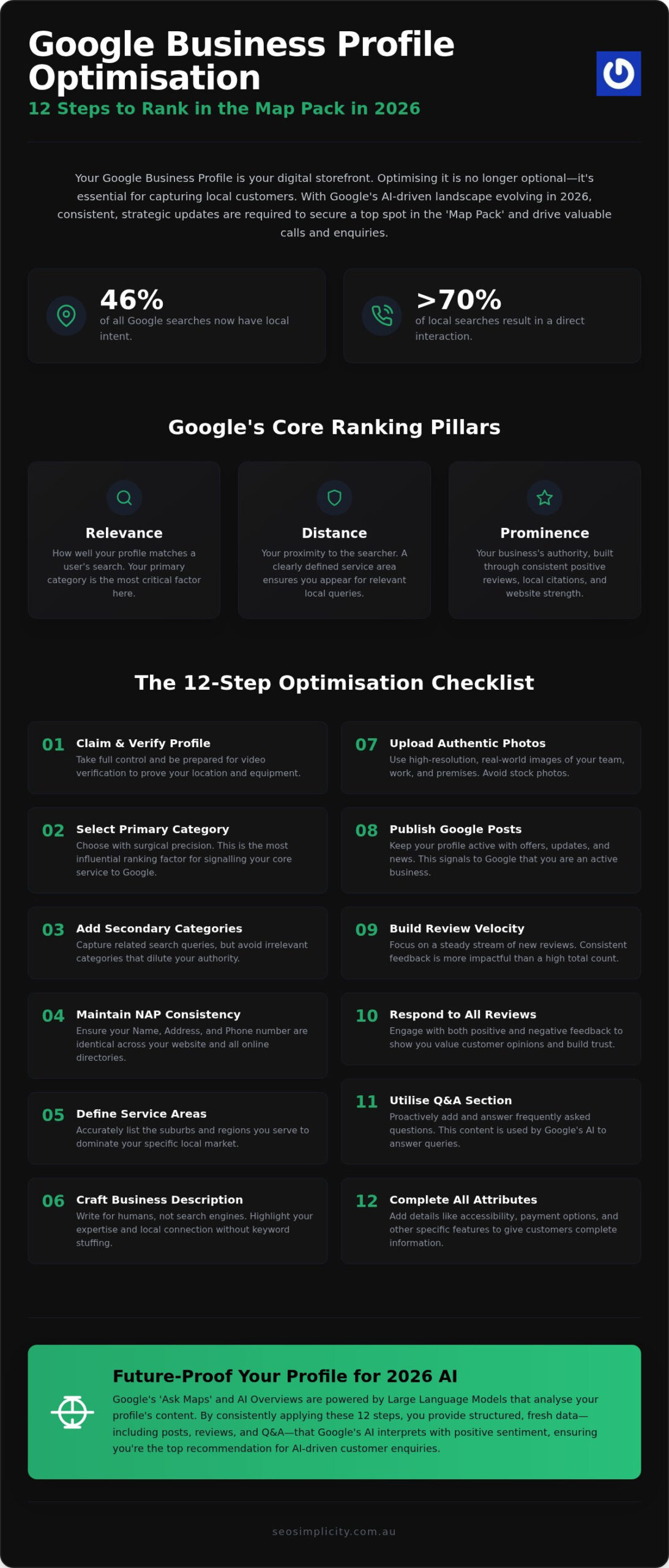
Your Google Business Profile (GBP) acts as the modern front door to your business. It is the single most influential factor in local search engine optimization, determining whether your brand appears when customers are ready to buy. In 2026, visibility is defined by the ‘Map Pack’, the prestigious trio of local results that appears at the top of the search page. Because over 70% of local searches result in a direct interaction with a profile, failing to secure a spot here means you’re essentially handing leads to your competitors. Mastering Google Business Profile Optimisation: 12 Steps to Rank in the Map Pack is no longer a luxury; it’s a fundamental requirement for commercial growth.
Optimisation isn’t a one-off task you can tick off a list. It’s an ongoing process of feeding Google’s algorithm fresh, accurate data. Research shows a measurable drop in visibility for profiles that go 30 days or more without an update. By consistently adding photos, responding to reviews, and publishing posts, you signal to Google that your business is active and reliable. This active management directly correlates with higher rankings for ‘near me’ searches, which carry the highest conversion intent in the digital marketplace.
The Shift from Search to Discovery in 2026
Google has evolved from a simple list of links into a discovery engine. Your GBP data now powers AI Overviews and the new ‘Ask Maps’ feature, where the Gemini AI answers customer questions in real-time. If your profile is static, you’ll lose out to more dynamic competitors. Google’s AI prioritises businesses that provide structured, fresh information it can easily interpret. User interaction signals, such as how often people click your ‘call’ button or request directions, now play a massive role in maintaining your position. You need to create a profile that doesn’t just sit there, but actively invites engagement.
Understanding the Core Ranking Factors
To dominate the Map Pack, you must satisfy three core pillars. First is Relevance, which measures how well your profile matches what the user is actually looking for. This is why choosing the correct primary category is vital. Second is Distance. While you can’t ‘hack’ your physical proximity to a searcher, you can ensure your service area is clearly defined. Finally, there’s Prominence. This is a reflection of your business’s authority across the web, built through high-quality reviews, local citations, and a strong website. When these three factors align, Google gains the confidence to recommend your business above all others.
The 12-Step Checklist to Conquer the Map Pack in 2026
Claim and verify your profile to take full control of your digital presence. Google now frequently requires video verification to confirm your physical location and access to equipment, so be prepared to show your workspace in action. Once verified, craft a business description that speaks to humans first, highlighting your expertise and local roots without overstuffing keywords. This description should be part of your broader Marketing plan to ensure a cohesive brand voice across all channels. You must also maintain absolute NAP (Name, Address, Phone) consistency across the entire web to prevent confusing search engines. Following the Google Business Profile Optimisation: 12 Steps to Rank in the Map Pack framework ensures your foundation is built for long-term growth.
Phase 1: The Technical Foundation
Select your Primary Category with surgical precision to signal your core service to Google. Your Primary Category is the single most influential on-page factor for local rankings. Complement this with secondary categories to capture related search intent, but avoid adding irrelevant ones that might dilute your authority. Finally, define your service areas accurately. It is better to be a dominant force in a specific area than to over-extend your reach and lose relevance in your home suburb.
Phase 2: Content and Engagement
Upload high-resolution, real-world photos of your team, premises, and completed projects. Avoid stock imagery, as Google’s AI now prioritises authentic visual content to verify your business’s legitimacy. Treat Google Posts like a mini-social media feed to keep your profile active and informative. This is vital because the ‘Ask Maps’ feature now crawls your posts and Q&A sections to answer customer questions directly via AI. Use attributes to define your unique selling points, such as ‘locally owned’ or ‘onsite services’, to help searchers find exactly what they need.
Phase 3: Authority and Conversion
Focus on review velocity rather than just the total number of stars. A steady flow of fresh reviews signals to Google that you’re a thriving, active business that customers trust today. Respond to every review, even the difficult ones, to show you value customer feedback and professional engagement. Set up messaging to capture leads instantly and optimise your service menu with clear descriptions and transparent pricing. Finally, link your profile to a high-performing landing page to convert visitors into customers. If you’re unsure how your online presence stacks up, a website audit can help you identify exactly where to focus your efforts for maximum impact.
Advanced Strategies: Leveraging GEO and AI Overviews
Generative Engine Optimisation (GEO) represents the next frontier for local businesses wanting to stay ahead of the curve. It shifts the focus from simple keyword matching to establishing your business as an authoritative entity that AI can confidently recommend. Google’s Large Language Models (LLMs) now scan your reviews, posts, and even unstructured citations, such as brand mentions on local news sites or community blogs, to determine your ‘sentiment’ and reliability. By using the ‘Products’ feature to detail your core offerings, you build entity authority that helps Google understand the specific services you provide. This level of detail is a critical component of Google Business Profile Optimisation: 12 Steps to Rank in the Map Pack because it provides the structured data AI needs to feature you in high-intent search results.
Feeding the AI: Keywords in Reviews and Posts
AI Overviews now appear in roughly 20% of Google searches, often synthesising profile data to provide ‘Best of’ recommendations for local users. To capture this visibility, you must prioritise semantic richness in your updates and customer interactions. Encourage your customers to mention specific services in their feedback rather than just leaving a generic star rating. When a review mentions a “prompt emergency repair” or “professional installation service,” it provides the specific context LLMs look for when generating answers. These rich signals help your business stand out as a specialist, increasing the likelihood of being cited as a source in AI-generated summaries.
Technical Alignment with Your Website
Your profile cannot exist in a vacuum; it must work in tandem with your website to confirm your authority. Implementing Local Schema ensures your GBP and site ‘talk’ to each other, reinforcing your location, hours, and service data across the web. You can further strengthen this connection by using internal links within your profile that point to specific on page seo services pages on your site. This creates a logical journey for both bots and humans, showing Google that your digital presence is organised and professional. Because Map Pack interactions often lead to mobile clicks, ensure your landing pages are fast and easy to use. A seamless mobile experience prevents potential leads from bouncing back to the search results after they’ve found you on the map.
Troubleshooting Your Ranking: Why You Aren’t Appearing in the Top 3
It is a common frustration for many business owners. You have applied the Google Business Profile Optimisation: 12 Steps to Rank in the Map Pack framework, yet your competitor still sits comfortably in the top spot. Often, the missing link is ‘Review Velocity’. Google doesn’t just look at your total star count; it prioritises businesses that receive a steady, fresh stream of feedback. If a competitor receives five reviews a week while you receive only one a month, their profile signals higher current relevance to the algorithm. Additionally, an underlying technical seo issue on your main website, such as slow loading speeds or broken schema, can actively drag down your map visibility by reducing Google’s trust in your digital entity.
Stay vigilant against competitors using ‘Black Hat’ tactics, such as stuffing their business name with keywords or using fake ‘ghost’ addresses to manipulate proximity. While it is tempting to copy these shortcuts, they eventually lead to hard suspensions that can take months to resolve. Instead, use the Business Redressal Complaint Form to report these violations. This maintains the integrity of the local search space while clearing the path for your legitimate, well-optimised profile to rise naturally.
The Proximity Paradox
Google prioritises the ‘centring’ effect, which heavily favours businesses closest to the searcher’s physical GPS point. This makes ranking in adjacent suburbs challenging if you don’t have a physical premises there. To expand your geographic reach, focus on building high-quality ‘Local Citations’ by ensuring your brand is mentioned on reputable Australian directories and industry-specific sites. This signals to Google that your authority extends beyond your immediate doorstep, helping you capture leads from surrounding areas without the need for multiple physical offices.
Suspensions and Quality Issues
Understanding the difference between a ‘soft’ and ‘hard’ suspension is vital for a quick recovery. A soft suspension allows your profile to remain visible to the public but prevents you from making updates; a hard suspension removes your business from Maps entirely. If you’ve recently moved premises, perform a thorough ‘clean up’ of your data across all digital platforms to avoid confusing the algorithm with conflicting addresses. Managing duplicate listings is equally important, as they cannibalise your authority and dilute your ranking power. To ensure your digital foundation is supporting your local growth, consider a comprehensive SEO audit to identify and fix these hidden roadblocks.
Managed Local SEO: How Professional Partnership Drives Growth
Achieving a top position in the Map Pack is a significant milestone, but maintaining that visibility requires a long-term commitment. Think of Google Business Profile Optimisation: 12 Steps to Rank in the Map Pack as your initial roadmap; however, local search is a marathon rather than a sprint. Algorithm updates, new competitor entries, and shifting consumer behaviours mean your profile needs constant refinement to stay relevant. Partnering with a specialist for local seo services provides the consistent oversight needed to protect your rankings and ensure your business remains the first choice for local customers. This strategic partnership transforms your profile from a static listing into a dynamic lead-generation engine that grows alongside your brand.
Professional management also unlocks the synergy between your profile, your website’s content, and your broader authority across the web. While a DIY approach might focus solely on the profile itself, an expert looks at the bigger picture. We ensure your GBP updates align with your link-building efforts and overall digital presence. This holistic view prevents silos and ensures every action you take contributes to a stronger, more trustworthy online identity that Google feels confident recommending to its users.
What an Agency Does Differently
Specialists use advanced tools that go far beyond the basic insights provided in the Google dashboard. We employ heat-map tracking to visualise exactly where your business ranks on a street-by-street level, allowing us to identify specific geographic gaps in your visibility. This data informs a precise competitive gap analysis, revealing exactly what the top three results are doing to outpace you. By integrating these insights with a comprehensive seo content creation plan, we ensure your business doesn’t just show up, but provides the most helpful and semantically rich answers to local queries.
Your Next Steps to Map Pack Dominance
Your journey toward local dominance begins with a clear understanding of your current performance. Conduct an initial audit to identify technical errors or missing information that could be holding you back. From there, set realistic KPIs focused on tangible growth, such as an increase in direct phone calls, direction requests, and website clicks. This data-driven approach allows you to measure the direct impact of your optimisation efforts on your bottom line. If you’re ready to stop guessing and start climbing the rankings, organise a consultation with SEO Simplicity today to secure your place at the top of the Map Pack.
Secure Your Future in the Map Pack
Mastering your local presence requires moving beyond a ‘set and forget’ mentality. You’ve realised how Google’s 2026 updates prioritise active profiles that feed AI models with fresh, semantically rich data. By implementing the strategies within Google Business Profile Optimisation: 12 Steps to Rank in the Map Pack, you establish a resilient foundation that turns searchers into loyal customers. Dominating the Map Pack is about more than just visibility; it’s about building a trustworthy digital entity that resonates with both algorithms and your local community. Whether you’re refining your primary categories or navigating the complexities of AI Overviews, the path to growth is paved with consistent, strategic action.
If you’re ready to bypass the trial and error of DIY management, our team provides an expert Australian-based SEO strategy backed by comprehensive technical and local audits. We focus on transparent reporting and proven growth frameworks to ensure your brand stands out where it matters most. Unlock your business’s potential with professional Local SEO Management and start transforming your digital footprint today. Your future customers are already searching for you; let’s ensure they find you first.
Frequently Asked Questions
How long does it take to rank in the Map Pack after optimisation?
You can expect to see initial movement within four to twelve weeks after implementing a comprehensive strategy. While some technical updates reflect quickly, building the necessary prominence and review velocity takes time. High-competition sectors often require a longer lead time to displace established competitors. Consistency is key; profiles that receive regular updates and fresh reviews tend to climb the rankings faster than those that remain static after an initial setup.
Does having a physical office address matter for Google Maps?
Proximity is a fundamental ranking factor, so a physical presence within your target area is highly beneficial. If you operate as a Service Area Business without a public storefront, you can still rank by correctly defining your service zones. However, you must have a verified physical address to register the profile. Google uses this data to ensure your business is a legitimate local entity before displaying it in the Map Pack.
Can I rank in the Map Pack without a website?
It is possible to appear in the Map Pack without a website, but it significantly limits your growth potential. Google’s AI models cross-reference your profile data with your site’s content to verify your expertise and relevance. Without a website, you lose the ability to use local schema and internal linking, which are vital components of Google Business Profile Optimisation: 12 Steps to Rank in the Map Pack for long-term dominance.
What is the difference between a Google Business Profile and Local SEO?
A Google Business Profile is a specific tool, whereas Local SEO is the entire strategy used to improve your visibility. Think of your profile as your digital front door and Local SEO as the road that leads customers to it. A complete strategy includes technical audits, on-page optimisation, and building local citations across the web to reinforce the authority and geographic relevance of your business to search engines.
How do I remove a fake or negative review from my profile?
You cannot manually delete reviews, but you can flag those that violate Google’s 2026 updated policies. This includes spam, fake content, or reviews from people who haven’t actually used your services. If a review is negative but legitimate, your best approach is to respond professionally and helpfully. This demonstrates transparency and reliability to other potential customers who are researching your brand before making a call.
Is Google Business Profile free for all Australian businesses?
Claiming and managing a Google Business Profile is entirely free for all legitimate Australian businesses. Google does not charge a subscription fee for the listing itself. The investment involved typically relates to professional local SEO services, where specialists manage your content, reporting, and link building to ensure you maintain a competitive edge. This helps you stay ahead of algorithm updates and competitors who are actively vying for the top spots.
What happens if my business has multiple locations?
Each physical location requires its own unique profile to appear correctly in local results. You should manage these through a single dashboard but ensure each listing has a unique phone number and location-specific photos. Linking each profile to a dedicated landing page on your website helps Google understand the distinct service areas for each branch, preventing your locations from cannibalising each other’s search authority and ranking power.
How often should I post updates to my Google Business Profile?
Aim to post at least once a week to maintain a high freshness signal. Google’s latest algorithm shows a measurable drop in visibility for profiles that remain inactive for more than 30 days. Using Google Business Profile Optimisation: 12 Steps to Rank in the Map Pack as your guide, you can share project photos, service updates, or helpful tips. Regular activity keeps your profile engaging for customers and signals to Google that your business is thriving.