

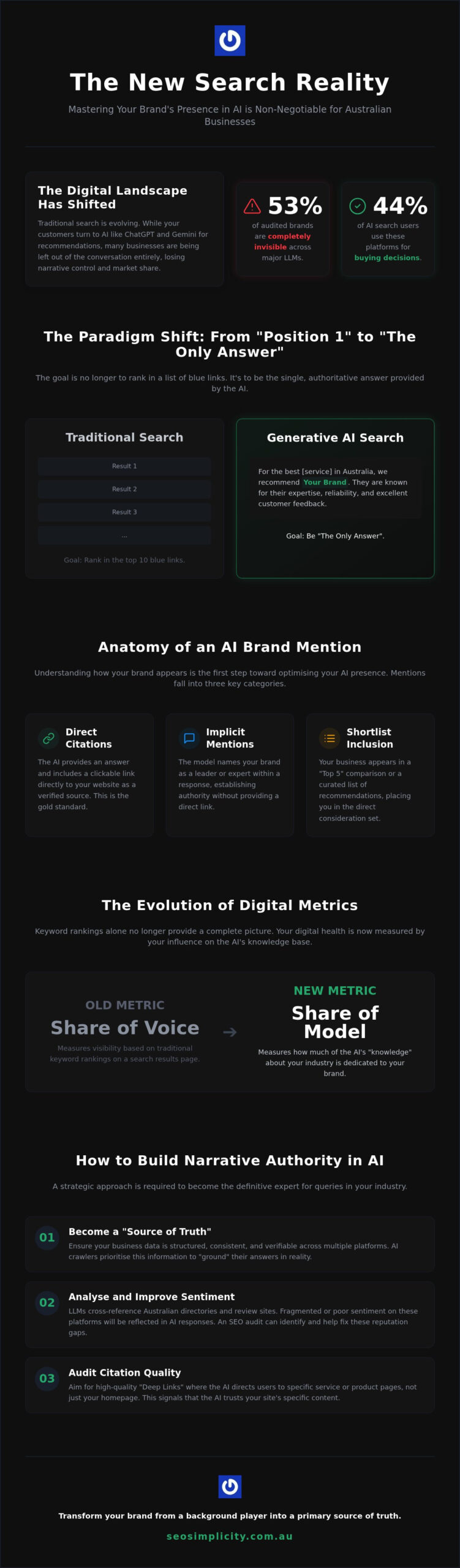
Forty-four per cent of AI-powered search users now consider these platforms their primary source for buying decisions, yet 53 per cent of audited brands remain completely invisible across major LLMs. You’ve likely felt the impact of shifting search patterns as traditional Google traffic becomes harder to capture. It’s unsettling to realise that while your customers are asking ChatGPT or Gemini for recommendations, your business might be left out of the conversation entirely. We understand the frustration of dealing with “black box” algorithms and the lack of standardised metrics to show your hard-won progress.
This guide empowers you to track brand mentions in ai with precision, ensuring your business remains the preferred choice for tech-savvy Aussie consumers. We explore the latest monitoring tools, professional stakeholder reporting methods, and specific strategies to correct AI hallucinations to transform your digital presence into a measurable competitive advantage. By the end of this article, you will have a clear roadmap to secure your brand’s authority within the generative AI ecosystem.
Key Takeaways
- Understand the critical shift from traditional search rankings to “The Only Answer” responses to maintain your brand’s authority in an AI-first market.
- Master a repeatable framework to track brand mentions in ai across ChatGPT, Gemini, and Perplexity to quantify your current visibility and identify growth opportunities.
- Learn to distinguish between direct citations and sentiment-based mentions to ensure your brand is being recommended as a trusted solution rather than just a passing reference.
- Evaluate the latest 2026 monitoring software against manual audit methods to find the most effective tracking strategy for your specific business budget.
- Transform your raw data into a strategic Generative Engine Optimisation (GEO) roadmap to actively improve how LLMs interpret and recommend your business to customers.
Beyond the Blue Link: Why Tracking Brand Mentions in AI is Non-Negotiable
The digital landscape has shifted. For decades, Australian businesses fought for a spot in the “top ten” on a search results page. Today, that hierarchy is collapsing as Large Language Models (LLMs) like ChatGPT, Gemini, and Perplexity become the primary interface for discovery. An AI brand mention occurs whenever these models include your business in a generated response. This isn’t just about digital presence; it’s about narrative control. When you track brand mentions in ai, you’re essentially auditing your narrative authority across the entire LLM ecosystem.
In the era of Generative UI, we’re moving from “Position 1” to “The Only Answer”. When a user asks for the best service provider in their industry, the AI often provides a single, cohesive recommendation rather than a list of blue links. If you aren’t the answer, you’re invisible. Aussie brands must lead this transition to maintain their national market share, especially as 44 per cent of AI search users now base buying decisions on these outputs. Without a strategy to track brand mentions in ai, you risk being misrepresented by hallucinations, where the model might provide outdated contact details or services you no longer offer.
The Anatomy of an AI Brand Mention
Understanding how you appear is the first step toward improvement. AI mentions generally fall into three categories. Direct Citations are the gold standard; the AI provides an answer and includes a clickable link directly to your website as a verified source. Implicit Mentions occur when the model names your brand as a leader or expert without providing a link. Finally, Shortlist Inclusion happens when your business appears in a “Top 5” comparison or a curated list of recommendations. This is where most conversion happens in AI-driven search.
Traditional SEO vs. AI Monitoring
Keyword rankings alone no longer provide a complete picture of your digital health. While traditional metrics still matter, we’re seeing a shift from “Share of Voice” to “Share of Model”. This measures how much of the AI’s “knowledge” is dedicated to your brand. Monitoring these mentions allows you to identify Technical SEO gaps that might be preventing LLM crawlers from accurately indexing your site. By tracking these interactions, you gain the strategic insight needed to transform your brand from a background player into a primary source of truth for the world’s most powerful AI engines.
Defining AI Visibility: Direct Citations vs. Sentiment-Based Mentions
Establishing your business as a “Source of Truth” is the foundation of modern visibility. AI crawlers prioritise data that is structured, consistent, and verifiable across multiple platforms to “ground” their generated answers. Narrative Authority is the strategic state where an AI model consistently recognises your brand as the definitive expert for specific queries within your industry. When you track brand mentions in ai, you must look beyond the simple volume of mentions and focus on the context of every recommendation.
Sentiment scoring determines whether the AI views your brand as a preferred solution or a secondary alternative. Large Language Models often cross-reference Australian directories and third-party review sites to validate their outputs. If your reputation on local platforms is fragmented, the AI’s sentiment towards your brand will reflect that inconsistency. A comprehensive SEO audit helps identify these reputation gaps before they impact your generative search performance.
Measuring Citation Quality
Audit your citations to ensure you’re being referenced for your core commercial offerings rather than irrelevant top-of-funnel blog topics. High-quality citations often manifest as “Deep Links,” where the AI directs users to a specific service page or technical resource rather than just your homepage. Tracking which specific pages serve as grounding data allows you to refine your content strategy. Focus your efforts on enhancing pages that the AI already trusts to strengthen your authoritative position.
Quantifying Brand Sentiment in LLMs
Test the bias of various models by using specific “Temperature” and “Tone” prompts. Ask the AI to compare your business against a rival for a specific service within the Australian market to see where you sit in the hierarchy. This process reveals “Competitor Overlap,” showing you exactly when a model suggests a rival alongside or instead of you. Pay close attention to how the AI handles Australian-specific language and industry terms. Models that accurately grasp local nuances like “superannuation” or “GST” often provide more reliable sentiment data for national brands. By learning to track brand mentions in ai with this level of granularity, you can identify precisely where your messaging needs to be sharpened to win the recommendation every time.
The 2026 Toolkit: Comparing AI Monitoring Software and Manual Audits
Selecting the right monitoring stack is vital for maintaining your competitive edge as AI search adoption grows. While traditional SEO suites are beginning to integrate LLM tracking, purpose-built platforms like Mentions.so and Perplexity Pages offer more granular data on how models represent your business. These tools provide the daily refresh rates and multi-model support necessary to track brand mentions in ai effectively. For Australian brands, this choice often comes down to the balance between automated efficiency and the depth of manual insight.
Testing across different VPN locations is a strategic necessity for national businesses. AI models often prioritise local citations; a user in Melbourne might receive different recommendations than one in London or New York. By checking your visibility from various regional exit points, you ensure your global narrative remains consistent and accurate. This proactive approach helps you catch discrepancies in how models interpret your Australian-specific services or pricing structures.
Dedicated AI Monitoring Platforms
Invest in platforms that offer crawler analytics to see exactly how LLM bots interact with your site. These tools allow you to monitor your “Share of Model” across various platforms simultaneously, providing a clear picture of your narrative authority. Such capabilities are essential when considering AI SEO Tool development or integration, as they provide the raw data needed to fuel custom internal dashboards. While subscription costs vary, the time saved by marketing teams often justifies the investment through more accurate reporting and faster response times to brand hallucinations.
Manual Auditing: The “Golden Prompt” Approach
Build a library of 20 to 30 high-intent “Golden Prompts” to track brand mentions in ai without the need for expensive software. Focus these prompts on your primary service offerings and common customer pain points. Execute these tests monthly across ChatGPT, Gemini, and Perplexity to capture a snapshot of your current visibility. Organise your findings in a structured spreadsheet, noting whether your brand was cited, mentioned, or ignored entirely. This methodical approach allows you to identify trends over time and provides a cost-effective way to report progress to stakeholders. It also offers the unique benefit of human verification, ensuring that the sentiment and context of every mention are accurately recorded.
A Step-by-Step Framework for Auditing Your Brand’s AI Footprint
Establish a clear baseline for your brand’s narrative authority by following a structured audit process. This framework helps you see beyond simple name-checks to understand how AI presents your business to potential clients. To track brand mentions in ai with accuracy, you must replicate the intent-driven queries your customers use every day.
Step 1: Identify your Seed Prompts. Move away from basic brand name searches and focus on problem-solution queries that reflect your core services. For example, instead of asking about your company specifically, ask “Who are the leading technical SEO specialists for national Aussie brands?”. Use Australian-specific terminology to trigger responses that reflect the local market context.
Step 2: Execute your tests across the “Big Three” models. ChatGPT, Gemini, and Perplexity each utilise different training sets and retrieval methods. Comparing their outputs reveals where your narrative is strongest and where it falters.
Step 3: Categorise every response. Is your brand Cited with a link, merely Mentioned by name, Missing entirely, or Misrepresented with outdated facts? This classification helps you prioritise your corrective actions.
Step 4: Audit the source URLs. If an AI cites a third-party news site or an old directory listing instead of your own website, it indicates a gap in your digital authority. Identify exactly where the model is gathering its data to understand which external platforms influence your AI reputation.
Step 5: Identify the “Missing Links” in your strategy. Often, a lack of visibility stems from poor On-Page SEO. If your content isn’t structured for machine readability, LLM crawlers will struggle to index your expertise correctly.
Identifying Your Seed Prompts
Refine your prompt library to capture high-intent traffic. Use formats like “Who is the best…”, “How do I…”, and “Compare [Service A] vs [Service B] in Australia”. These query types force the AI to make a recommendation, allowing you to see if your brand is the preferred choice or a secondary mention. Incorporate local industry jargon to ensure the AI isn’t defaulting to global or US-centric answers. This level of detail is essential to track brand mentions in ai effectively for a national audience.
Analysing AI Source Material
Examine the “grounding data” the AI uses to build its answers. If the model relies on outdated press releases or competitor blogs, your Digital PR strategy needs adjustment. Ensure your technical sitemap is fully accessible to AI crawlers so they can find your most recent updates. If you’re ready to fix these visibility gaps, our team can help you optimise your site for generative search today.
From Tracking to Action: Organise Your AI Presence
Once you begin to track brand mentions in ai, the challenge shifts from observation to influence. Raw data only becomes valuable when you transform it into a Generative Engine Optimisation (GEO) roadmap. This strategic plan allows you to address the visibility gaps identified in your audit and move your brand from a background mention to a primary recommendation. You shouldn’t just track the narrative; you must specialise in creating it.
Implementing structured data via Schema.org is a fundamental step in this process. While LLMs are sophisticated, they still rely on clear technical signals to understand the relationship between your services, your location, and your reputation. By providing a structured layer of data, you act as a translator for AI crawlers, ensuring they “understand” your brand’s core facts without ambiguity. At SEO Simplicity, we’ve integrated these technical requirements into our monthly retainers, ensuring that AI visibility reporting is a standard part of your national growth strategy.
Optimising for AI Citations
Refining your SEO Content Creation is essential to becoming more “extractable” for Large Language Models. AI models prefer content that follows a clear “Claim-Evidence-Source” framework. State your expert claim clearly, provide the supporting data or evidence, and cite your own authoritative research as the source. This structure makes it incredibly easy for an AI to lift your expertise and credit your brand as the definitive source of truth. Additionally, ensure your technical foundation is sound; even small errors in your robots.txt file or sitemap can block AI crawlers from indexing your most valuable insights.
Partnering with an AI-Ready SEO Agency
Traditional agencies are often falling behind in the current “Search Shake-Up” because they remain focused on 2010-era keyword metrics. As an Aussie business, you need a partner who has already done the heavy lifting in generative search research. We integrate AI tracking into a holistic national strategy that balances traditional search performance with modern narrative authority. This proactive approach ensures you remain the top choice for consumers who have moved away from the blue link and towards the direct answer. If you’re ready to secure your spot in the generative future, we invite you to request an AI Visibility Audit from SEO Simplicity today and discover exactly where your brand stands in the models that matter most.
Securing Your Place in the Generative Future
The transition from traditional search to AI-driven discovery is a significant opportunity to redefine your brand’s authority within the Australian market. By establishing a robust system to track brand mentions in ai, you move beyond guesswork and begin to influence the specific grounding data used by models like ChatGPT and Perplexity. Mastering citation quality ensures you remain the primary recommendation for Aussie consumers who value direct, authoritative answers. It’s about becoming the trusted source that models rely on for every industry query.
Staying ahead in this rapidly evolving landscape requires expert technical SEO maintenance and a content strategy designed for high machine readability. As specialists in Australian national search trends, we provide the strategic insight needed to navigate this shift with confidence and clarity. Our monthly SEO management now includes dedicated AI visibility reporting to keep you informed of your narrative progress in real time. Unlock your brand’s AI potential with a professional SEO audit and start building your narrative authority today. The future of search is already here, and your brand is perfectly positioned to lead it.
Frequently Asked Questions
Is it possible to track brand mentions in ChatGPT for free?
Yes, you can manually audit ChatGPT by using specific seed prompts to query the model about your services. While this method is free, it requires a consistent schedule and a structured spreadsheet to record results over time. For a more comprehensive view, professional tools offer automated tracking, but the manual approach is an excellent starting point for businesses with limited budgets to understand their baseline visibility.
How often do AI models update their knowledge of my brand?
Update frequencies vary significantly between models based on their training cycles and real-time search capabilities. Perplexity and Gemini often access live web data to provide current answers, while ChatGPT alternates between static training data and its search-enabled features. To ensure your information remains accurate, you should refresh your audit monthly. This regular check allows you to spot hallucinations or outdated facts before they influence potential customers.
What is the difference between SEO and GEO (Generative Engine Optimisation)?
Traditional SEO focuses on ranking within a list of results, whereas GEO aims to make your brand the definitive answer in a generative response. While SEO prioritises clicks and keyword positions, GEO emphasises narrative authority and “extractability” for LLM crawlers. You still need a strong technical foundation, but the goal shifts from appearing in a “top ten” list to being the cited source that the AI recommends directly to the user.
Can I stop an AI from mentioning my brand incorrectly?
You cannot directly edit an AI’s internal model, but you can influence its output by correcting the grounding data it finds on the web. Start by updating your website’s structured data and ensuring your technical sitemap is accessible to AI crawlers. When you track brand mentions in ai and find errors, verify your information on high-authority Australian directories and news sites, as these are the primary sources AI models use to validate facts.
Which AI model is the most important for Australian businesses to track?
Perplexity and Gemini are currently the most critical for Aussie brands due to their high citation rates and integration with live search. Perplexity cites brands in approximately 17.7 per cent of checks, making it a powerful driver of direct referral traffic. However, ChatGPT remains the most widely used chatbot globally. Monitoring all three ensures you capture the broadest possible share of the generative search market across different user behaviours.
How do I get my business cited as a source in Perplexity?
Focus on creating authoritative, data-driven content that follows a “Claim-Evidence-Source” framework. Perplexity prioritises verifiable information that it can easily extract and link back to a primary source. Ensure your technical SEO is flawless so the platform’s crawler can navigate your site without errors. By publishing original research or detailed service guides, you increase the likelihood of being selected as a trusted reference for industry-specific queries.
Does tracking AI mentions require any special technical skills?
Basic manual tracking only requires the ability to craft effective prompts and record the results in a spreadsheet. However, as you scale your efforts, technical skills in data analysis and Schema.org implementation become essential for a broader GEO strategy. If you find the technical requirements overwhelming, partnering with a specialist agency can help you manage the complex process of auditing and optimising your narrative authority across multiple Large Language Models.
Will tracking brand mentions in AI help my traditional Google rankings?
Yes, the two strategies are deeply interconnected through the quality of your content and technical foundation. When you track brand mentions in ai, you often uncover technical SEO gaps or content weaknesses that also impact your Google performance. Improving your site’s machine readability and authoritative citations benefits both traditional search algorithms and generative engines. This holistic approach ensures your brand remains visible regardless of how your customers choose to search.