
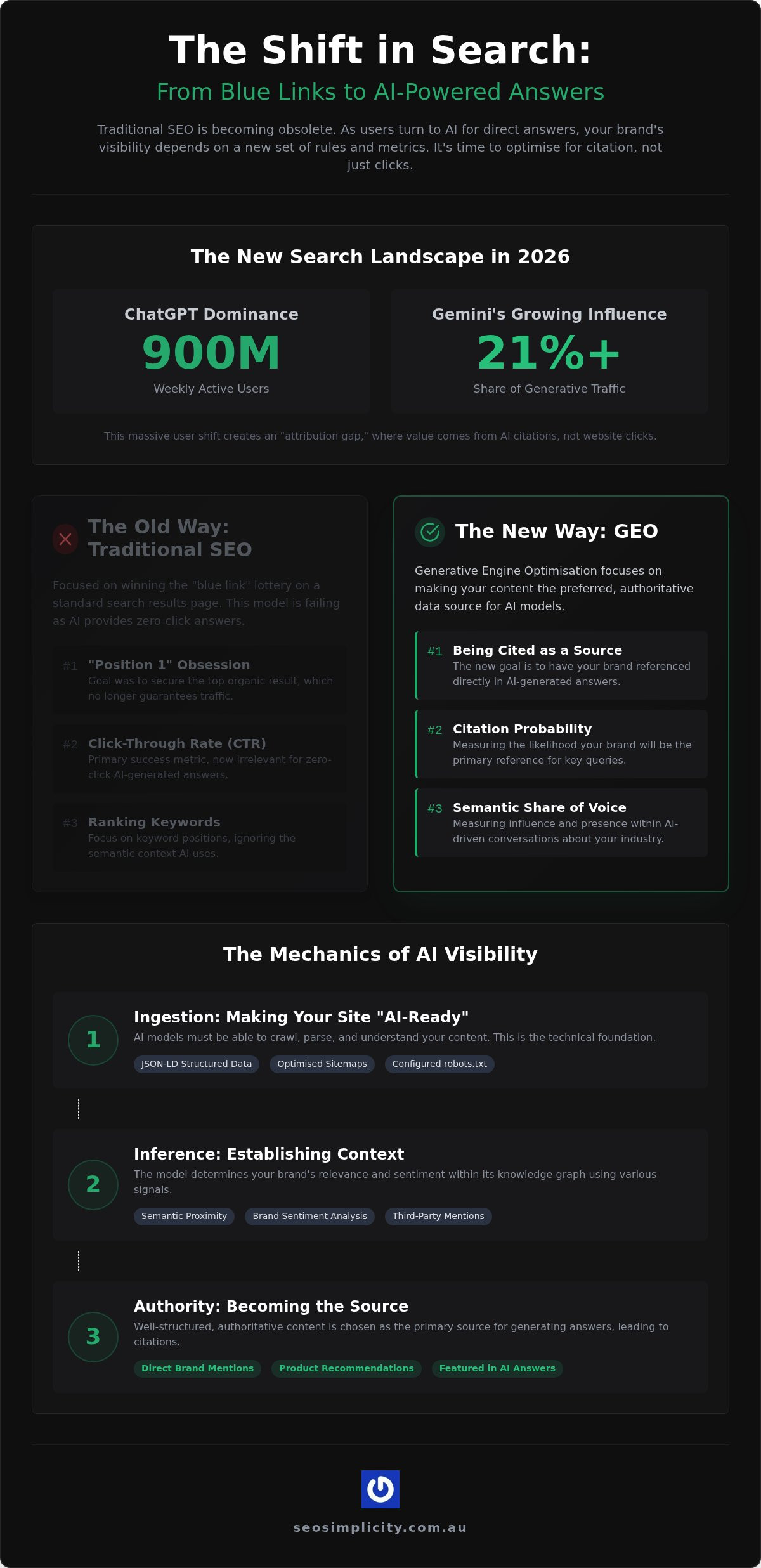
Did you know that by early 2026, ChatGPT reached 900 million weekly active users, while Gemini’s share of generative traffic climbed to over 21 per cent? It’s frustrating to hold the top spot on a standard search results page only to find that AI engines are recommending your competitors instead. You’re likely struggling to explain this “AI visibility” gap to your stakeholders without the hard metrics they expect. To solve this, you need a new generation of llm rank tracking tools that look beyond simple blue links to measure what actually matters: citation probability and semantic proximity.
You’ll discover how to track and optimise your brand’s presence across the major models using the most sophisticated technology available today. We’ll provide a clear list of platforms for monitoring brand mentions, a structured framework for reporting visibility to your board, and actionable insights to ensure your content becomes the primary source for AI-generated answers. It’s time to move past traditional tracking and start measuring your influence where the conversations are actually happening. By the end of this guide, you’ll have the clarity needed to turn AI search into a reliable growth engine for your business.
Key Takeaways
- Understand why traditional tracking is failing and bridge the “attribution gap” to capture value from zero-click AI answers.
- Master the technical SEO requirements for AI ingestion to ensure model crawlers can efficiently access and parse your most valuable content.
- Identify the essential metrics, such as Citation Probability and Recommendation Share, provided by modern llm rank tracking tools to measure your brand’s true influence.
- Evaluate the difference between SERP-based trackers and direct-API tools to build a more robust prompt library for your reporting.
- Integrate AI visibility into your monthly management strategy to transform complex data into a clear path for national growth.
From Blue Links to LLMs: Why Traditional Rank Tracking is Failing in 2026
The era of chasing the top spot in Google’s organic results is rapidly closing. While traditional SEO focused on winning the “blue link” lottery, the current environment demands a more nuanced approach. LLM rank tracking refers to the systematic process of monitoring how often your brand is mentioned, recommended, or used as a primary source within a Large Language Model (LLM) such as ChatGPT, Gemini, or Perplexity. This shift is driven by a widening “attribution gap” where traditional click-through rates (CTR) are replaced by “Zero-Click” AI answers that satisfy user intent directly. Aussie national brands must pivot their measurement strategy to focus on “Semantic Share of Voice” to remain visible in a world where AI synthesises information rather than just listing it.
The Death of the “Position 1” Obsession
Securing the first organic result no longer guarantees the traffic it once did. If an AI Overview captures the user’s intent and provides a complete answer at the top of the page, the incentive to click through to your website vanishes. Generative engines synthesise information from multiple sources to create a single, authoritative response. This means your brand could be the primary source of the data while receiving none of the direct traffic. You must move your focus from “ranking” to “being cited”. Being the trusted source that the AI references is the only way to maintain brand authority. Monitor how these models describe your services to ensure you aren’t being left out of the conversation.
The Rise of Generative Engine Optimisation (GEO)
Generative Engine Optimisation (GEO) has emerged as the strategic successor to traditional SEO. This discipline focuses on making your content the preferred data source for AI models. To succeed, you need robust llm rank tracking tools that provide the data required to refine your content for AI consumption. These tools allow you to measure “Citation Authority”, a key 2026 metric that tracks the probability of your brand being the primary reference for specific queries. By understanding which parts of your content the AI finds most valuable, you can optimise your site architecture to increase your recommendation share. Start prioritising these metrics now to protect your market share against competitors who are already mastering the AI search space.
The Mechanics of AI Visibility: Ingestion, Inference, and Authority
Understanding how an AI model perceives your brand requires a shift in how you view your website’s architecture. Unlike traditional search engines that index pages for retrieval, LLMs ingest data to build internal representations of knowledge. This makes technical SEO more critical than ever. You must ensure that AI agents can access, parse, and synthesise your content without friction. If your site’s structure is opaque, your brand effectively doesn’t exist to the model. For a deeper dive into these requirements, explore our Technical SEO 2026: Strategic Guide for Australian Brands.
Ingestion Infrastructure: Making Your Site “AI-Ready”
Ingestion Infrastructure is the technical gateway through which LLMs consume website data. To pass through this gateway, your site needs to speak the language of structured data. By 2026, Schema.org implementation has evolved from an optional extra to a mandatory requirement for LLM comprehension. You should focus on JSON-LD to provide clear entity relationships that models can easily map. Similarly, your sitemaps and robots.txt files must be specifically configured to manage high-frequency AI crawlers. These adjustments allow you to prioritise your most authoritative content, ensuring the model’s training data reflects your brand’s true value. If you need help refining these elements, a comprehensive technical SEO audit can identify hidden barriers to AI ingestion.
Semantic Context and Brand Sentiment
Once data is ingested, the model uses inference to determine where your brand fits within its knowledge graph. This is where “Semantic Proximity” becomes vital. LLMs categorise your brand based on the words, topics, and entities that frequently appear alongside your name. It isn’t just about what you say on your own site; it’s about the broader digital ecosystem. Third-party reviews, industry mentions, and social signals all feed into the model’s sentiment analysis. Modern llm rank tracking tools have adapted to this by measuring “Sentiment Score” alongside traditional visibility. Tracking this metric helps you understand if the AI views your brand as a trusted authority or a risky recommendation. High entity authority is only achieved when the model consistently finds positive, high-context mentions of your brand across multiple reputable sources.
Key Metrics Your LLM Rank Tracking Tools Must Measure
Shift your focus from static rankings to dynamic influence by adopting metrics that reflect how AI models actually synthesise information. In 2026, traditional keyword positions are secondary to your Generative Share of Voice (GSoV). This metric stands as the ultimate KPI for national brands, representing the total percentage of AI-generated answers that feature your brand across all major models. To manage this effectively, your llm rank tracking tools must provide granular data on how models perceive your authority. You need to know if you’re being recommended as a market leader or merely mentioned as an afterthought.
Two critical pillars of this new measurement framework are Citation Probability and Recommendation Share. Citation Probability measures the likelihood of your brand being the primary source for an AI answer, while Recommendation Share tracks how often you appear in “Top 10” style lists or comparative queries. Additionally, Source Attribution allows you to see exactly which pages on your site are being used as training or reference data. This insight helps you double down on the specific content structures that the machines find most valuable, ensuring your optimisation efforts are always data-driven and results-oriented.
Citation Probability and Source Linkage
Track whether the AI provides a direct link back to your site or merely mentions your name without a clickable reference. Measuring the “strength” of a citation involves analysing the prompt context to see if the model presents your brand as the definitive answer or just one of many options. Unlinked mentions in LLMs have become the new “unlinked brand mentions” of the SEO world; they represent lost traffic potential that you can reclaim through better technical alignment. By identifying these gaps, you can refine your content to encourage models to provide direct source linkage, turning a simple mention into a high-value referral.
Brand Sentiment and Association Mapping
Use specialised tools to see which keywords and concepts the AI naturally associates with your brand name. This association mapping reveals your “competitor co-occurrence,” showing you exactly which brands the AI groups you with during a user’s research phase. If the model consistently pairs your high-end service with budget competitors, you have a semantic positioning problem that needs urgent attention. Sentiment mapping allows brands to identify and correct AI-generated misconceptions in real-time by tracking the specific semantic clusters that trigger negative or inaccurate brand associations. This proactive approach ensures your brand’s reputation remains untarnished as it moves through the AI’s complex inference engine.
Evaluating LLM Rank Tracking Tools: A 2026 Buyer’s Checklist
Selecting the right technology is the foundation of a successful AI visibility strategy. As you evaluate llm rank tracking tools, it’s vital to distinguish between SERP-based trackers and Direct-LLM API trackers. SERP-based tools primarily scrape Google’s AI Overviews, which provides a useful snapshot of search-integrated AI. However, Direct-LLM trackers connect straight to the APIs of models like ChatGPT and Claude. This direct connection allows you to understand how the models themselves recommend your brand in a conversational context, independent of a search engine’s interface. Weigh the cost of specialised services against the breadth of your existing suite to determine the most efficient path forward.
Prioritise tools that offer “Prompt Library” features. Modern tracking isn’t about single keywords; it’s about the complex, multi-turn questions users actually ask. A robust library allows you to save and monitor these prompts over time, ensuring your data reflects real-world usage rather than isolated search terms. You should also look for platforms with Australian data centres. AI models frequently serve different variations of an answer based on regional context. Tracking from a local hub ensures your reports accurately reflect what your Australian customers are seeing on their screens.
Direct API Integration vs. SERP Scraping
Accuracy is the primary reason to favour API integration over traditional scraping. Tracking ChatGPT via API provides a raw look at the model’s inference without the filtering layers often applied by search engines. Some advanced platforms now utilise “Synthetic User” testing, which mimics real human interaction to see how follow-up questions impact your brand’s visibility. While scraping is often cheaper, it lacks the depth required for a true conversational strategy. For those with specific requirements, you might consider Building an AI SEO Tool or App in 2026 to create a custom tracking solution tailored to your unique business needs.
The 2026 Tool Evaluation Checklist
Use this checklist to ensure your chosen software can handle the complexities of the modern landscape:
- Multi-Model Coverage: Does the tool track citations across ChatGPT, Claude, Gemini, and Perplexity simultaneously?
- Natural Language Processing: Can it handle long-form “Natural Language Prompts” instead of just static keywords?
- Historical Analysis: Does it provide a clear view of AI model updates and how they have shifted your brand’s recommendation share over time?
- Cost Efficiency: Does the pricing model, such as the $99 monthly add-on for the Semrush AI Visibility Toolkit or the specialised plans from providers like AIclicks, align with your reporting requirements?
Secure your brand’s future by investing in a comprehensive technical SEO audit to identify which tools and optimisations will best serve your national growth goals.
Strategic SEO Management: Transforming Data into National Growth
Navigating the transition from traditional search results to AI-driven answers requires more than just access to software. You need a strategic partner who can interpret the noise and turn it into a roadmap for sustainable growth. SEO Simplicity specialises in unlocking visibility for Australian national brands by bridging the gap between raw data and executive-level insights. Our monthly management retainers now include integrated AI visibility reporting as a standard feature. We move beyond simply listing your positions to explaining how your brand’s presence in generative answers is directly influencing your market share. By leveraging sophisticated llm rank tracking tools, we provide the clarity you need to make informed investment decisions.
Monthly Reporting That Actually Makes Sense
We believe that data is only valuable if it leads to improvement. Our reporting translates complex metrics like “Semantic Proximity” into clear business revenue opportunities. We don’t just report a drop in your recommendation share; we investigate the root cause and adjust your site’s architecture to fix it. This action-oriented approach ensures your brand remains “AI-digestible” through ongoing technical maintenance. We focus on the systematic improvement of your digital footprint, ensuring that every update to your site serves to enhance its authority in the eyes of the major models. This proactive management keeps your brand at the centre of the AI conversation, rather than a footnote in a generated response.
Partnering for the Future of Search
National brands need a specialised agency to navigate the significant search shake-up currently underway. A successful strategy relies on the synergy between technical precision and Strategic Content Creation. We work as a dedicated ally, offering a “You-focused” partnership that prioritises your long-term organic growth over short-term hacks. Our team has already done the heavy lifting to master the shift from SERPs to LLMs, allowing you to move from reactive tracking to proactive optimisation. It’s time to stop wondering if competitors are being recommended over you and start building a presence that the AI cannot ignore.
Ready to modernise your digital strategy? Organise a consultation with us today for a comprehensive SEO audit and discover how we can transform your AI visibility into a reliable engine for progress.
Secure Your Brand’s Future in the AI Search Landscape
The transition from traditional search results to generative answers is no longer a future prediction; it’s your current reality. You’ve seen how the shift from simple keyword rankings to citation probability requires a complete re-evaluation of your digital strategy. By prioritising technical SEO for ingestion and leveraging modern llm rank tracking tools, you can ensure your brand remains a trusted authority that AI models recommend with confidence. Success in 2026 relies on translating these complex semantic metrics into actionable growth that protects your market share.
As a specialist Australian SEO agency, we provide the expertise in technical and AI optimisation needed to navigate this search shake-up. We offer results-driven monthly reporting that provides clear, strategic insights for your national brand. Unlock your brand’s AI visibility with a strategic SEO audit from SEO Simplicity and start transforming your data into a clear path for progress. You now have the framework and the metrics to lead your industry. We’re here to help you take that first step towards total AI visibility with confidence.
Frequently Asked Questions
What is the best tool for tracking brand mentions in ChatGPT in 2026?
Profound is currently one of the most specialised options for monitoring ChatGPT specifically, with its starter plan dedicated to this single engine for 50 prompts. Other robust llm rank tracking tools like Rank Prompt also offer coverage across multiple models, including GPT-4 and Claude. Choosing the right tool depends on whether you need direct API integration or broad brand mention monitoring to ensure your Aussie business stays ahead in the AI recommendation race.
Can traditional SEO tools like Semrush track AI Overviews?
Yes, Semrush has adapted by offering an AI Visibility Toolkit as a $99 monthly add-on to their standard subscriptions. This tool allows users to track 25 specific prompts for a single domain. While traditional rank tracking focuses on organic positions, this toolkit helps you measure your presence in AI Overviews, giving you a clearer picture of how generative search impacts your overall visibility on the search results page in 2026.
How often should I check my LLM rankings compared to traditional SERP rankings?
You should integrate LLM visibility checks into your monthly reporting cycle, though high-competition brands may benefit from fortnightly reviews. Unlike traditional SERPs that fluctuate daily, LLM responses are tied to model updates and ingestion cycles. We focus on “Action-Benefit” reporting in our monthly management retainers, ensuring that you spend less time obsessing over daily shifts and more time implementing the technical optimisations that drive long-term citation probability for your brand.
Is it possible to “optimise” a website specifically for Perplexity AI?
Optimising for Perplexity requires a heavy focus on “Citation Authority” and being present on the third-party sites the engine frequently cites. Perplexity functions as an answer engine that prioritises real-time web indexing. To improve your visibility there, ensure your technical SEO allows for seamless ingestion and that your content strategy targets the specific, long-tail questions users ask. This proactive approach helps you secure a spot in their cited sources and authoritative references.
Does a drop in traditional rankings always mean a drop in AI visibility?
Not necessarily, as there is often a significant “attribution gap” between traditional organic positions and AI visibility. Your website might drop for a specific keyword while simultaneously becoming the primary cited source in an AI Overview for that same query. This is why using specialised llm rank tracking tools is essential. They allow you to see the full picture of your brand’s influence, even when traditional click-through rates appear to be declining in your standard reports.
How do LLM rank tracking tools handle different user prompts for the same keyword?
Modern tracking platforms utilise “Prompt Libraries” to manage the variety of ways users ask for information. Since LLMs rely on semantic context, a single keyword can trigger different answers based on the prompt’s phrasing. These tools track your “Recommendation Share” across multiple variations of a query to provide an average visibility score. This ensures your reporting reflects the nuanced, conversational nature of how Australians actually interact with AI models during their daily research tasks.
Are there any free tools for tracking brand visibility in AI search?
Several platforms offer limited free tiers to help you get started with monitoring. Cloro.dev provides a Lite plan with an API-based approach including 500 free credits per month, while Qwairy offers a free plan with 120 credits. These are excellent for initial testing before you commit to a professional subscription. Using these free options allows you to explore how your brand is perceived across different models without an immediate financial investment or long-term contract.
How does technical SEO impact how an LLM “ranks” my business?
Technical SEO acts as the primary gateway for AI ingestion and model comprehension. If your site architecture is messy or your Schema.org markup is missing, AI crawlers will struggle to parse your data accurately. This directly impacts your “Entity Authority,” as the model won’t trust your site enough to cite it as a primary source. High-quality technical maintenance ensures your content is “AI-digestible,” which is the first step in winning the AI recommendation lottery.