

By February 2025, 60% of digital searches ended without a single click to a website. It’s a confronting reality for Australian business owners who have spent years perfecting traditional search rankings, only to find that AI summaries now capture the audience’s attention before they ever reach a list of links. You likely feel the pressure of declining click-through rates as Google’s AI Overviews and platforms like ChatGPT provide immediate answers that keep users on the search page. This shift doesn’t mean your content is less valuable; it simply means you need a new approach through generative engine optimisation to ensure your brand remains visible.
This article will help you adapt your digital presence so you can transform into a primary authority cited by the world’s leading AI engines. You’ll learn how to refine your content strategy to ensure your brand is recommended by Gemini and GPT-4o, turning the “clickless” trend into a competitive advantage. We will break down the exact mechanics of AI citations and provide a practical checklist to refine your 2026 strategy, giving you the confidence to lead your industry in a generative search era.
Key Takeaways
- Understand how AI engines synthesise information through Retrieval-Augmented Generation (RAG) and why this changes your approach to technical visibility.
- Shift your strategy from simple keyword matching to entity-based optimisation to secure your brand’s share of voice in synthesised answers.
- Master the five essential pillars of generative engine optimisation to ensure your business is consistently cited and recommended by platforms like Gemini and ChatGPT.
- Identify why third-party authority and multimodal content are now just as important as your own website for gaining AI search visibility.
- Build a resilient 2026 digital strategy that combines technical precision with strategic brand authority to stay visible in a “clickless” search environment.
What is Generative Engine Optimisation (GEO)?
Generative engine optimisation refers to the methodical process of refining your digital content so it can be efficiently indexed, understood, and cited by Large Language Models (LLMs). For years, digital marketing focused on helping users find a list of links through traditional search engines. Today, the focus has shifted toward providing synthesised answers directly within the search interface, where the AI does the reading for the user. Understanding What is Generative Engine Optimisation? helps you move beyond simple rankings to secure a place in the AI-generated responses of major platforms like Google AI Overviews, ChatGPT (SearchGPT), Gemini, and Perplexity. Ultimately, generative engine optimisation is the strategic alignment of web content with the retrieval patterns of generative AI.
The Evolution from SEO to GEO
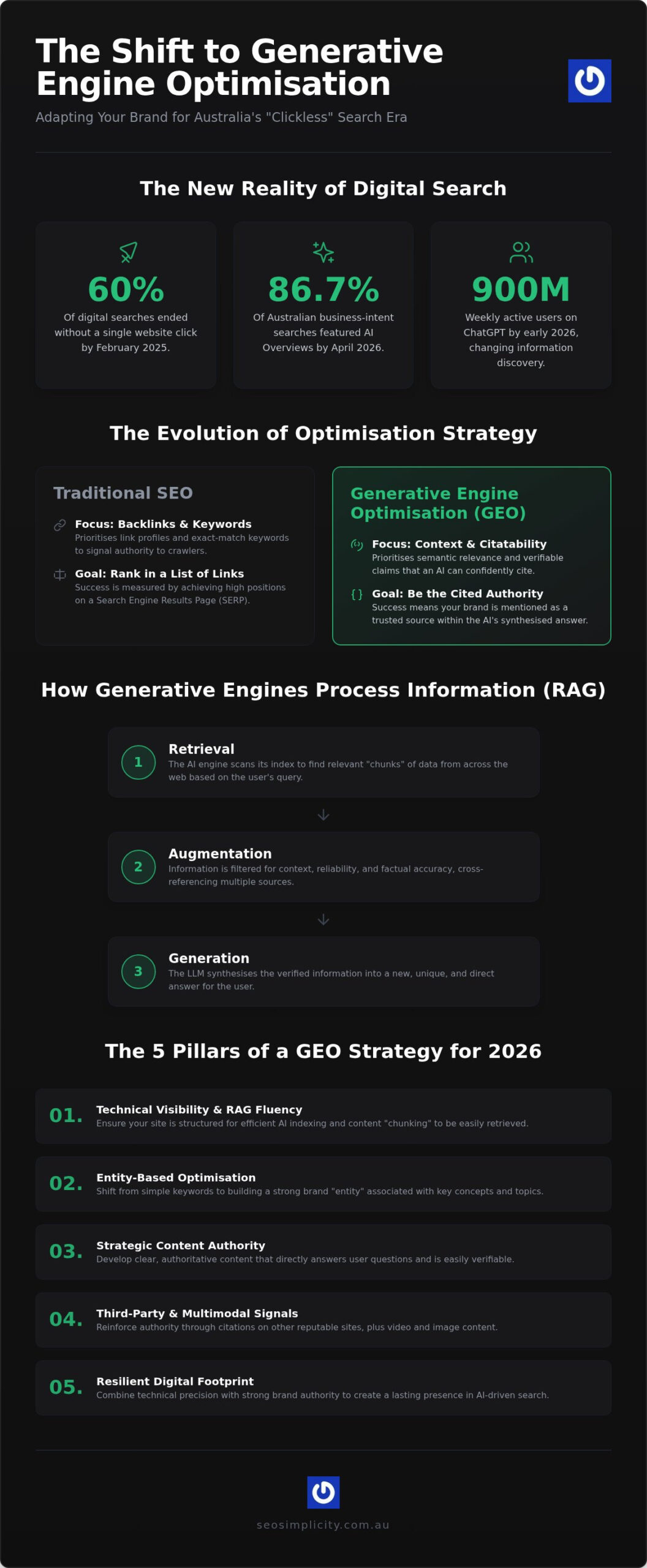
Traditional SEO relies heavily on signals like backlink profiles and exact keyword matching to determine a page’s value. While these elements still matter, GEO prioritises contextual relevance and citatability above all else. In the past, winning meant capturing ‘position zero’ in a featured snippet. Now, success is defined by the ‘AI citation’, where an LLM mentions your brand as a trusted source within its synthesised answer. For Australian national brands, this means your digital footprint must be clear and authoritative enough for an AI to synthesise your information with confidence. If an engine can’t verify your claims across multiple reputable sources, it simply won’t recommend you as a solution to the user’s query.
Why 2026 is the Tipping Point for Aussie Brands
The Australian digital market reached a critical threshold in 2026 as answer volume began to overtake traditional search volume for high-intent queries. Data from April 2026 shows that Google’s AI Overviews now appear on 86.7% of business-intent searches, a significant jump from 56.9% just a year prior. This has created a ‘Traffic Gap’ where users get the information they need without clicking through to a website. By February 2025, 60% of searches already ended without a click, and that trend has only accelerated as ChatGPT reached 900 million weekly active users in early 2026. If your content isn’t optimised for LLM ingestion, your brand faces total exclusion from the primary way Australians now discover products and services. Adopting a generative engine optimisation strategy ensures you remain part of the conversation rather than becoming invisible in a synthesised search world.
How Generative Engines Work: LLMs vs Search Crawlers
Traditional search crawlers operate like meticulous librarians who index every book in the building so you can find them later. They focus on mapping your site structure and cataloguing keywords to match them with user queries. In contrast, generative engines act like a researcher who has already read every book and synthesises the key points into a direct answer. This fundamental shift is why generative engine optimisation is now essential for brand visibility. Instead of just appearing in a list of links, your content must be understood by the AI layer that sits on top of the search index. These engines look for semantic clusters and conceptual meaning, placing your brand within a “Latent Space” where your proximity to certain topics determines your authority.
Understanding the RAG Process
Most modern AI search tools use a framework called Retrieval-Augmented Generation (RAG). This process involves three distinct steps that change how you should structure your website content. First, the engine performs “Retrieval” to find relevant data chunks from across the web. Next, it moves to “Augmentation”, where it filters this information for context and reliability. Finally, “Generation” occurs as the AI writes a unique response for the user. To succeed here, you must organise your information into clear, “chunkable” sections that the AI can easily extract. Refining your technical seo ensures that these engines can navigate your site without friction, making your data more likely to be retrieved during the first stage of the RAG cycle.
The Role of Citations and Attributions
While early AI chatbots were prone to making things up, 2026 search engines focus heavily on verification. Platforms like Perplexity and Google’s AI Overviews now provide prominent links to verify their claims, creating a new type of “AI citation”. Users are undergoing a psychological shift; they no longer click links to find answers, but they do click them to verify the AI’s suggestions. If you want your brand name to appear in the “Sources” box, you need to provide clear entity signals that the AI can attribute to your business. This involves more than just having good content on your own site; it requires a consistent presence across the web. This shift also brings up new discussions regarding the ethical implications of GEO and how brands maintain trust. By focusing on generative engine optimisation, you position your brand as a primary source that AI engines can confidently recommend to their users. If you want to see how your current site measures up, you can audit your digital presence to identify gaps in your AI citatability.
GEO vs Traditional SEO: Key Strategic Differences
Success in digital visibility used to be measured by how many keywords you could rank on page one. While keyword research remains a foundational skill, generative engine optimisation requires a shift toward entity optimisation. AI models don’t just look for specific words; they look for the relationships between your brand, your products, and the problems you solve. This transition forces a move from tracking raw traffic volume to monitoring brand share of voice. In an environment where 60% of searches result in no click, being the brand that the AI chooses to synthesise into its answer is the only way to maintain market presence. You must now treat technical health as a non-negotiable prerequisite rather than a simple competitive advantage; if an AI cannot parse your site efficiently, it will exclude you from its citation pool entirely.
Building Expertise, Authoritativeness, and Trustworthiness (E-E-A-T) takes on a new dimension in the generative era. AI engines verify your claims by cross-referencing your content with the broader web. If your brand authority isn’t reflected on high-quality third-party platforms, the AI is unlikely to recommend you as a trusted source. This makes your digital reputation just as important as your on-page content. You need to ensure that your brand is perceived as a leader not just by your own metrics, but by the entire digital ecosystem.
From Keywords to Entities
Think of your business as an ‘Entity’ within a massive digital knowledge graph. An AI views your brand not just as a website, but as a collection of attributes including your leadership, your specific services, and your industry reputation. To win at generative engine optimisation, you should actively build an entity map that defines these relationships clearly. Research from early 2026 suggests that 68% of AI citations come from third-party sources; this highlights why being mentioned on reputable industry sites, directories, and news outlets is crucial. When multiple authoritative sources point to your brand as an expert, you solidify your position in the AI’s latent space, making your business more likely to be recommended.
The ‘Source of Truth’ Factor
Becoming the original source of data is the most effective way to anchor your brand in AI answers. LLMs prioritise unique perspectives and verifiable facts over recycled information. Industry data indicates that adding original statistics and direct quotations to your content can lift visibility in generative engines by up to 41%. By publishing original case studies and proprietary data, you provide the “raw materials” that AI engines need to build their answers. Utilising professional seo content creation services australia helps you develop these high-authority assets, ensuring your brand stays at the centre of the synthesised search conversation while driving strategic growth.
Implementation: The 5 Pillars of a GEO Strategy
To lead your industry in 2026, you need a structured framework that addresses how AI models consume data. Successful generative engine optimisation relies on five core pillars: citatability, technical readiness, content diversification, third-party authority, and performance monitoring. By building a multi-platform strategy, you ensure your brand is recognised by Google’s Gemini, OpenAI’s GPT-4o, and Anthropic’s Claude. Start with these tangible shifts to move from simple keyword visibility to becoming a trusted citation within synthesised answers.
Optimising for Citatability and Brand Mentions
AI engines prioritise content that is easy to extract and repeat. You should adopt a writing style that features ‘Quotable Sentences’, which are clear, declarative claims that stand alone without needing extensive context. This technique, often called ‘Citation Bait’, involves creating data-heavy snippets that an AI can easily grab to support its synthesised answer. Beyond your own site, you must manage off-site mentions by ensuring your brand’s core facts are consistent across review platforms and industry directories. If the AI sees the same authoritative information repeated across the web, its confidence in citing your business increases significantly.
Structured Data and Technical Readiness
Technical health is the foundation upon which all AI-driven visibility is built. Utilise advanced Schema.org markups to define the specific relationships between your products, services, and leadership team. This structured data acts as a translator for AI engines, helping them understand the context of your information. You also need to ensure your site is fast and easily crawlable so that AI indexes stay current with your latest updates. Integrating these technical elements with high-quality on page seo services australia provides the necessary infrastructure for AI engines to retrieve your content without friction.
Content Diversification for AI Ingestion
Generative engines thrive on structured, conversational content. You should transform complex reports into AI-friendly formats such as detailed FAQs, glossaries, and bulleted summaries. These formats serve as the ‘fuel’ for generative answers, as they match the natural language patterns of user queries. Focus on using conversational language that mirrors how Australians actually speak and ask questions. This approach ensures that your content is not only indexed but also selected as the most relevant answer for voice and text-based AI searches.
- Add a ‘Key Facts’ summary box to the top of every long-form article to aid AI retrieval.
- Update your ‘About Us’ page with clear entity signals like awards, industry affiliations, and founder credentials.
- Implement FAQ schema on all high-intent service pages to mirror natural language queries.
- Convert complex data tables into clear, descriptive bullet points that AI models can easily parse.
If you’re ready to enhance your brand’s citatability across all generative platforms, you can request a GEO-focused technical audit to identify your most impactful growth opportunities.
Future-Proofing Your Visibility with SEO Simplicity
Maintaining visibility in the generative era requires a shift from static rankings to active brand management. You shouldn’t view generative engine optimisation as a one-time fix or a simple technical checkbox. Instead, it’s an ongoing process of refining how AI models perceive your authority and expertise across the digital ecosystem. At SEO Simplicity, we combine technical precision with strategic authority to ensure your business remains a primary source of truth for LLMs. We handle the underlying complexity of these models so you can focus on your core business growth without the fear of brand invisibility.
Our approach focuses on transforming complex technical requirements into manageable growth strategies. We leverage our expertise in Technical SEO and Content Strategy to build a robust foundation that AI engines can trust. By aligning your site structure with the retrieval patterns we’ve explored, we help you unlock new levels of visibility that traditional methods simply can’t reach. This systematic improvement ensures that every piece of content you produce serves as a high-value signal for generative engines, enhancing your performance across all major platforms.
Why an AI-First Audit is Your First Step
An AI-focused audit provides a clear picture of your current ‘AI footprint’ and identifies how different engines categorise your brand. We examine which platforms currently recommend your services and pinpoint the specific reasons why others might be overlooking your content. This deep dive allows us to develop a tailored roadmap that closes the gap between your existing site and the requirements of Google’s AI Overviews. We don’t just look at your code; we analyse how your brand’s entities are mapped across third-party sites and directories. Identifying these technical and conceptual hurdles early allows you to improve your citatability and secure your share of voice before your competitors react.
Partnering for Long-Term National Growth
The AI landscape is evolving at a rapid pace, making a dedicated strategic partner essential for long-term success. Our monthly retainers are designed to adapt as new models and search behaviours emerge, ensuring your strategy remains effective throughout 2026 and beyond. We understand the specific nuances of the Australian market and focus on building your authority within a national context. This collaborative approach means you’re never left behind as technology shifts, providing the steady assurance you need to plan for the future. Proactive management allows you to lead your industry with confidence, knowing your digital presence is ready for the next generation of user behaviour. You can organise a consultation with SEO Simplicity to master your GEO strategy and secure your brand’s future in the age of AI answers.
Lead Your Industry Through the Generative Shift
The digital landscape has fundamentally changed, moving away from a simple list of links toward a future defined by synthesised AI answers. You now have the opportunity to lead this transition by refining your approach to generative engine optimisation, ensuring your brand is the one the world’s most advanced models choose to cite. By focusing on technical readiness, entity clarity, and high-authority content diversification, you’ll turn the “clickless” search trend into a powerful engine for growth.
Our expert Australian-based strategy team is ready to help you navigate this complexity with a specialised 2026 technical SEO framework. We deliver data-driven results for national brands, helping you close the visibility gap and secure your share of voice across ChatGPT, Gemini, and Google’s AI Overviews.
Unlock your brand’s potential in the AI era with SEO Simplicity. Taking this step ensures your digital strategy remains resilient, giving you the confidence to grow while we manage the technical shifts of the AI age.
Frequently Asked Questions
What is the difference between SEO and GEO?
Traditional SEO focuses on improving your position in a list of website links, whereas generative engine optimisation aims to get your brand cited within synthesised AI answers. While traditional SEO relies heavily on keyword density and link profiles, GEO prioritises the semantic relationship between your business and specific topics. Success in GEO means your brand appears as a trusted recommendation in tools like Gemini or SearchGPT, rather than just another result on a page.
Will GEO replace traditional SEO entirely by 2027?
GEO is unlikely to replace traditional SEO entirely by 2027, but it will certainly become the dominant strategy for brand discovery. Traditional search remains essential for navigational queries and specific website visits. However, as AI search adoption continues to grow, the two disciplines will merge into a single, unified digital strategy. You’ll need to balance technical site health with the entity-based authority required to remain visible in generative summaries.
How can I track if my business is being mentioned by ChatGPT?
Tracking AI mentions requires a combination of manual testing and specialised monitoring tools. You can prompt platforms like ChatGPT directly to see how it describes your brand, or use proprietary SEO tools designed for performance monitoring. At SEO Simplicity, we include these new metrics in our monthly reporting to help you understand your brand’s share of voice. This systematic approach allows you to see exactly how often AI engines are recommending your services to users.
Does my website need a specific technical structure for GEO?
Your website requires a structure that prioritises clarity and “chunkability” for AI models to retrieve information efficiently. Utilising advanced Schema.org markups and clear, declarative headings helps AI engines understand the relationships between your products and services. A fast, technically sound site is a prerequisite for successful generative engine optimisation. Ensuring your data is structured logically allows these models to index your content as a primary source of truth without technical friction.
Are backlinks still important for Generative Engine Optimisation?
Backlinks remain a vital component of the AI verification process because they signal authority and trust to Large Language Models. AI engines often cross-reference multiple sources across the web to verify the accuracy of their answers. High-quality links from reputable Australian industry sites act as votes of confidence, making it more likely that an AI will cite your brand. Building a diverse off-page profile is essential for establishing the E-E-A-T required for long-term AI visibility.
How long does it take to see results from a GEO strategy?
Results from a GEO strategy typically become visible within three to six months, depending on how frequently AI models update their knowledge bases. While technical changes can be indexed quickly, building the necessary brand authority and third-party citations takes time. You’ll likely see incremental improvements in your AI share of voice as engines begin to recognise your content as a reliable source. Consistent updates and strategic content creation are key to maintaining this compounding advantage.
Can I use AI to write my GEO-optimised content?
Using AI to generate content is possible, but it lacks the original research and unique perspective that generative engines prioritise. LLMs look for “Source of Truth” signals, such as proprietary data and case studies, which AI-generated text often fails to provide. To succeed in GEO, your content must offer genuine expertise that hasn’t been recycled from elsewhere. Combining human-led strategic growth with technical precision ensures your content is authoritative enough for AI models to recommend.
How much does a GEO audit cost for an Australian business?
The investment for a GEO audit varies based on the size of your website and the complexity of your current digital footprint. At SEO Simplicity, we offer fixed-price SEO audit fees that provide a comprehensive roadmap for identifying your AI visibility gaps. These audits evaluate your technical health, entity mapping, and citatability across the national market. You can contact our team to discuss a personalised consultation that aligns with your specific growth objectives and digital strategy.