
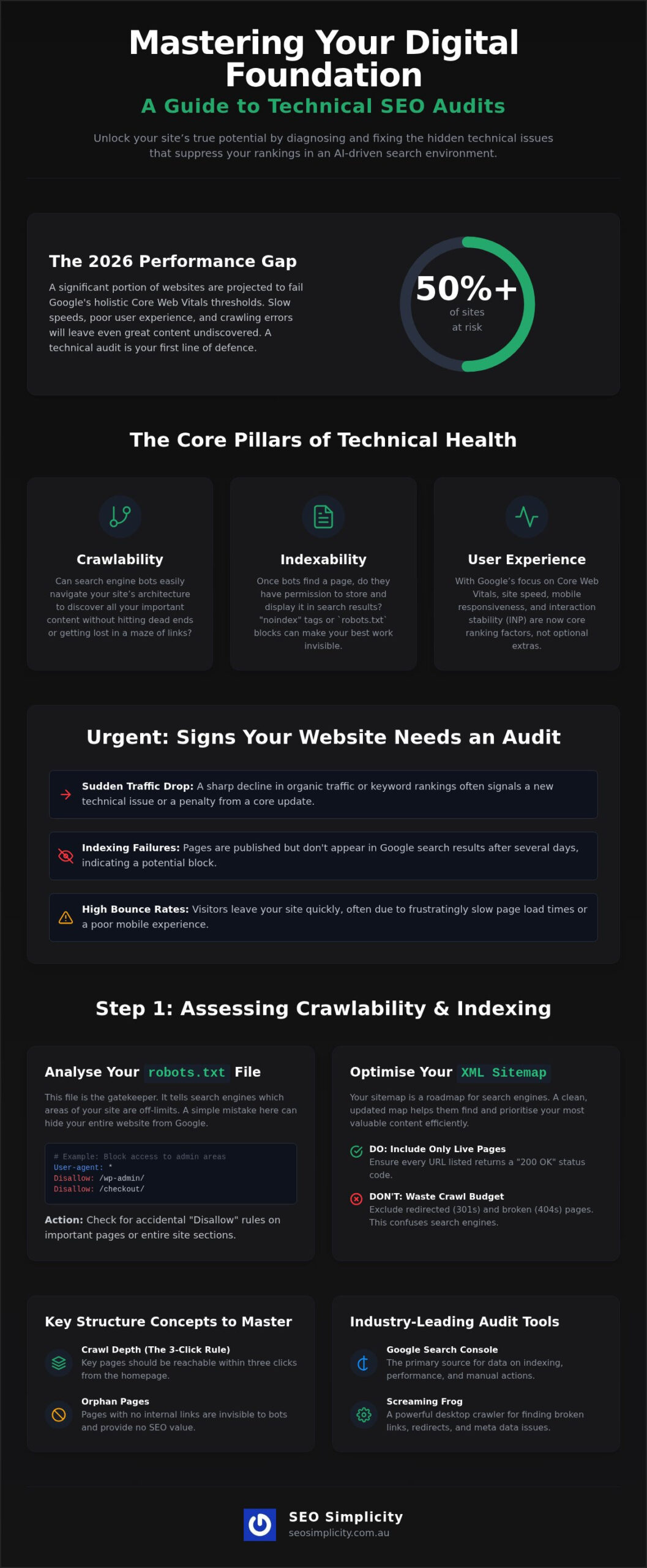
Did you know that in 2026, over 50% of websites still fail to pass Google’s holistic Core Web Vitals thresholds? It’s incredibly frustrating to produce great work only to see it buried by slow loading speeds or hidden crawling errors that prevent your pages from ranking. You might feel overwhelmed by technical jargon, but you recognise that a high-performing site is non-negotiable for success. Learning how to do a technical seo audit is the most effective way to unlock your site’s potential and turn it into a streamlined engine for organic growth.
We promise to simplify these complexities by providing a step-by-step auditing framework and a curated list of the best tools to optimise your digital presence. This guide previews everything from the impact of the March 2026 core update to practical strategies for improving your Interaction to Next Paint (INP) scores. You’ll walk away with a clear, actionable checklist and the confidence to lead strategic conversations with your web developers. By addressing these technical bottlenecks now, you ensure your brand remains visible and competitive in an increasingly AI-driven search environment.
Key Takeaways
- Recognise that a robust technical foundation is the essential first step before investing in content or link building to ensure search engines can actually discover your site.
- Discover how to do a technical seo audit by systematically checking robots.txt files and XML sitemaps to prevent accidental indexing blocks.
- Optimise for the 2026 user experience by mastering Core Web Vitals and leveraging Australian-based servers to reduce latency for local visitors.
- Utilise industry-leading tools like Google Search Console and Screaming Frog to identify hidden errors that are currently throttling your organic visibility.
- Transform your audit findings into a prioritised roadmap that allows you to communicate clearly with developers and resolve critical errors first.
What is a Technical SEO Audit and Why Does it Matter?
Think of your website as a high-performance vehicle. You can have the most striking bodywork and a powerful engine, but if the transmission is seized, you aren’t going anywhere. A technical SEO audit is a systematic evaluation of a website’s infrastructure to ensure optimal crawling, indexing, and user experience. It serves as the vital bridge between your creative content and a search engine’s ability to find, understand, and rank that content. Without this foundation, even the most expensive digital marketing campaigns will struggle to gain traction.
Many Australian business owners make the mistake of investing heavily in link building or social media before checking their site’s health. We view a technical audit as the essential first step. A healthy site ensures that every dollar you spend on Search engine optimization delivers a maximum return. While a “quick check” might flag a few broken links, a comprehensive deep-dive audit uncovers the structural bottlenecks that actively suppress your rankings. Learning how to do a technical seo audit with precision allows you to identify these hidden issues before they become costly failures.
The Core Pillars of Technical Health
To maintain a competitive edge, you must focus on three primary areas of technical performance:
- Crawlability: This focuses on whether search bots can navigate your site architecture without hitting dead ends. If your internal linking is a maze, bots will simply leave.
- Indexability: Once a bot finds a page, it needs permission to store it. We check for “noindex” tags or robots.txt blocks that might be hiding your best work from the world.
- User Experience: Google’s 2026 updates place immense weight on how users interact with your site. Speed, mobile responsiveness, and stability are no longer optional “extras”; they are core ranking signals.
Signs Your Website Needs an Urgent Audit
If you notice any of the following red flags, it is time to investigate your site’s infrastructure immediately. A sudden drop in organic traffic or keyword rankings often suggests your site has failed a new quality threshold during a core update. Similarly, if your pages do not appear in search results despite being published for several days, you likely have an indexation error. High bounce rates coupled with slow page load times are also clear indicators that your technical performance is frustrating your visitors. Realising how to do a technical seo audit helps you transform these frustrations into a clear roadmap for recovery and growth.
Step 1: Assessing Crawlability and Indexing Efficiency
Mastering how to do a technical seo audit begins with ensuring search bots can actually reach your content. If your site’s infrastructure is cluttered, search engines will struggle to understand your hierarchy, leading to poor visibility. The importance of technical optimization becomes clear when you realise that even the best content is worthless if it remains invisible to the bots that crawl the web.
Start by auditing your robots.txt file. This small text file acts as a gatekeeper, telling search engines which areas of your site are off-limits. You must ensure you aren’t accidentally blocking vital sections, such as your main service pages or resource hubs. In 2026, we also look for “crawl depth” issues. If a user or a bot has to click more than three times from the homepage to find a specific page, that content is likely buried too deep to rank effectively. Similarly, you should hunt for “orphan pages,” which are those with no internal links pointing to them. These pages are essentially invisible to crawlers and rarely provide any SEO value.
Navigating Your Robots.txt and Sitemap
Your XML sitemap should serve as a clean, updated map of your website’s most important URLs. Ensure it only contains “200 OK” status code pages. Including redirected pages (301) or broken links (404) in your sitemap wastes your crawl budget and sends confusing signals to Google. Use the “Disallow” command in your robots.txt file strategically to hide low-value pages like checkout screens or internal search results. This allows bots to focus their energy on the pages that actually drive revenue for your brand. If you find these technical hurdles daunting, our professional SEO audits provide a clear path to resolution by identifying these bottlenecks for you.
Solving Indexing Roadblocks
Once you’ve confirmed that bots can crawl your site, you must verify that they are allowed to index it. Check for accidental “noindex” tags in your page headers, which are a common cause of sudden ranking drops. You should also audit your canonical tags to ensure you aren’t creating duplicate content issues that dilute your ranking power. Use Google Search Console to monitor the “Crawled – currently not indexed” report. This often indicates that Google found your page but decided it wasn’t high-quality or unique enough to show to users. Understanding how to do a technical seo audit helps you prioritise these fixes, turning “excluded” pages into active traffic drivers.
Step 2: Optimising Site Performance and User Experience
Building on the foundation of crawlability, you must now focus on the visitor’s journey. Google’s March 2026 core update introduced a holistic scoring system for Core Web Vitals, meaning your site’s performance is now judged as a composite score rather than isolated metrics. Understanding how to do a technical seo audit requires a deep dive into these signals to ensure you aren’t losing potential customers to a sluggish interface. Failing to meet these thresholds doesn’t just frustrate users; it actively suppresses your visibility in a competitive market.
Your Largest Contentful Paint (LCP) should ideally be under 2.0 seconds to meet the strictest 2026 standards, while Cumulative Layout Shift (CLS) must remain below 0.1 to prevent jarring visual jumps. Crucially, Interaction to Next Paint (INP) has become the definitive measure of responsiveness, with a “Good” threshold of under 200 milliseconds. For Australian brands, server location is a critical factor that many global guides overlook. If your target audience is in Brisbane but your server is in London, the physical distance adds significant latency that no amount of code minification can fully fix. Securing your site with HTTPS is equally vital, as it protects user data and serves as a baseline requirement for Google’s 94.1% share of the Australian search market.
Improving Page Load Speed for Australian Users
Hosting your website on local servers in Sydney or Melbourne provides an immediate speed advantage for your domestic audience. If you serve a national or global market, implementing a high-quality Content Delivery Network (CDN) ensures your assets are cached at the “edge,” closer to the user’s physical location. Optimise your images by using modern formats like WebP and minify your CSS and JavaScript to strip away unnecessary code bloat. These proactive steps directly improve your LCP and INP scores, making your site feel instantaneous and reliable.
Mobile-Friendliness and Accessibility
With mobile traffic accounting for 59.28% of the Australian market share in 2026, a mobile-first approach is mandatory. Use responsive design to ensure your layout adapts seamlessly to every screen size, from the smallest smartphone to the largest desktop monitor. Pay close attention to touch element spacing to prevent accidental clicks and ensure your font sizes remain legible without the need for zooming. We’ve found that focusing on accessibility often improves overall technical health, as clear structures benefit both screen readers and search bots. Learning how to do a technical seo audit allows you to verify these elements systematically, ensuring your site is inclusive and high-performing for every visitor.
Roundup: The Best Technical SEO Audit Tools for 2026
Selecting the right software is a fundamental part of learning how to do a technical seo audit effectively. While the market is flooded with options, we recommend focusing on a curated stack that addresses different stages of the auditing process. These tools allow you to move beyond guesswork and base your strategy on verifiable data. By combining technical insights with our on-page SEO services in Australia, you create a comprehensive approach that ensures your content is both discoverable and highly relevant.
- Google Search Console: This is the non-negotiable starting point for every brand. It provides direct feedback from Google on your indexing status, security issues, and Core Web Vitals performance.
- Screaming Frog SEO Spider: As the industry standard for deep site crawling, this tool mimics how search engines traverse your site. A paid license costs £199 per year and is worth every cent for identifying broken links and redirect loops.
- PageSpeed Insights: Use this to diagnose specific performance bottlenecks. It offers actionable advice on reducing LCP and improving INP scores for your Australian visitors.
- Ahrefs Site Audit: This tool excels at visualising your site structure and providing a clear health score. It helps you track progress over time and identify issues that might be missed by manual checks.
Remember that technical health is only half the battle. Once your site is crawlable, you must ensure your content is optimised through on-page SEO services in Australia to truly dominate the search results. Using these tools in tandem allows you to build a website that search engines love to reward.
Free vs. Paid Audit Tools: Which Should You Choose?
Small business owners often find that free tools like Google Search Console provide enough data to manage a basic site. However, as your website grows in complexity, premium crawlers become essential for managing thousands of pages without manual error. If you’re looking for a quick snapshot of your performance, using a modern SEO checker can help you identify high-level issues before committing to a deeper investigation. For enterprise-level brands, the investment in paid tools pays for itself by preventing costly developer mistakes and protecting your organic revenue.
Specialised Tools for Advanced Auditing
Once you’ve mastered the basics, you might need specialised software to unlock further growth. Log file analysers are invaluable for seeing exactly how search bots interact with your server, allowing you to optimise your crawl budget with surgical precision. We also recommend using Schema markup validators to ensure your rich snippets are configured correctly, which is vital for visibility in AI-powered search results. Protecting your reputation is equally important; use security scanners to monitor for vulnerabilities or malware that could lead to a manual penalty. If you want to ensure no stone is left unturned, our technical SEO experts can perform a comprehensive evaluation using our full suite of professional tools.
From Audit to Action: Implementing Your Findings
Completing your investigation is only half the battle. Now you must transform that raw data into tangible growth for your brand. When you understand how to do a technical seo audit, you quickly realise that a spreadsheet of errors is useless without a prioritised plan. Focus on “critical errors” first. These are the showstoppers, such as “noindex” tags on revenue-generating pages or 5xx server errors, that prevent search engines from accessing your site. Once these are resolved, you can shift your attention to “warnings” which, while less urgent, still contribute to your overall site health and user experience.
Creating a structured roadmap is the best way to prevent your development team from feeling overwhelmed. If you find the complexity of these fixes too great for a DIY approach, engaging a professional technical SEO audit service ensures that every technical bottleneck is identified and resolved with specialist precision. This proactive approach saves time and prevents the costly developer mistakes that often occur when SEO requirements are poorly defined. By treating your audit as a strategic blueprint, you turn technical debt into a competitive advantage.
Communicating with Developers
Clear communication is the secret to getting technical fixes implemented correctly the first time. Instead of sending a vague list of complaints, translate your SEO findings into actionable tickets with specific URLs, clear instructions, and expected outcomes. Set clear KPIs to measure the success of these fixes, such as a 20% improvement in LCP scores or a measurable reduction in crawl errors within Search Console. Always insist on using a staging environment to test major changes before they go live on your main site. This safety net ensures that your technical optimisations don’t accidentally break other features, keeping your visitor experience seamless and professional.
The Value of Ongoing SEO Management
Technical health is not a “one-and-done” task. As you add new content, update plugins, or change your site architecture, new errors will inevitably creep in over time. This is why regular, monthly monitoring is essential for maintaining your hard-won rankings in the Australian market. A monthly SEO management retainer provides peace of mind by ensuring a specialist is constantly watching your site’s vitals. This continuous oversight allows you to catch and fix issues before they impact your rankings or organic revenue. Understanding how to do a technical seo audit helps you stay informed, but an ongoing partnership ensures long-term progress. Unlock your site’s full potential with a comprehensive audit today.
Future-Proof Your Digital Presence
You’ve now explored the essential framework of how to do a technical seo audit, from securing your site’s crawlability to refining performance for a local audience. By addressing these structural pillars, you transform your website into a high-performance asset that search engines recognise and reward. A healthy technical foundation is the prerequisite for all other growth, ensuring that your content and marketing efforts reach their full potential without being held back by hidden errors.
Our expert Australian-based team at SEO Simplicity is here to guide you through this process with clarity and precision. As part of the established Purplecow Digital Marketing group, we provide fixed-price audit roadmaps that eliminate the guesswork and offer a clear path to improvement. Book a Comprehensive Technical SEO Audit with SEO Simplicity today to begin enhancing your site’s visibility and user experience. We look forward to partnering with you on your journey toward sustained digital growth and search excellence.
Frequently Asked Questions
How often should I perform a technical SEO audit on my website?
Perform a comprehensive audit at least every three to six months to maintain peak performance. This frequency allows you to catch errors introduced by plugin updates, theme changes, or new content before they impact your rankings. High-traffic sites benefit from even more frequent monthly monitoring to ensure their technical foundation remains stable and error-free.
Can I do a technical SEO audit myself without knowing how to code?
You can certainly perform the initial discovery phase yourself by using automated tools that highlight issues in plain English. Learning how to do a technical seo audit involves interpreting these reports to understand what is broken and why it matters. While you’ll likely need to partner with a developer to resolve complex code-based errors, you can lead the strategy and prioritisation without being a programmer.
What is the most common technical SEO error found on Australian websites?
High latency caused by overseas hosting is a remarkably common issue for local businesses. Many brands use international servers that increase page load times for Australian visitors, which negatively affects Core Web Vitals scores. Moving to a local server or implementing a high-quality CDN often provides an immediate performance boost for your domestic audience.
How long does it take to see results after fixing technical SEO issues?
Expect to see measurable improvements in your rankings or traffic within four to twelve weeks after your fixes are deployed. Search engines require time to re-crawl your updated pages and re-calculate your site’s quality scores based on the new data. The speed of your recovery often depends on how frequently Google currently visits and indexes your website.
Do technical SEO audits help with mobile search rankings?
Yes, technical audits are critical for mobile success because Google uses mobile-first indexing for almost all websites. An audit verifies that your site is responsive, touch-friendly, and fast on smartphones. Since mobile devices drive nearly 60% of Australian web traffic, these technical optimisations are essential for maintaining your visibility in search results.
What is the difference between a technical audit and an on-page audit?
Technical audits focus on the infrastructure and bot accessibility, covering elements like crawlability, indexing, and site speed. On-page audits examine the content itself, including keyword usage, heading structures, and metadata relevance. You need both to succeed, but the technical health of your site is the essential prerequisite that allows your on-page efforts to be discovered.
Is Google Search Console enough for a complete technical audit?
Google Search Console is an excellent starting point, but it isn’t sufficient for a complete deep-dive investigation. It provides a snapshot of how Google sees your site rather than a comprehensive map of every internal link, script, and asset. Using a dedicated crawler alongside Search Console allows you to find hidden errors and structural issues that Google might not report directly.
How much should I expect to pay for a professional technical SEO audit in Australia?
Investment levels for professional audits in Australia depend entirely on the size and complexity of your website. We suggest looking for providers who offer a clear, prioritised roadmap rather than just a generic list of errors. This ensures you receive a strategic plan that focuses on the specific technical fixes that will drive the most significant growth for your brand.