
Did you know that the google august 2026 spam update triggered an 82% increase in top 10 rankings dropping out of the top 100 compared to a standard week? For many Aussie business owners, waking up to a sudden dip in search visibility is a genuine nightmare that feels both unfair and confusing. You’ve likely spent months building your online presence, only to feel like the goalposts have shifted again without warning. It’s exhausting to keep up with these changes while trying to run a company.
We understand the stress of wondering if your recent content strategy or use of AI tools has put a target on your back. This article provides the clarity you need to understand exactly what Google changed during the update’s rollout, which ran from 18 to 21 August. You’ll learn how to identify if your site was hit and how to protect your rankings from future penalties related to scaled content abuse.
We’ll explore the specific spam policies currently in focus and offer a practical, step-by-step recovery plan to help you restore your traffic. By the end, you’ll have a clear strategy to organise your content and ensure your brand remains a trusted authority in the eyes of search engines.
Key Takeaways
- Understand the impact of the google august 2026 spam update, which targeted low-value, mass-produced content to prioritise genuine expertise in search results.
- Distinguish between ‘bottom-shelf’ AI automation and human-led strategic content by focusing on ‘Information Gain’ to provide unique value your competitors lack.
- Identify critical red flags such as ‘Parasite SEO’ and learn why hosting low-quality third-party content could be sabotaging your domain’s visibility.
- Implement a structured five-step recovery roadmap that prioritises pruning and improving your existing pages rather than reacting with a ‘delete all’ panic.
- Discover how a proactive content strategy and technical oversight can transform algorithm volatility into a manageable process for long-term growth.
The Google August 2026 Spam Update: What’s Changed for Aussie Sites?
The google august 2026 spam update represents a significant leap in how search engines distinguish between genuine expertise and mechanical noise. Completed on 21 August 2026, this update wasn’t a change in policy, but a massive upgrade to Google’s automated detection systems. Its primary objective remains clear: purging the search results of low-value, mass-produced content that offers no unique insight to the reader.
Aussie businesses that relied heavily on unedited AI output often copped a hit during this three-day rollout. While the update targets traditional ‘black hat’ spam, it also casts a wider net over ‘grey hat’ tactics, such as scaled content created primarily to capture traffic rather than solve problems. Reviewing the history of Google algorithm updates confirms that while the methods change, the goal of rewarding quality stays the same.
The Core Focus: Scaled Content Abuse
Scaled content abuse involves churning out hundreds or even thousands of pages to manipulate search rankings. In the 2026 search environment, volume no longer equals visibility. Google’s systems are now sophisticated enough to recognise when a site is simply rehashing existing information without adding any ‘Information Gain’.
Distinguish between useful automation and spammy automation to stay safe. Useful automation helps you organise data or streamline formatting. Spammy automation, however, generates entire articles without human oversight or original research. Audit your content production line to ensure human expertise leads every piece. This proactive step protects your site from being flagged as a content farm.
Why the Rollout Matters for National Visibility
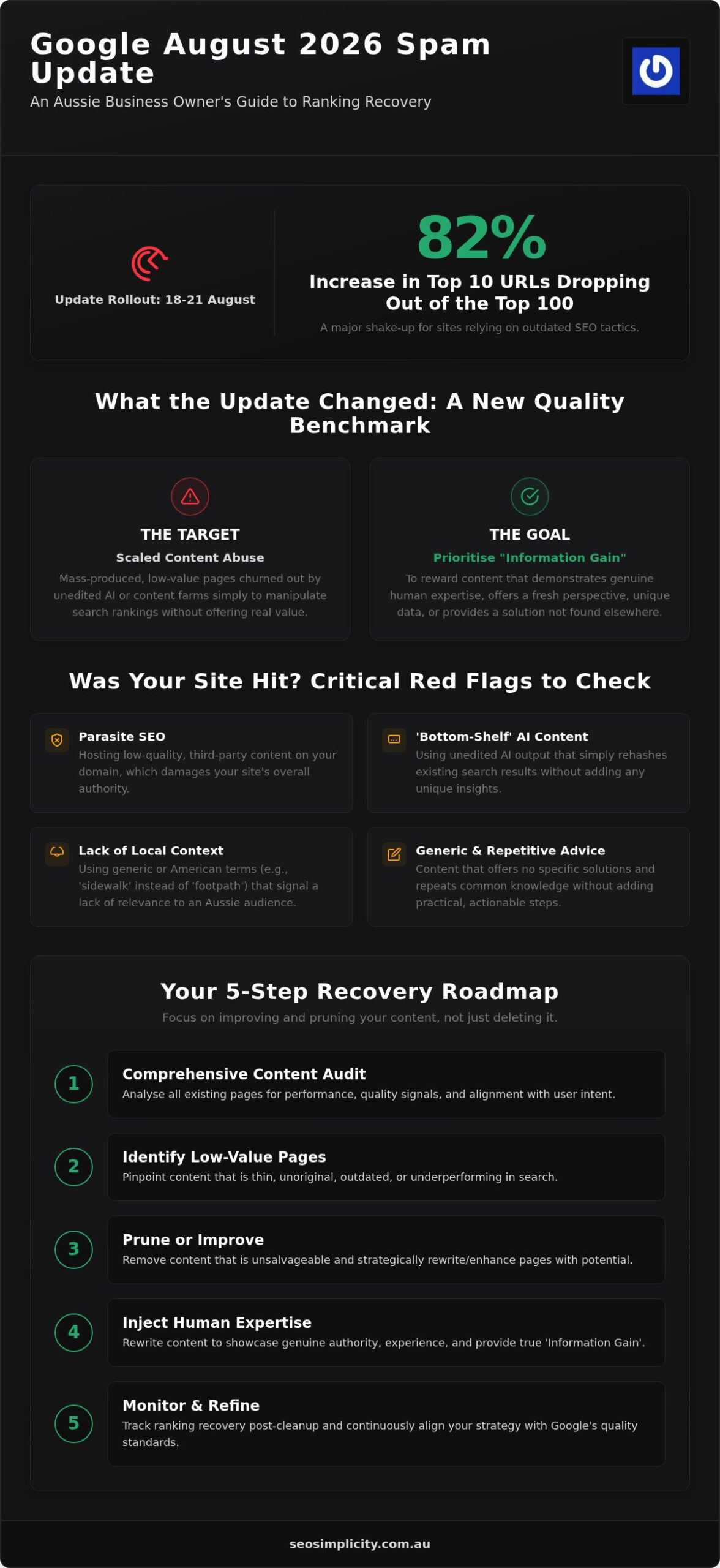
National brands competing for broad Australian keywords face the highest risk. As Google uses AI to fight AI-generated spam in real-time, the margin for error has vanished. If your site is perceived as a source of low-effort content, your national visibility can evaporate overnight. This is particularly relevant given that SE Ranking data showed an 82% increase in top 10 URLs dropping out of the top 100 during this period.
Monitor your rankings for any sudden fluctuations that occurred between 18 and 21 August. Identifying these patterns early allows you to refine your content strategy before a temporary dip becomes a permanent decline. Align your digital presence with Google’s quality standards to safeguard your organic performance and maintain a competitive edge in the Australian market.
Scaled AI Content vs Strategic Expertise: The New Quality Benchmark
The google august 2026 spam update has effectively ended the era of ‘bottom-shelf’ AI content. Churning out generic articles that simply parrot existing search results no longer works for Aussie brands. Google now prioritises ‘Information Gain’. This concept requires your website to offer a fresh perspective, unique data, or a different angle that isn’t already available on ten other sites. If your pages just rehash what your competitors say, they’re likely to lose visibility as Google’s filters become more aggressive.
Strategic expertise is the new currency of search. You need to demonstrate that a real human with genuine experience is behind your brand’s voice. This is where seo content creation services australia become essential for your growth. These services bridge the gap between AI efficiency and human quality, ensuring your content meets the strict standards outlined in Google’s spam policies. In the current Australian market, aiming for ‘good enough’ is a recipe for ranking failure. The google august 2026 spam update has changed the rules of the game, but it also provides a roadmap for those willing to invest in quality.
Characteristics of At-Risk Content
Identify these red flags in your current library to avoid future penalties. Content that lacks local context, such as using American terminology like ‘sidewalk’ instead of ‘footpath’ or ignoring specific Australian regulations, stands out to Google’s refined detection systems. Other risks include:
- Repetitive phrasing and a lack of specific, local examples that resonate with an Aussie audience.
- Generic advice that fails to solve a specific user problem or answer a unique search intent.
- A high volume of pages published in a short window without adding any unique insights or original data.
The Anatomy of a High-Quality Page
High-quality pages now require clear evidence of E-E-A-T. Include original research, internal case studies, or a unique brand perspective to show you’ve actually done the heavy lifting. Transforming your blog from a news aggregator into a source of wisdom will help you reclaim lost ground. Organise your content around genuine user needs to win back rankings and build long-term trust with your audience. This systematic improvement ensures you aren’t just chasing traffic, but building a loyal customer base. If you’re unsure where to start, a comprehensive SEO audit can help you identify exactly which pages need a human touch to survive the latest updates.
Red Flags: Why Your Site Might Have Copped a Ranking Hit
If your traffic took a tumble during the google august 2026 spam update, it’s time to examine the specific signals Google’s automated systems are now flagging. This update refined how the algorithm identifies deceptive patterns that attempt to game the search results. One major red flag is ‘Parasite SEO’. This involves hosting low-quality third-party content on your reputable domain to capitalise on your existing authority. Google now views this as a breach of trust, and it can lead to your entire site losing its hard-earned visibility. Chasing quick wins through these methods often results in long-term ranking damage that takes months to repair.
The google august 2026 spam update has made technical health inextricably linked to content trust. Maintaining a healthy site goes beyond just writing good words; your technical foundation must support your content strategy. A comprehensive technical seo check ensures that underlying issues, like broken redirects or poor crawlability, aren’t mimicking spam signals. When your site feels broken or neglected, Google’s filters are far more likely to categorise your content as low-quality noise.
Automated Content Without Oversight
‘Set and forget’ AI workflows are the primary target for the 2026 update. Churning out posts without human verification often leads to hallucinated facts and outdated data, which are clear indicators of unreliability. Google’s filters easily catch ‘pattern-based’ content that lacks a unique voice or original research. To stay safe, focus on producing people-first content that prioritises the reader’s experience. You can enhance your automated drafts by:
- Adding unique brand perspectives or internal case studies.
- Verifying all facts against current Australian industry standards.
- Injecting local examples that generic AI cannot replicate.
Poor User Experience and Ad-Heavy Layouts
Your site’s layout plays a massive role in how search engines perceive your authority. Excessive pop-ups or intrusive ads can trigger spam-like classifications, even if your written content is decent. Slow load times also signal a site that hasn’t been properly organised for the user. Audit your site’s UX to ensure your quality content actually gets seen by your audience. Removing clutter creates a manageable environment where users feel valued. This results-oriented approach helps you rebuild trust with both search engines and potential customers.
Recovery Roadmap: Organising Your Content for Post-Update Success
Recovering from the google august 2026 spam update requires a methodical approach rather than a panicked reaction. Avoid the temptation to delete your entire blog library overnight. Instead, adopt a ‘prune and improve’ strategy that prioritises quality over sheer volume. This logical progression helps you rebuild authority while ensuring your remaining assets are working harder for your brand. By focusing on a manageable digital process, you can transform a ranking dip into an opportunity for systematic improvement.
Step 1: Conduct a Comprehensive Content Audit
A content audit is a systematic review of all website assets to ensure they meet quality standards. Start by identifying ‘zombie pages’ that attract zero traffic and show low engagement. These pages often dilute your site’s overall perceived quality in the eyes of automated detection systems. Analyse the search intent for every page that dropped in ranking during the rollout. Ask yourself if the page truly answers a specific query or if it’s just taking up space without helping the user. This clarity allows you to decide which content to keep, which to merge, and which to remove entirely.
Step 2: Inject Human Expertise and ‘Information Gain’
Injecting human expertise is the fastest way to signal quality to Google’s refined filters. Rewrite AI-heavy sections by including brand-specific insights and authentic Aussie terminology. This creates ‘Information Gain’ that automated tools simply cannot replicate. Adding direct quotes from your internal experts boosts your E-E-A-T signals and transforms generic text into a valuable resource. Enhance your pages with unique value to signal quality to Google and regain lost visibility. This human-led approach ensures your brand speaks with a voice that resonates with local customers.
To complete your recovery roadmap, follow these final three steps:
- Consolidate content: Merge similar pages to remove internal competition and strengthen your topical authority on key subjects.
- Align metadata: Utilise on page seo services australia to revitalise your metadata and ensure your improved pages are properly indexed for the right keywords.
- Monitor performance: Set up a routine to track your progress and adjust your content strategy based on real-time ranking data and user feedback.
Focusing on a long-term mindset rather than quick-fix hacks will safeguard your search presence for years to come. If you’re ready to start your recovery journey and move past the uncertainty of algorithm changes, a professional SEO Audit is the first step to identifying exactly what needs to change for your brand’s growth.
Future-Proofing Your Search Presence with SEO Simplicity
The google august 2026 spam update served as a significant wake-up call for many brands, but it also highlighted the immense value of having a steady, professional hand at the helm of your digital strategy. We help you organise the complexity of search into manageable, rewarding processes that drive real results for your business. Instead of reacting to every algorithm fluctuation with anxiety, you can move into a state of strategic growth with a partner who has already done the heavy lifting. We believe that clarity and systematic improvement are the keys to surviving and thriving in the 2026 search environment.
Our monthly retainers provide the constant monitoring required to navigate the volatility of modern search engines. We act as a dedicated ally, ensuring your content strategy and technical health remain aligned with Google’s evolving standards. This proactive approach means you spend less time worrying about the next rollout and more time focusing on your core business operations. By choosing a partnership model focused on transparency, you gain the confidence that your search visibility is being protected by specialists who value quality over shortcuts.
Expert Audits and Ongoing Management
Request a fixed-price audit to identify update-specific vulnerabilities before they impact your bottom line. We specialise in pinpointing the exact areas where your site might be copping a hit, whether it is due to unedited AI output or underlying technical issues. We don’t just hand you a list of problems; we provide a clear path forward for improvement. Combine this with our ongoing link building and technical maintenance to build the long-term trust that Google’s automated systems crave. Unlock your site’s potential with a strategy built for 2026 and beyond by addressing red flags early and decisively.
Your Path to Sustainable Organic Traffic
A ‘simplicity’ mindset wins when search environments become increasingly complex. We focus on the metrics that actually drive business growth in Australia, such as conversion-ready traffic and genuine brand authority, rather than just chasing vanity numbers. Our ‘Action-Benefit’ approach ensures that every task we perform on your site is directly linked to a positive outcome for your brand’s visibility. Partner with us to transform your search visibility into a reliable asset that generates consistent leads for your company. By organising your digital presence around user needs and technical excellence, you ensure that your brand remains a trusted leader in your industry, regardless of future updates.
Secure Your Search Growth for the Year Ahead
The search landscape has shifted permanently toward quality and genuine human insight. While the google august 2026 spam update created significant volatility, it also clarified the path for Aussie brands that value long-term visibility. You now have the tools to distinguish between ‘bottom-shelf’ automation and the strategic, human-led content that Google rewards. By organising your digital assets and focusing on ‘Information Gain’, you transform your website into a resilient asset that isn’t easily shaken by algorithm changes.
Maintaining this momentum requires constant monitoring and a commitment to technical excellence. As authoritative Aussie SEO specialists, we provide the action-oriented growth strategies you need to outpace your competitors. We are specialists in technical SEO 2026, helping you unlock hidden potential while safeguarding your rankings from future penalties. Our team is ready to help you navigate these complex processes with confidence and clarity.
Take the first step toward a more manageable and profitable search presence. Book a Comprehensive SEO Audit Today and let’s build a strategy that delivers steady results for your brand. You’ve got the expertise; we’ve got the roadmap to ensure the world sees it. Together, we’ll turn these updates into your biggest competitive advantage.
Frequently Asked Questions
How do I know if my site was hit by the Google August 2026 Spam Update?
Monitor your Google Search Console for sharp traffic drops that occurred between 18 and 21 August 2026. If your rankings for key terms plummeted during this window, you likely fell foul of the updated detection systems. Check for manual actions in your console, though most spam updates rely on automated filters that don’t trigger a notification. Systematic audits of your content quality and backlink profile are the best ways to confirm a hit.
Is all AI-generated content considered spam by Google now?
No, Google doesn’t penalise AI content simply because of how it was produced. The algorithm targets content created primarily to manipulate search rankings without adding value. If your AI-generated posts are unedited, generic, or lack original insights, they’re at high risk. The key is to use automation as a tool for efficiency while ensuring human experts refine the final output to meet quality standards and provide genuine help to Aussie readers.
How long does it take to recover from a Google spam penalty?
Recovery typically takes several months as Google’s automated systems need time to recrawl and re-evaluate your site. Once you’ve implemented a comprehensive recovery plan and improved your content quality, you must wait for the next major update or a series of smaller refreshes. There’s no instant fix button. Consistency is your best ally. Focus on building long-term trust through technical maintenance and high-quality content creation to see a gradual return in visibility.
Can I just delete the low-quality pages to fix my rankings?
Deleting pages is one option, but a prune and improve approach is usually more effective for business growth. Removing zombie pages with zero engagement can help, but merging similar pages or rewriting them with unique data often yields better results. Simply deleting large chunks of your site might cause unintended technical issues. We recommend a structured content audit to determine which assets are worth saving and which should be permanently removed from your domain.
What is ‘Information Gain’ and why does Google care about it?
Information Gain is a concept where Google rewards content that provides new, unique information not found elsewhere in the search results. In a world full of AI rehashes, Google wants to see original research, case studies, or brand-specific perspectives. If your page just repeats what ten other Aussie competitors say, it has zero Information Gain. Providing unique value ensures your site stands out as an authoritative source rather than a redundant copy of existing information.
Will the August 2026 update affect my local search rankings in Australia?
Yes, the update applies globally and can impact local visibility if your site relies on spammy tactics to capture regional traffic. While the update targets broad spam patterns, any drop in your domain’s overall authority will eventually trickle down to your local performance. Ensuring your technical health is sound and your content reflects genuine local expertise is vital for maintaining your national presence. A healthy site foundation supports rankings across every Australian state and territory.
What should I do if my competitors are still using spammy tactics and ranking?
Focus on your own long-term strategy rather than chasing competitors who haven’t been caught yet. Algorithm updates often roll out in waves; tactics that work today might lead to a total wipeout tomorrow. By building a sustainable search presence based on quality and technical integrity, you’re protecting your business from future volatility. Eventually, Google’s refined AI detection catches up with manipulative patterns, leaving high-quality brands to claim the top spots in the results.
How often does Google update its spam detection systems?
Google updates its systems constantly, but confirmed major spam updates occur several times a year. The google august 2026 spam update was the third major spam-focused rollout of 2026, following updates in March and June. These updates are designed to refine automated detection rather than introduce new rules. Staying ahead of these changes requires ongoing monitoring and a commitment to a clean, user-focused content strategy that prioritises reliability over shortcuts.