
What if you could condense your content production cycle from a multi-day ordeal into a single afternoon without risking a Google penalty? With 91% of marketers now using artificial intelligence, the challenge isn’t simply finding a tool; it’s building a reliable AI SEO workflow that actually moves the needle on your organic rankings. You’ve likely realised that manual methods can’t keep pace with 2026 search environments, yet the fear of spam updates often keeps you tethered to slow, outdated habits.
We understand your time is your most valuable asset, and you can’t afford to waste it on processes that don’t deliver a clear ROI. It’s frustrating to watch competitors scale their visibility while you’re stuck managing manual tasks or second-guessing if your content is high-quality enough to rank. You deserve a system that empowers you to work smarter, allowing you to maintain the professional standards Google demands without the burnout of traditional content creation.
This article provides a professional-grade, step-by-step guide to modernising your strategy for the current search landscape. You’ll discover how to streamline everything from keyword research to the final published post, ensuring your content is perfectly optimised for both traditional results and AI Overviews. We’ll show you how to use AI as a strategic partner to enhance your authority and transform your digital performance.
Key Takeaways
- Implement a hybrid AI-human system to ensure your brand remains competitive against manual-only competitors in the 2026 Australian market.
- Transition from targeting single keywords to building comprehensive topical clusters using automated intent mapping and intelligent research.
- Streamline your production by adopting a professional ai seo workflow that moves you from research to a high-quality, published post in just one day.
- Enhance your national visibility by automating complex Schema Markup and deploying AI agents for continuous technical health checks.
- Maximise your ROI and avoid tool fatigue by using a strategic SEO audit to pinpoint exactly where AI can most effectively scale your growth.
The Evolution of the AI SEO Workflow in 2026
A modern ai seo workflow is a strategic sequence of automated data analysis and human-led creative refinement. It represents a shift from simple automation to a sophisticated hybrid system where generative engines handle the heavy lifting of data processing while human experts provide the critical oversight. This approach has transformed Search engine optimization (SEO) from a slow, manual craft into a high-precision, scalable operation that allows Australian brands to remain visible in an increasingly crowded digital space.
In the 2026 Australian market, the landscape has moved decisively away from the era of “keyword stuffing” where density was the primary ranking factor. Instead, Large Language Models (LLMs) have enabled a focus on “intent satisfaction.” These models understand what a user actually wants when they type a query, allowing you to create content that answers their specific needs with surgical precision. By integrating AI into your daily operations, you unlock the ability to process search trends in real-time, ensuring your brand stays ahead of the curve.
Why Traditional SEO Workflows Are Failing
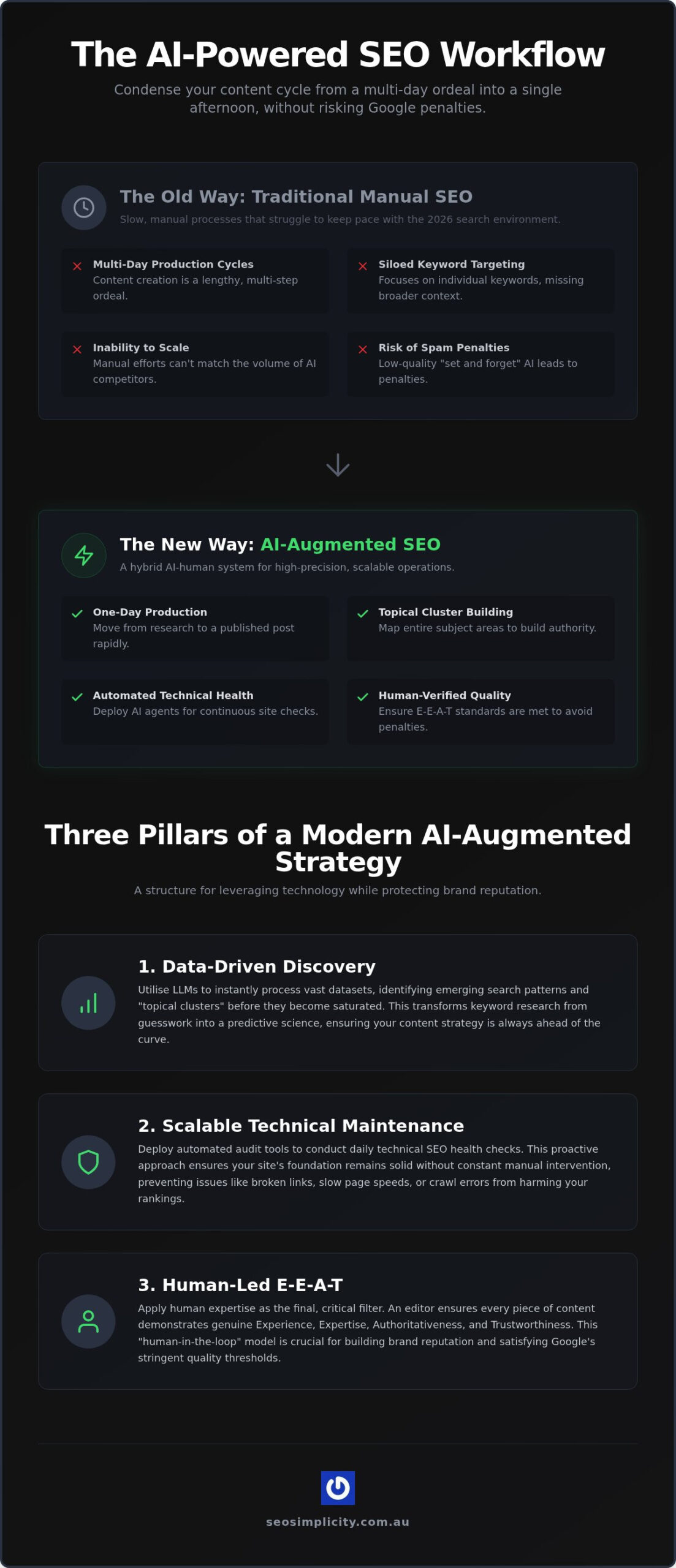
Manual-only SEO simply can’t compete with the sheer speed of production seen in 2026. If your competitors are using AI to map out topical clusters and draft foundational content in hours, your multi-week manual cycle will leave you invisible. Google’s 2026 core updates, including the major refreshes in March and May, have prioritised sites that can rapidly adapt to shifting search trends. Sites relying on slow, manual processes often fail to produce enough volume to stay relevant, while those using “set and forget” AI are being penalised for low-quality output following the June 2026 Spam Update.
There’s also a significant “noise” problem to address. Search results are currently flooded with unedited AI spam, which has led Google to tighten its quality thresholds significantly. To cut through this clutter, your content strategy must move beyond generic generation. You need a system that filters out the robotic repetition and replaces it with genuine, value-driven insights that resonate with your specific audience.
The Pillars of a Modern AI-Augmented Strategy
To succeed today, your ai seo workflow must rest on three specific pillars that ensure both scale and quality:
- Data-driven discovery: Use LLMs to process vast datasets instantly, identifying emerging search patterns and “topical clusters” before they become saturated by competitors.
- Scalable technical maintenance: Deploy automated audit tools to conduct daily technical SEO health checks, ensuring your site’s foundation remains solid without constant manual intervention.
- Human-led E-E-A-T: Apply human expertise as the final filter to ensure every piece of content demonstrates genuine Experience, Expertise, Authoritativeness, and Trustworthiness.
This structure ensures you’re leveraging technology for maximum efficiency while protecting your brand’s reputation through rigorous editorial standards. By focusing on these pillars, you transform AI from a simple writing tool into a comprehensive engine for organic growth and long-term search visibility.
Phase 1: Intelligent Keyword Research and Intent Mapping
The first stage of a high-performance ai seo workflow moves beyond the simple search for high-volume terms. In 2026, success depends on your ability to build topical authority by grouping related queries into clusters. Instead of targeting a single phrase, you use AI to map out an entire subject area, ensuring your site becomes the definitive resource for both users and search engines. This systematic approach to keyword research allows you to dominate a niche by answering every possible question a customer might have.
Automating the categorisation of search intent is where efficiency truly scales. By feeding raw data into an LLM, you can instantly distinguish between informational, commercial, and transactional queries. This ensures you don’t waste resources creating a long-form guide for a term where users clearly want to buy a product. AI-powered SERP analysis also identifies gaps in national competitor strategies. It highlights where others have relied on generic content, allowing you to step in with specific Australian insights that provide the unique value Google rewards.
Moving Beyond Basic Volume Metrics
Traditional volume metrics often provide a distorted view of a keyword’s true value. A modern strategy uses AI to predict difficulty by analysing real-time SERP volatility and the strength of current ranking domains. You should also look for “zero-volume” keywords. These are highly specific, niche phrases that traditional tools might overlook but which drive high-intent conversions from ready-to-act customers. You can even use tools like ChatGPT and Gemini to audit your own brand’s niche perception, asking them how they categorise your services compared to the broader market.
Mapping Content to the Australian Buyer Journey
Success in the local market requires content that reflects the specific needs of an Australian audience. Use AI to persona-map your national customers, identifying the unique pain points they face at each stage of the funnel. From top-of-funnel (TOFU) awareness to bottom-of-funnel (BOFU) decision-making, every piece of content must feel relevant to the local experience. When creating your seed list, ensure your AI prompts specify Australian search vocabulary and spelling. Using terms like “superannuation” or “centre” instead of their American counterparts builds immediate trust. If you’re unsure where to start, a professional SEO audit can help identify which clusters will offer the fastest path to growth.
Phase 2: Content Production with the Human-in-the-Loop Model
Transforming raw keyword data into a ranking article requires a disciplined ai seo workflow. It’s not about letting a machine run on autopilot; it’s about using technology to accelerate your output while you maintain absolute control over the final quality. By using AI to generate a first draft in seconds, you bypass the psychological hurdle of the blank page and move straight into the high-value work of refinement and strategy.
A professional-grade production cycle follows a strict five-step process: Briefing, Generation, Fact-Checking, Personalisation, and Optimisation. For your content strategy to succeed in 2026, every piece of content must lead with unique Aussie insights that a generic model cannot replicate. This hybrid approach ensures you produce content at scale without sacrificing the nuances that build trust with a local audience.
Fact-checking is the most critical stage of this model. AI models occasionally create “hallucinations” or use outdated American data that doesn’t apply to the local market. Follow this guide to verify your content using primary Australian sources:
- Identify specific claims: Highlight every statistic, date, or regulatory claim in the AI draft.
- Verify via official domains: Cross-reference these claims by searching for the topic alongside “.gov.au” or “.edu.au” to find current legislation or research.
- Consult the ABS: Use the Australian Bureau of Statistics for any population, economic, or industry-specific data points.
- Localise examples: Replace generic global case studies with specific Australian business scenarios or cultural references.
Prompt Engineering for High-Quality SEO Content
Develop custom prompts that act as a detailed creative brief for the AI. You’ll get better results by explicitly defining your brand’s unique tone and insisting on Australian English spelling conventions. Instruct the AI to use “optimise” instead of “optimize” and “centre” instead of “center” to maintain professional credibility. You should also provide a list of specific entities and semantic keywords identified in Phase 1, ensuring the engine weaves these naturally into the text for better indexing and topical relevance.
The Crucial Role of the Human Editor
The human editor provides the “boots on the ground” context that search engines crave in 2026. Your job is to inject real-world experience into the draft, removing generic corporate jargon that makes readers tune out. Focus on making the text feel helpful and approachable, ensuring it aligns with on-page SEO services best practices. By polishing the structure and adding personal anecdotes or expert opinions, you transform a standard AI output into a high-authority asset that satisfies Google’s E-E-A-T requirements.
Phase 3: Automating Technical SEO and Internal Linking
Maintaining a large-scale domain requires more than just high-quality writing. A robust ai seo workflow integrates technical maintenance into your daily routine, ensuring your site’s infrastructure supports your growing content library. While manual audits used to take weeks, AI agents now conduct daily technical SEO health checks, instantly flagging broken links, crawl errors, or performance bottlenecks that could hinder your visibility.
Establishing a solid baseline is essential before you begin any automation. A comprehensive technical SEO audit identifies existing structural issues that might confuse an AI agent or a search crawler. Once your foundation is clear, you can deploy automated systems to handle the repetitive, high-precision tasks of structured data generation and internal link mapping. This ensures your site remains technically perfect as you scale your organic traffic throughout 2026.
Scaling Schema and Structured Data
Automating the generation of complex Schema Markup (JSON-LD) is a game-changer for national visibility. AI tools can crawl your pages to identify opportunities for “Review” and “FAQ” schema, automatically drafting the code required to earn rich snippets in search results. For national brands, standardising “Organisation” schema across hundreds of pages ensures search engines clearly understand your entity relationships. You can then use AI-driven debugging tools to validate these code snippets, ensuring they’re error-free before they go live on your site.
AI-Powered Internal Link Optimisation
Strategic internal linking helps distribute authority across your domain, but it’s often the first thing to break as you publish more frequently. Modern ai seo workflow systems use natural language processing (NLP) to map the relationship between disparate articles. Instead of guessing where to link, the system suggests contextually relevant anchor text that connects new posts to established pillar pages. This process significantly reduces “orphan pages” by ensuring every new piece of content is instantly integrated into your site’s hierarchy through automated sitemap analysis.
You don’t have to manage these complex technical integrations on your own. If you’re ready to unlock the full potential of your site’s infrastructure, book a professional SEO audit to identify exactly where automation can drive the most growth for your brand.
Scaling Your Organic Growth with a Managed AI Strategy
Managing an ai seo workflow in-house often leads to “tool fatigue” as teams struggle to keep up with the rapid release cycles of 2026. You might find yourself juggling half a dozen subscriptions, each requiring constant prompting and manual oversight just to stay functional. This fragmented approach wastes precious time and risks creating an inconsistent brand voice across your domain. By partnering with a strategic specialist, you shift the burden of technical integration to experts who have already done the heavy lifting to refine these processes.
Setting a clear baseline is the most important step in your transition to an automated future. A professional SEO audit identifies the specific gaps in your current performance and highlights where automation will deliver the highest return on investment. At SEO Simplicity, we integrate these high-performance workflows into our monthly management retainers. We focus on turning AI efficiency into measurable organic traffic growth, ensuring your brand remains a dominant force in the Australian search market while you focus on running your business.
The Difference Between AI Tools and AI Strategy
Think of AI tools as the bricks and your strategy as the blueprint. Having the best tools in the world won’t help your rankings if you don’t have a cohesive plan for how they fit together. Professional oversight is vital for preventing the long-term ranking drops that often follow unrefined, scaled content production. We act as your knowledgeable guide, navigating the 2026 search environment to protect your visibility. Our approach ensures your ai seo workflow remains compliant with the latest Google quality standards, transforming a simple writing tool into a systematic engine for progress.
Next Steps: Unlocking Your Site’s Potential
Begin your journey toward sustainable growth by conducting a thorough technical evaluation of your current digital assets. Moving from a manual mess to an automated engine requires a structured transition that respects your existing brand equity while unlocking new levels of productivity. You can stop second-guessing your tool stack and start following a proven path to search dominance. This systematic improvement is the key to maintaining a competitive edge as the digital landscape continues to evolve. Organise a professional SEO audit with SEO Simplicity today.
Future-Proof Your Search Visibility
Adopting a professional ai seo workflow is no longer a luxury; it’s the standard for brands that want to remain competitive in the 2026 search environment. You’ve seen how a hybrid model allows you to scale content production without sacrificing the unique insights that build trust with your audience. By automating technical checks and focusing on intent-driven topical clusters, you can finally move away from slow manual tasks and start building a scalable engine for organic growth.
Success today requires a strategic partner who understands the nuances of the Australian digital landscape. You deserve a clear path forward that eliminates tool fatigue and provides a measurable ROI on your AI investments. Our team is here to help you unlock visibility and enhance your site’s performance through systematic improvement and professional oversight. We’ve done the heavy lifting so you can focus on the rewards of a high-ranking domain.
Unlock your organic growth with a professional SEO audit from SEO Simplicity. Let’s work together to transform your search strategy and ensure your brand remains at the centre of your industry’s conversation. You’re just one step away from a more efficient, results-oriented future.
Frequently Asked Questions
What is an AI SEO workflow?
An AI SEO workflow is a systematic sequence of automated data analysis and human-led creative refinement used to scale organic visibility. It integrates artificial intelligence into every stage of the search process, from initial keyword research to final technical optimisation. This hybrid approach allows Australian brands to produce high-quality content at a volume that manual methods simply cannot match, ensuring your business remains competitive in the fast-moving 2026 search landscape.
Will Google penalise my website for using AI-written content in 2026?
Google does not penalise content simply because it was generated by artificial intelligence; its primary focus remains on quality and helpfulness. As of September 2026, official policies state that original, expert-led content can rank well regardless of the production method. However, low-quality, unedited AI spam was specifically targeted in the June 2026 Spam Update. To protect your rankings, you must ensure your content provides unique value and satisfies the E-E-A-T criteria.
How much time can I actually save with an AI SEO workflow?
Adopting a professional ai seo workflow can condense a traditional multi-day production cycle into a single afternoon. By using AI to automate intent mapping and generate foundational drafts, you eliminate the “blank page” problem that often slows down marketing teams. This efficiency allows you to focus your energy on strategic refinement and high-level content strategy, effectively tripling your output without increasing your headcount or compromising on your brand’s editorial standards.
Do I still need a human SEO expert if I use AI tools?
Human expertise remains essential for providing the final filter of experience, expertise, authoritativeness, and trustworthiness. While AI handles the heavy lifting of data processing, a human expert is required to inject real-world Australian context and prevent robotic hallucinations. A professional partner ensures your strategy aligns with your broader business goals and protects your brand from the risks of over-automation, which can lead to long-term ranking drops if left unmanaged.
Can AI help with my technical SEO audits?
AI agents are incredibly effective at conducting daily technical health checks and flagging infrastructure issues in real-time. These tools can automate the generation of complex Schema Markup and identify crawl errors that might hinder your visibility. However, you should always start with a professional technical SEO audit to set your baseline. This ensures your automated systems are built on a solid foundation and aren’t simply magnifying existing structural problems across your domain.
What are the best AI tools for an SEO workflow in 2026?
In 2026, the most effective stacks combine specialised tools for different stages of the process. Popular options include Surfer SEO for on-page optimisation, Jasper AI for drafting, and SEMrush for competitive data analysis. KoalaWriter and BlogSEO are also widely used for rapid content generation. However, the best tool is always the one that integrates seamlessly into your specific strategy and supports your brand’s unique voice and national growth objectives across the country.
How does AI handle Australian English spelling and local context?
AI models require specific prompt engineering to correctly apply Australian English spelling conventions like “optimise” or “centre.” Without clear instructions, these models often default to American standards, which can alienate a local audience. You must also manually inject “boots on the ground” context, such as local regulatory references or cultural nuances, to ensure your content resonates. A human-in-the-loop model is the only way to guarantee your brand maintains its local authority.
Is an AI SEO workflow suitable for large national brands?
An ai seo workflow is particularly beneficial for large national brands managing thousands of pages and complex site architectures. Automation allows these organisations to standardise their data-driven discovery and maintain technical excellence across a massive domain. By using AI to suggest internal links and map topical clusters, national brands can distribute authority more effectively. This systematic approach ensures your entire digital presence remains organised and highly visible to your target audience.