
What if your most valuable content is invisible to Google simply because you haven’t provided a clear enough sitemap? It’s incredibly frustrating when you’ve poured hours into a new blog post or a detailed service page, only to find it hasn’t appeared in search results weeks later. You likely recognise that your site has immense potential, but the technical side of search engine discovery often feels like a hurdle rather than a help.
We understand that managing a growing website is complex, especially when you’re trying to balance user experience with technical requirements. This guide will show you how to organise your website’s structure using a strategic sitemap to ensure search engines find, crawl, and index every vital page for maximum organic growth. By taking control of this communication channel, you’ll transform your site from a confusing maze into a clear path for search bots.
You’ll gain a clear understanding of different sitemap types, learn how to stop wasting your crawl budget on irrelevant pages, and establish a structured roadmap for faster indexing and long-term site growth.
Key Takeaways
- Master the role of a sitemap as your website’s strategic roadmap to ensure search engines never miss a vital page during the discovery process.
- Distinguish between XML, HTML, and RSS formats to improve both automated crawling efficiency and the experience of your human visitors.
- Optimise your crawl budget by prioritising high-value content and signaling topical authority to modern, AI-driven search bots.
- Generate and verify your files using CMS tools or specialist platforms to eliminate technical errors before you submit them to search engines.
- Integrate regular sitemap reviews into your technical SEO audit process to maintain a clean and high-performance site architecture as your business grows.
Understanding the Sitemap: Your Website’s Strategic Roadmap
Think of a sitemap as the architectural blueprint for your digital presence. It provides a structured list of every page you want search engines to find, ensuring that no valuable content remains hidden in the depths of your site. While some believe search engines will simply find everything on their own, relying on luck isn’t a strategy for growth. By providing a clear sitemap, you’re actively guiding search bots through your domain, which significantly reduces the time it takes for your new content to appear in search results.
There’s a critical difference between discovery and indexing that many business owners overlook. Discovery is when a bot finds your URL; indexing is when it actually understands and adds that page to its database. A well-organised map accelerates this entire journey. Without this roadmap, search engines may struggle to find pages that aren’t properly linked, leaving your hard work invisible to potential customers. This is particularly vital for large sites or those with complex navigation where important pages might sit several clicks away from the homepage.
By taking a systematic approach to your site structure, you empower search engines to crawl your site more efficiently. This isn’t just about technical compliance; it’s about ensuring your business strategy is reflected in how search engines see your brand. When you provide a direct path to your most important content, you’re setting the stage for maximum organic growth and long-term visibility.
Why Search Engines Rely on Sitemaps
Search engine crawlers typically move from one page to another by following links. However, if your site contains “orphan pages” that aren’t linked internally, crawlers might miss them entirely. By adhering to the Sitemaps protocol, you provide a direct path to every essential URL, regardless of your internal linking structure. Sitemaps also provide metadata like “last modified” dates, which helps search engines prioritising their crawl budget on your newest content rather than wasting resources on static pages.
The Business Value of Clear Site Architecture
Organising your site isn’t just a technical chore; it’s a strategic move to improve user experience and conversion paths. When you structure your site logically, you’re creating a roadmap that guides both bots and humans toward your high-value “money pages.” This level of organisation is a core component of a professional website seo audit. By identifying and fixing structural gaps, you build a reliable foundation for your brand’s performance and ensure your most important services are always easy to find. A polished brand presence extends to every detail, including small but impactful elements like your favicon, which plays a key role in how visitors perceive your site’s professionalism across devices and browser tabs.
XML, HTML, and Beyond: Navigating Different Sitemap Formats
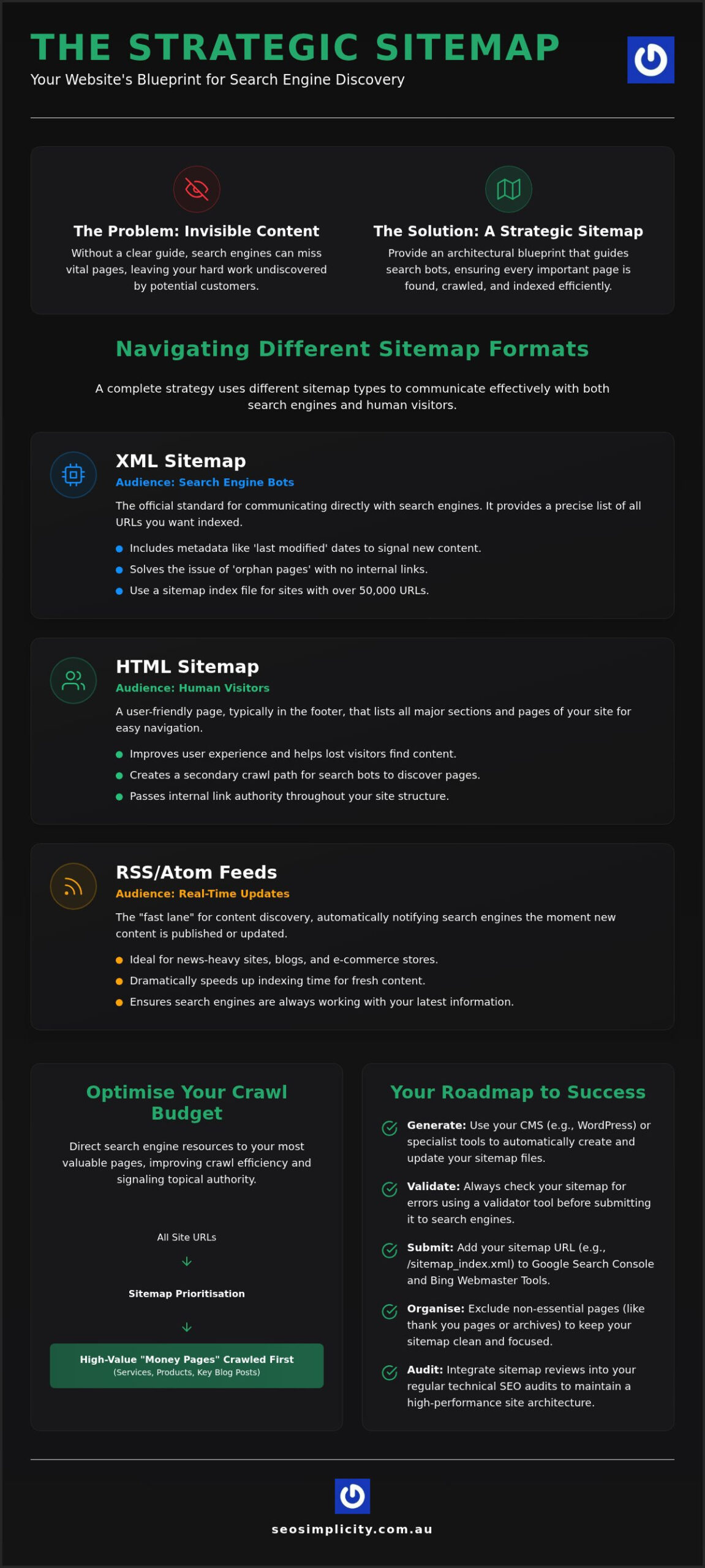
Choosing the right format for your sitemap is about more than just technical preference; it’s about matching the right tool to the right audience. You’ll find that while XML is the primary language of search engines, HTML remains the language of your customers. A sophisticated strategy for national brands involves using both, alongside RSS feeds for real-time updates. This multi-format approach ensures that no matter how a bot or a human interacts with your site, they always have a clear path to follow.
RSS and Atom feeds are often overlooked but serve as the “fast lane” for content discovery. These feeds notify search engines the moment you publish a new blog post or update a product page, which is particularly useful for news-heavy sites or e-commerce stores with frequent inventory changes. By layering these formats, you create a robust ecosystem that leaves nothing to chance.
XML Sitemaps: The Search Engine Standard
XML files act as a direct line to a search engine’s index. They don’t look like much to a human, but they provide a precise list of URLs and metadata that tell bots which pages are most important. For larger Australian websites, you’ll likely hit the 50,000 URL limit. When this happens, we use a sitemap index file to bundle multiple maps together. This structured approach is essential for off-page seo strategies, as it ensures that any authority you build through backlinks is quickly recognised and distributed across your indexed pages.
HTML Sitemaps: Enhancing User Navigation
An HTML sitemap is usually found in your website’s footer and serves as a simple, clickable list of your pages. This doesn’t just help lost visitors; it also passes internal authority throughout your site. By organising these links into clear categories, you improve accessibility and ensure search bots have a secondary way to find your content if the XML file ever encounters an error. If you’re unsure if your current setup is working effectively, seeking professional technical SEO support can help clarify your site’s structure and performance.
Inside your XML file, you’ll notice “priority” and “changefreq” tags. These are suggestions you give to search engines about how often a page updates and how important it is relative to other pages on your domain. While modern algorithms are increasingly autonomous, these tags still provide a useful signal for your site’s hierarchy. They help search engines understand whether a page is a permanent cornerstone of your brand or a temporary promotional offer that requires frequent crawling.
Optimising for Discovery: How Sitemaps Feed AI and Search Crawlers
Modern search is evolving rapidly, shifting from simple keyword matching to a sophisticated understanding of context and intent. Your sitemap now serves a dual purpose: it guides traditional crawlers and provides a clean data source for the AI models that increasingly power search results. By presenting a clear hierarchy, you help these systems map out your topical authority, proving that your brand is a reliable source of information within your industry.
Ensuring that your file only contains canonical URLs is a vital step in this process. Including duplicate or non-canonical pages confuses search bots and dilutes your ranking power. When you provide a single, definitive version of each page, you make it easier for search engines to attribute value correctly. This technical precision is even more critical when you’re considering the role of structured data in AI SEO Tool development, where clean data is the foundation of high performance.
Feeding the AI Search Ecosystem
Large Language Models (LLMs) rely on structured information to understand the relationship between different topics on your site. Instead of just looking for specific words, they perform entity mapping to identify how your services and expertise connect. To support this, include your most strategic content strategy pages in your map. This proactive step ensures that AI-driven search engines recognise the depth of your knowledge, which can lead to more prominent placements in AI-generated summaries and responses.
Managing Crawl Budget for National Sites
Your crawl budget is the specific number of pages a search bot will visit on your domain during a single day. For larger Australian sites, wasting this budget on low-value or “thin” content can prevent your most important pages from being indexed. Refine your map by removing outdated pages, login screens, or utility pages that don’t offer value to a searcher. This focuses the crawler’s attention exactly where you want it: on the content that drives conversions and business growth.
Pair your map with a well-configured robots.txt file to create a powerful discovery system. While the robots.txt file tells bots where they aren’t allowed to go, your map tells them exactly where they should spend their time. This combination ensures that search engines move through your site efficiently, indexing your latest updates faster and keeping your organic presence fresh and competitive in a crowded market.
Best Practices for Creating and Submitting Your Sitemap
Generating a high-quality sitemap is a straightforward process when you use the right tools for your specific platform. If you’re running a WordPress site, plugins like Rank Math or Yoast SEO automatically create and update your file as you publish new content. Shopify users benefit from a built-in sitemap that handles the technical heavy lifting without any manual intervention. For custom-built websites, you can utilise specialist external crawlers to map your URLs, though these require more frequent manual checks to stay accurate.
Managing international or multi-language sites requires a more nuanced approach. You must ensure your map includes hreflang tags to tell search engines which version of a page is intended for specific regions or languages. This prevents confusion and ensures your Australian customers aren’t accidentally directed to a US or UK version of your site. Before moving to the submission stage, always run your file through a validator to catch syntax errors that could prevent search engines from reading it correctly.
Submission via Google Search Console
Open your Google Search Console dashboard and head to the “Sitemaps” report under the “Indexing” menu to begin the submission process. Enter the exact URL of your map, click submit, and wait for the system to process the data. You’ll see one of three primary statuses:
- Success: Google has successfully fetched and processed your URLs.
- Has Errors: The file was found, but specific technical issues are preventing full indexing.
- Couldn’t Fetch: Google was unable to access the file, often due to a robots.txt blockage or a server error.
Resubmit your sitemap whenever you perform a significant site restructure or launch a large batch of new content to prompt a fresh crawl of your domain. If you find the technical setup overwhelming, our professional technical SEO services can handle the entire configuration for you.
Common Pitfalls to Avoid
Avoid including “noindex” pages or URLs that return a 404 error, as these signals contradict your goal of discovery. When you include a page in your sitemap, you’re telling Google it’s a high-priority URL; sending it to a dead end or a blocked page wastes your crawl budget and creates technical friction. Similarly, ensure every link is a canonical URL to prevent search engines from indexing duplicate versions of the same content.
Refrain from manually editing your XML file unless you have specific technical oversight. Small syntax errors, like a missing bracket or an unclosed tag, can break the entire file and render your roadmap useless to search bots. Stick to automated generation tools that maintain the correct XML structure, allowing you to focus on creating content while the technology manages the discovery path.
Maintaining a Healthy Sitemap: The Role of Technical SEO Audits
Many businesses mistakenly treat their sitemap as a “set and forget” task. As your website grows, your digital footprint expands, and without regular maintenance, your file can quickly become cluttered with outdated or irrelevant links. Systematic cleaning ensures that search engines only focus on your most current and valuable content. This process isn’t just about housekeeping; it’s a fundamental part of a comprehensive technical seo strategy that maintains your site’s health and performance over time.
Think of structural errors as an early warning system for your domain. When you spot frequent “404 Not Found” or “5xx” server errors in your reports, they often signal deeper architectural rot that needs immediate attention. Addressing these issues promptly prevents search engines from losing trust in your brand. Additionally, a clean map is a non-negotiable prerequisite for effective link building. There’s little point in earning high-authority backlinks if those links lead to a foundation that search engines struggle to crawl or understand.
The Impact of Broken Sitemaps on Rankings
Search engines reward reliability and consistency. If your sitemap repeatedly directs bots to broken links or redirected pages, they’ll eventually crawl your site less frequently, which delays the indexing of your new content. This lead to “Indexing Bloat,” a common problem where your index is filled with low-quality or duplicate pages that dilute your overall ranking power. Resolving these conflicts provides a clear signal of quality. This technical precision works in tandem with professional on page seo services australia to ensure every page Google sees is optimised for the modern, AI-driven search environment.
Why Ongoing SEO Management is Essential
Partnering with a specialist for monthly management takes the guesswork out of site maintenance. A dedicated partner monitors your crawl errors in real time, ensuring that your automation tools are functioning correctly and that no new technical hurdles are blocking your growth. Regular reporting allows you to track indexing rates accurately, giving you a clear view of how your site’s visibility is improving month by month. This proactive approach ensures your site remains agile and ready to adapt to any algorithm changes. Unlock your site’s potential with a professional SEO audit today to build a foundation that supports long-term organic success.
Master Your Search Visibility for 2026 and Beyond
Establishing a robust digital presence starts with a clear, strategic roadmap. You now understand that a sitemap is far more than a simple file; it’s a vital communication channel that informs both traditional search bots and modern AI models about your brand’s authority. By implementing best practices for submission and maintaining a clean hierarchy, you eliminate the technical friction that often keeps valuable content hidden from potential customers. These structural improvements ensure that every page you publish has a direct path to the people searching for your expertise.
Ongoing success requires a commitment to systematic improvement. Our specialist Australian SEO expertise provides the clarity you need to navigate complex indexing issues with confidence. We offer comprehensive technical SEO audits and data-driven monthly reporting to ensure your site architecture remains a catalyst for progress rather than a hurdle. This proactive approach keeps your business agile in an ever-evolving search landscape.
Optimise your site’s roadmap with SEO Simplicity
Your business has incredible potential. By refining your technical foundation today, you’re paving the way for a more visible, rewarding, and successful future.
Frequently Asked Questions
How often should I update my sitemap?
Update your file whenever you publish a new page, delete old content, or make major structural changes. Most modern CMS platforms handle this automatically, ensuring your directory reflects your current site architecture in real time. For manual setups, aim for a weekly review to ensure search engines aren’t chasing dead links. This consistent maintenance ensures your latest updates are indexed promptly for maximum visibility and organic growth in the Australian market.
Can a sitemap improve my search engine rankings directly?
A sitemap doesn’t function as a direct ranking factor like high-quality backlinks or on-page optimisation. Instead, it acts as a catalyst for discovery, ensuring search engines can find and index your pages efficiently. You can’t rank for a keyword if Google doesn’t know the page exists. By facilitating faster indexing, you reduce the time it takes for your content to enter the search results and start competing for top positions.
What is the difference between a sitemap and robots.txt?
Think of these two files as the “green light” and “red light” for search bots. Your directory provides a comprehensive list of URLs you want search engines to visit and index. Conversely, the robots.txt file contains instructions on which areas of your site should be ignored, such as login pages or internal search results. Using both correctly ensures that crawlers spend their limited budget only on your most valuable, customer-facing content.
Do I need a sitemap if my website only has a few pages?
Yes, providing a formal file is highly recommended regardless of your site’s size. While search engines can usually crawl a five-page site without help, a formal document establishes a direct communication line with Google Search Console. It allows you to monitor indexing status and receive alerts about technical errors that might otherwise go unnoticed. Starting with a solid technical foundation now ensures your site remains organised and visible as your business grows.
Why is Google not indexing all the pages in my sitemap?
Inclusion in a sitemap is a suggestion, not a guarantee of indexing. Google may choose to ignore pages that it deems to be low-quality, thin, or duplicate content. Technical hurdles like “noindex” tags, canonical errors, or slow server response times can also prevent indexing. If you notice a large gap between submitted and indexed URLs, it’s often a signal that your site requires a deeper technical audit to resolve underlying quality issues.
Can I have more than one XML sitemap on my website?
You can definitely utilise multiple XML files, which is a standard practice for large-scale websites or e-commerce stores. Individual files are often categorised by content type, such as products, blog posts, or images, to keep things organised. If you exceed the 50,000 URL limit or a 50MB file size, you must use an index file. This master file acts as a directory that points search engines to all your individual listings across your domain.
How do I find my sitemap URL if I didn’t create it myself?
Most websites host their primary directory at a standard URL ending in .xml, often found in the root folder. If it’s not there, check your robots.txt file at yourdomain.com.au/robots.txt, as it’s best practice to list the location there for crawlers to find. You can also log into Google Search Console to see if a submission has already been made. If you’re still stuck, specialist SEO tools can crawl your domain to locate any existing files.
Is an HTML sitemap still necessary in 2026?
Human-readable directories remain highly valuable for both user experience and technical SEO. While XML files are for bots, this version provides a clear directory that helps lost visitors navigate your site. From an SEO perspective, it creates a robust internal linking structure that distributes authority across your pages. This dual-purpose approach ensures that your site is accessible to everyone, including users with disabilities who rely on clear navigation structures to find your services. Just as a well-structured sitemap signals professionalism to search engines, small branding details like a properly implemented favicon help establish your site’s credibility and visual identity across every browser tab and device.